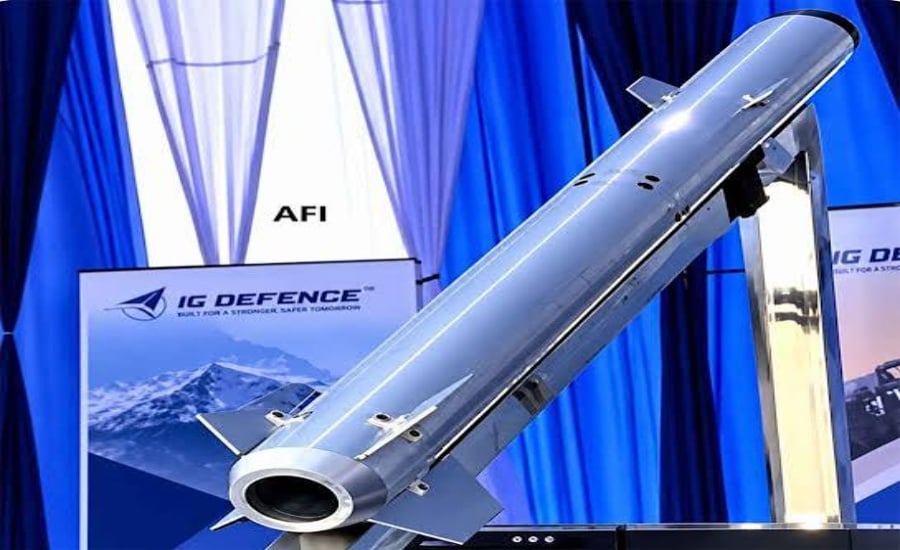
New Delhi: India’s JWALA Micro-Missile programme achieved a major milestone after IG Defence successfully conducted tests of two indigenous solid rocket motors. The successful trials mark important progress in developing a low-cost and scalable counter-drone interceptor designed to address emerging aerial threats.
The company announced that the propulsion tests are part of its efforts to build an indigenous hard-kill Counter-Unmanned Aircraft System (C-UAS), a critical capability as drone warfare becomes increasingly common across modern battlefields.
What Is The JWALA Micro-Missile Programme
JWALA is an indigenous micro-missile interceptor being developed by IG Defence to counter hostile drones. The programme focuses on creating an affordable and scalable solution that can be deployed in large numbers while maintaining effective interception capabilities.
Read also: IAF Launches First Dronathon in Pokhran to Test Next-Gen Unmanned Systems
According to the company, the growing use of low-cost drones in conflicts worldwide has increased the need for counter-drone systems that are both effective and economically viable.
Successful Solid Rocket Motor Tests Mark Key Milestone
IG Defence confirmed that it successfully test-fired two solid rocket motors under the JWALA programme.
The propulsion tests were conducted in the early hours of the morning and demonstrated progress in indigenous missile propulsion technology. The company described the successful tests as a major step toward developing a reliable hard-kill interceptor capable of neutralising aerial drone threats.
Why Solid Rocket Motors Matter
Solid rocket motors are the propulsion systems that provide thrust to missiles. Their performance directly impacts speed, range, response time, and interception capability.
Successful motor testing is therefore one of the most important stages in missile development before moving toward advanced trials and operational deployment.
JWALA Micro-Missile Programme Is Being Built To Counter Modern Drone Threats
The rapid spread of drones has changed the nature of warfare. Military forces around the world are increasingly facing threats from low-cost unmanned aerial systems that can conduct surveillance, reconnaissance, and attack missions.
IG Defence says JWALA is specifically designed to address this challenge by providing a scalable interceptor solution capable of engaging drone threats at scale.
Key Objectives Of The JWALA Programme
- Develop an indigenous counter-drone interceptor.
- Create an affordable and scalable defence solution.
- Enable deployment in meaningful numbers.
- Reduce dependence on expensive air-defence systems.
- Strengthen India’s domestic C-UAS ecosystem.
JWALA Will Work With AI-Powered GRID Defence System
One of the unique aspects of the programme is its integration with IG Defence’s AI-enabled GRID ecosystem. The company said GRID is designed as a battle management system that combines sensors, effectors, and command systems into a single operational framework.
This integrated architecture is intended to improve threat detection, identification, tracking, assessment, and engagement management.
How GRID Will Support JWALA
According to IG Defence, GRID will:
- Process data from multiple sensors.
- Create a common operational picture.
- Track aerial threats in real time.
- Coordinate authorised engagement responses.
- Improve decision-making through AI-powered analysis.
Under this architecture, JWALA will act as the hard-kill interceptor, while GRID will provide mission management and coordination capabilities.
Building A Complete Counter-Drone Defence Architecture
IG Defence has emphasized that JWALA is not being developed as a standalone missile. Instead, it is being designed as part of a broader intelligent defence ecosystem that combines artificial intelligence, sensors, command systems, and interceptor technologies.
Company leadership stated that the goal is to integrate AI, sensors, command networks, and effectors into a single system capable of handling counter-UAS operations from detection to engagement.
FAQs
The tests validate the missile’s propulsion technology, which is essential for speed, range, reliability, and interception performance.
JWALA is an indigenous micro-missile interceptor being developed by IG Defence to counter hostile drones and support Counter-Unmanned Aircraft System (C-UAS) operations.
JWALA acts as the hard-kill interceptor, while the AI-powered GRID system manages threat detection, tracking, assessment, and engagement coordination.