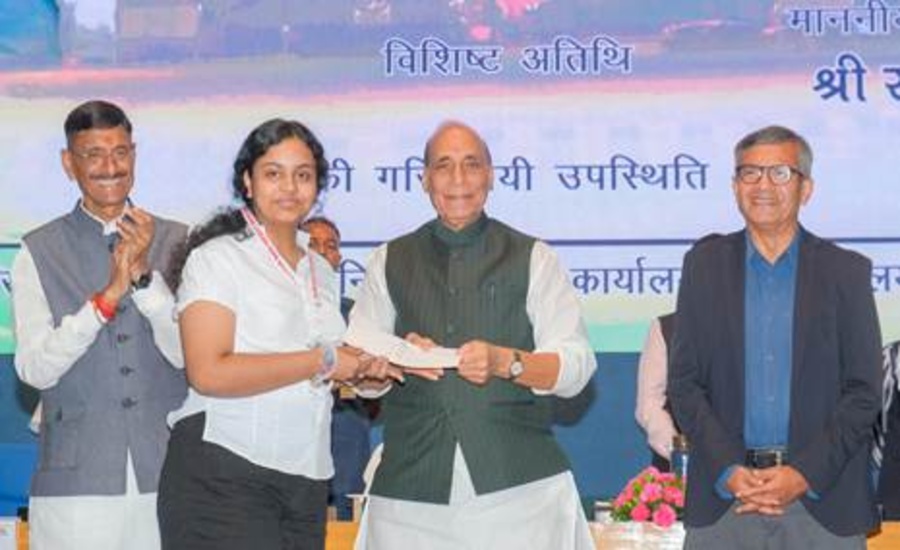
New Delhi: Military-civil integration is essential to strengthen India’s national security and build a future-ready defence system, Defence Minister Rajnath Singh said while addressing the 85th AFHQ Civilian Services Day 2026 in New Delhi. He urged greater cooperation between military personnel and civilian officers, saying that a unified approach under the “Nation First” vision will help India tackle emerging security, cyber, and technological challenges. The event also saw the launch of several digital initiatives to modernise defence administration.
What Did Rajnath Singh Say About Military-Civil Integration
Rajnath Singh said military and civilian services should not work separately. Instead, both should function as one integrated team to improve India’s defence preparedness. He said military officers bring operational experience, while civilian officers contribute administrative knowledge, policy expertise, financial management, and institutional continuity. Together, they create stronger and faster decision-making.
85th AFHQ Civilian Services Day: Why Is Military-Civil Integration Important For India
According to the Defence Minister, today’s security environment is changing rapidly because of cyber threats, artificial intelligence, emerging technologies, and modern warfare. He said stronger military-civil integration will help India:
- Improve defence planning
- Strengthen cyber security
- Increase innovation in defence research
- Speed up policy implementation
- Improve logistics and administration
- Enhance national security
85th AFHQ Civilian Services Day: AFHQ Civilian Services Should Become India’s Strategic Brain
Rajnath Singh described the AFHQ Civilian Services as the strategic brain of India’s defence management. He encouraged officers to focus on:
- Strategic research
- Geo-strategic thinking
- Defence innovation
- Cyber security
- Joint planning
- Better coordination between military and civilian departments
He also recommended joint training programmes and cross-functional assignments to improve understanding between both services.
85th AFHQ Civilian Services Day: Rajnath Singh Highlights Cyber Warfare
Using cyber warfare as an example, Rajnath Singh said AFHQ Civilian Services can develop defence-specific cyber tools using their technical expertise. He also encouraged more research on Indian military history from a civilian perspective to generate innovative ideas that can support India’s long-term defence strategy.
85th AFHQ Civilian Services Day: New Digital Initiatives Launched
During the event, Rajnath Singh launched several digital platforms to improve defence administration. The initiatives include:
- Internet-Based Accommodation Management System (IBAMS)
- Integration of eHRMS with TULIP 2.0
- CAO Office integration with TULIP 2.0 for Pay & Allowances
- SPARROW Online Performance Appraisal System
These platforms aim to improve efficiency, transparency, and digital governance within the Ministry of Defence.
85th AFHQ Civilian Services Day: Samvad Magazine Released And Awards Presented
The Defence Minister released the 34th edition of Samvad magazine, which features articles, essays, travelogues, and poems written by employees of Service Headquarters and Inter-Service Organisations. He also honoured AFHQ employees for achievements in sports and recognised children of employees who excelled in academics.
Senior Defence Leadership Attended The Event
The ceremony was attended by several senior defence officials, including:
- Raksha Rajya Mantri Sanjay Seth
- Chief of Defence Staff General NS Raja Subramani
- Chief of Army Staff General Dhiraj Seth
- Chief of Naval Staff Admiral Krishna Swaminathan
- Air Chief Marshal Ashutosh Dixit
- Defence Secretary Rajesh Kumar Singh
The event highlighted the government’s commitment to strengthening India’s integrated defence ecosystem.
What Is AFHQ Civilian Services Day
AFHQ Civilian Services Day is celebrated every year on August 1 to recognise the contribution of civilian employees working alongside India’s Armed Forces. The AFHQ civilian cadre was established on August 1, 1942, and continues to play a vital role in defence administration, logistics, finance, human resources, and policy implementation within the Ministry of Defence.