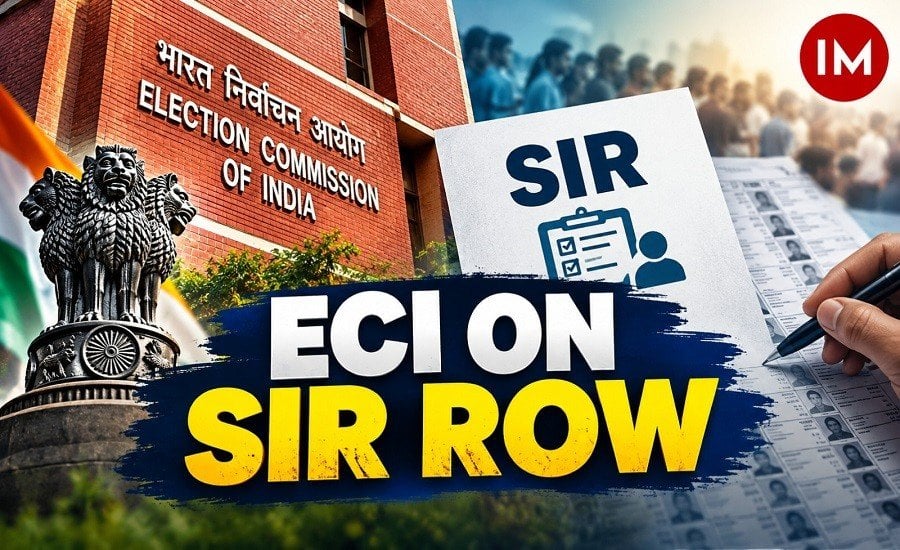
New Delhi: The Election Commission of India (ECI) has responded to reports of alleged internal differences among its members over the Special Intensive Revision (SIR) of electoral rolls, saying that differing views and observations are a normal part of institutional deliberation before a final decision is taken.
In a one-page press note issued on social media, the Commission said written notes, observations, technical suggestions and internal checks-and-balances are part of its regular functioning as a multi-member constitutional body.
The statement came after an Indian Express investigation reported that Election Commissioners Sukhbir Singh Sandhu and Vivek Joshi had raised objections on several occasions over issues related to electoral-roll revision, voter registration and deletion, and access to electoral-roll databases. The newspaper reported that the two Commissioners had formally raised objections at least 14 times over a 10-month period.
The ECI, however, said such internal observations should be understood as part of the normal decision-making process and maintained that the Commission’s decisions over the past year were unanimous.
ECI: Written Notes and Internal Checks Are Routine
The Commission said it functions under Article 324 of the Constitution, statutory provisions and established institutional conventions.
According to the ECI, it operates as a multi-member constitutional body in which written notes, observations, technical suggestions and internal checks are standard mechanisms intended to ensure transparency, legal compliance and operational rigour.
The Commission said its actions have been taken in accordance with applicable laws and instructions issued by the Commission.
It also pointed to the Chief Election Commissioner and Other Election Commissioners (Appointment, Conditions of Service and Term of Office) Act, 2023, saying official orders, decisions and administrative directions carry legal sanction and follow established statutory procedures.
“Differing Views Are Part of Decision-Making”
Addressing the reports of differences among Commissioners, the ECI said members can raise questions, seek clarifications or make suggestions while a proposal is still at the drafting stage.
The Commission said such inputs are intended to further improve electoral processes and safeguard voters’ rights.
It added that differing views and observations are normal in institutional deliberations and form part of the process before a final decision is reached.
The Commission further said the opportunity to provide suggestions is not limited to the three Election Commissioners. According to the statement, every officer of the Commission is authorised to provide suggestions aimed at improving the electoral system.
ECI Says Focus on Internal Notes Gives Only “One Part of the Picture”
The Commission also objected to what it described as the selective highlighting of specific internal notes and observations over a 10-month period.
It said focusing on such notes while overlooking the larger body of approvals, decisions, instructions and initiatives provides only one part of the overall picture.
According to the ECI, the Commission has taken numerous decisions in recent months, issued instructions and introduced around 40 new initiatives and electoral reforms.
These include electoral-roll revision exercises, including the Special Intensive Revision being conducted across the country.
The Commission said all such decisions during the past year were unanimous decisions of the full Commission.
ECI Points to Recent Elections and Electoral Exercises
The Commission also cited the conduct of major elections during the period as part of its response.
It said elections were successfully conducted in Bihar, Kerala, Tamil Nadu, Puducherry, Assam and West Bengal, alongside several other election-related exercises.
According to the ECI, these activities required extensive administrative and operational coordination, involving numerous approvals and instructions from the Commission.
The statement used these activities to underline the scale of work undertaken by the institution during the period in question.
Defence of ECINet and Electoral Database Security
The ECI also addressed concerns surrounding its digital platforms, including ECINet, which is used as part of the Commission’s electoral-management infrastructure.
The Commission said its digital platforms operate under strict data-security protocols designed to prevent unauthorised tampering and manipulation.
It said IT security checks and audit controls are standard cybersecurity measures used for national databases.
The Commission further pointed to the statutory roles of Electoral Registration Officers (EROs) and District Election Officers (DEOs), saying they exercise their powers relating to registration and deletion of names in accordance with the law.
The issue of access to electoral-roll databases had been raised in the Indian Express investigation, which reported that the two Election Commissioners had expressed concerns about what they described as a gradual centralisation of electoral-roll database access.
Background to the SIR Dispute
The Special Intensive Revision has been one of the most closely watched electoral exercises undertaken by the ECI in recent years.
The Indian Express investigation reported that the internal objections related to several aspects of the revision process, including the registration of new voters, deletion and restoration of names, changes to Form 6, access to electoral-roll databases and appeals concerning voter deletions in West Bengal.
The newspaper also reported that Sandhu and Joshi had raised concerns regarding changes to voter-registration procedures and the access of statutory officials to electoral databases. Separately, the two Commissioners reportedly approached Cabinet Secretary T V Somanathan over concerns relating to the electoral software and work allocation.
These are reported findings of the newspaper investigation; the ECI’s response characterises such internal notes and suggestions as part of routine institutional deliberation.
West Bengal SIR and Pending Appeals
The SIR process in West Bengal has also generated extensive legal and administrative proceedings.
The ECI recently told the Supreme Court that more than 22 lakh of the 27.16 lakh voters deleted during the West Bengal SIR had filed appeals seeking reinstatement. Overall, the Commission reported 38.31 lakh appeals, including 22.21 lakh seeking inclusion and 16.10 lakh seeking further deletion.
The Indian Express investigation reported that one of the internal issues raised by Election Commissioner Sukhbir Singh Sandhu concerned the authorisation and filing of appeals relating to voters included by judicial officers during the West Bengal process.
The Commission’s latest statement does not specifically address each reported internal note individually. Instead, it emphasises the broader institutional process through which proposals are examined, discussed and finally decided.
Commission Reaffirms Constitutional Mandate
Concluding its statement, the ECI said it remains committed to carrying out its constitutional responsibilities with integrity.
The Commission emphasised its role in conducting elections and maintaining the electoral system, while asserting that its decisions and administrative actions are governed by the Constitution, statutory provisions and established procedures.
The statement therefore presents the reported internal observations as part of the deliberative process rather than evidence, in the Commission’s characterisation, of a breakdown in institutional functioning.
The Commission reiterated that differing opinions, questions and technical suggestions can arise before a final decision is reached, while maintaining that the decisions ultimately taken by the full Commission on SIR and other electoral reforms in the past year were unanimous.