The image of an IAS or IPS officer often carries instant authority. A government vehicle, an official-looking identity card or even a claim of being posted at a senior position can make people lower their guard.
Several fraud cases in Madhya Pradesh show how criminals have exploited exactly this perception. By posing as IAS and IPS officers or senior government officials, the accused allegedly targeted job seekers, businessmen, hotel staff, drivers and government officials.
Their methods ranged from fake appointment letters and forged identity cards to luxury cars, expensive hotels and carefully created social media profiles.
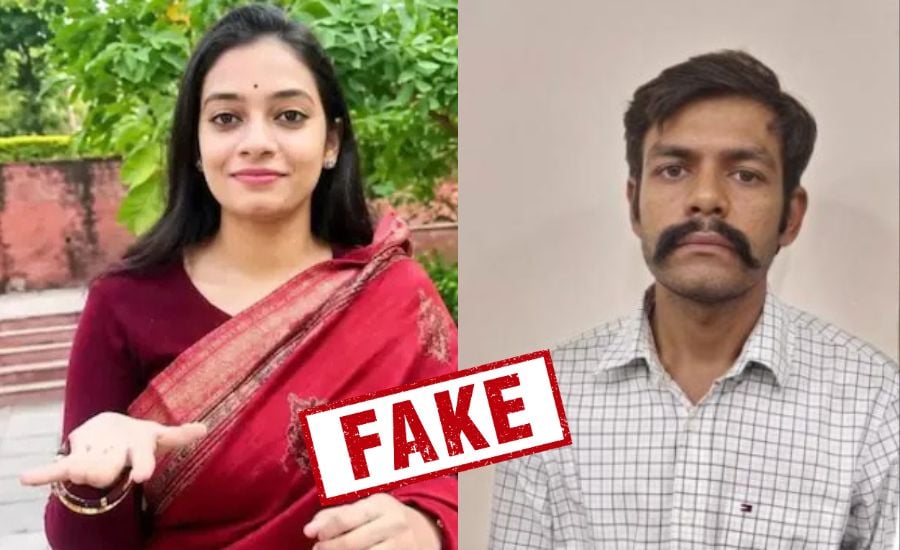
Fake IAS Officer Tripti Singh Rajput Promised Government Jobs
Tripti Singh Rajput allegedly operated a network by presenting herself as an IAS officer and Additional Director with the Madhya Pradesh State Tourism Development Corporation (MPSTDC). Her brother Sudhanshu Singh and other associates were also named as co-accused.
Four FIRs have been registered in Bhopal and Ashoknagar in connection with the alleged frauds. Her targets reportedly included unemployed youths and businessmen from Seoni, Balaghat and Ashoknagar.
According to the case details, Tripti travelled in a luxury Innova carrying a “Government of India” nameplate and used the appearance of an official to win people’s confidence. She allegedly collected money from youngsters by promising government jobs and was also accused of cheating people in Seoni and Balaghat.
During searches at the accused’s residence, police reportedly recovered expensive iPhones, hotel bills, flight tickets and forged documents. Investigators suspect these items were part of the lifestyle she displayed to convince potential victims that she had access to senior government circles.
From a Tea Stall to a Fake IPS Profile
Vikas Gautam, also known as Vikas Yadav, reportedly went from selling tea outside coaching centres in Delhi’s Mukherjee Nagar to pretending to be an IPS officer.
The Gwalior resident, who had studied only up to Class 8, allegedly became fascinated by the status associated with civil services officers while living around UPSC aspirants.
After the 2020 UPSC results were announced, he reportedly copied details from the list of successful candidates and created an Instagram account under the name @Vikashyadav_ips. The account eventually attracted around 20,000 followers.
He allegedly used the fake identity to establish contact with a woman doctor and introduced himself as a trainee IPS officer. He reportedly sought ₹25,000 from her, claiming that the money was required for his mother’s medical treatment.
The matter reached the cyber cell, following which Delhi Police traced the accused to Gwalior. The investigation allegedly revealed that his online IPS persona was completely fabricated. Police also linked him to fraud involving more than 50 people on social media, with the alleged amount exceeding ₹14 lakh.
Another case involving a fake IPS officer came to light in Bhopal when spelling mistakes in official-looking documents raised suspicion.
Rishi Kumar Yadav, an M.Tech graduate from Jhansi, allegedly introduced himself as a 2016-batch IPS officer and claimed to be working as an Assistant Investigation Officer in the Income Tax Department.
He reportedly approached UPSC aspirants at MP Nagar’s Annapurna Café and offered them jobs in the Income Tax Department in exchange for money. Six aspirants were allegedly targeted, with around ₹1 lakh demanded from each.
Yadav allegedly created a fake identity card and joining letter by modifying an old ID card. However, the documents contained several spelling errors, which made the aspirants suspicious. They subsequently approached the police.
MP Nagar police arrested Yadav and sent him to jail.
Fake Collector, Star Hotel Bills and a VIP Pass Attempt
Himanshu Panchal, a resident of Ahmedabad, allegedly created an elaborate fake identity in Indore by presenting himself as “IAS Raj Soni, District Collector.”
Panchal had reportedly faced action earlier in Gujarat for allegedly impersonating a police station in-charge and collecting money illegally. He arrived in Indore with his mother and rented a house in Omex City for ₹15,000 a month.
He allegedly installed a nameplate identifying himself as “IAS Raj Soni, District Collector” and hired a vehicle with a driver for ₹2,500 per day. Drivers were reportedly told that he was awaiting a government posting and would help them secure permanent government employment.
Police reportedly found an unusual setup inside the rented house. The ceiling had been decorated with cotton to create a cloud-like appearance, RGB lights had been installed and photographs carrying references to “IAS” were displayed.
Panchal also allegedly hosted a party for drivers and their families at a star hotel. When the bill reached ₹16,000, he reportedly signed the hotel register as “IAS Raj Soni” and said his personal assistant would settle the payment.
The hotel staff became suspicious and alerted the police. Lasudiya police subsequently reached the spot and exposed the alleged impersonation.
The fifth case surfaced in Ujjain, where Atul Kumar allegedly posed as a Joint Secretary in the Ministry of Civil Aviation.
Kumar, a resident of Dwarkapuri in New Delhi, reportedly arrived in Ujjain and managed to secure two rooms at the Circuit House without producing the required documents.
He allegedly then sought VIP access to the Mahakal Temple’s 4 a.m. Bhasma Aarti. When temple officials asked him to provide proof of his official position, he reportedly claimed that several members of his family were IAS officers and also referred to a supposed letter from the High Court Registrar.
Instead of accepting the claims, officials verified his credentials directly with the Ministry of Civil Aviation. The verification reportedly established that no Joint Secretary by that name was posted there.
Police then arrested Kumar.
These cases underline how easily the appearance of authority can influence people when official symbols, government designations and VIP privileges are involved. The accused allegedly relied on the public’s trust in senior officials, along with the appeal of government jobs and privileged access.
The cases also show the importance of verification. Whether the claim involves an IAS or IPS posting, a government job, an official letter or VIP access, checking credentials with the concerned department can expose a fake identity before the fraud goes further.