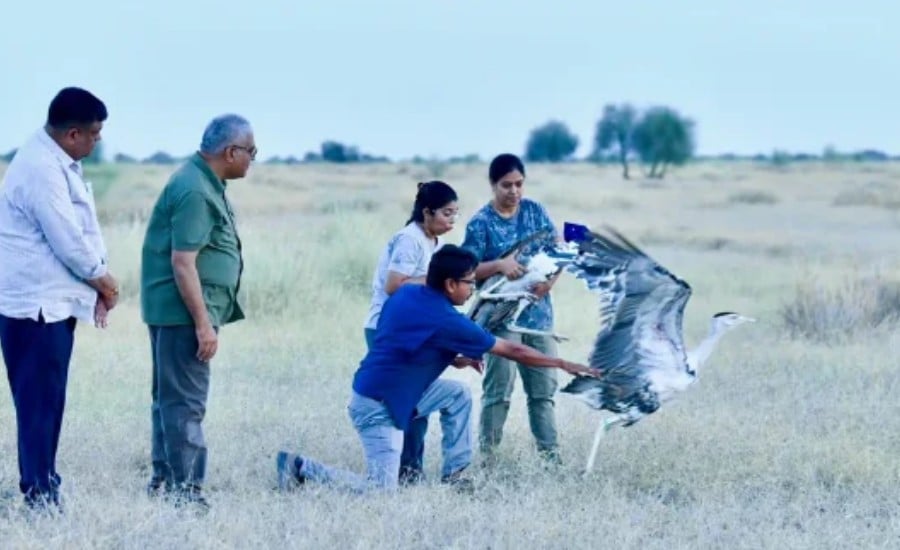
Jaisalmer: Union Environment, Forest and Climate Change Minister Bhupender Yadav on Sunday released two male Great Indian Bustards (GIBs) into the wild at Sam in Rajasthan’s Desert National Park, marking a transition from conservation breeding towards rewilding the critically endangered species in its natural habitat.
Rajasthan Forest and Environment Minister Sanjay Sharma and senior officials from the Centre and state government were present during the release.
Two Captive-Bred Birds Return to the Wild
The release is part of India’s Bustard Recovery Programme, which aims to build a viable conservation-breeding population and subsequently augment the species in its natural habitat.
According to the Ministry of Environment, Forest and Climate Change, the GIB facilities at Sam and Ramdevra currently house 97 birds. Of these, 40 originated from wild-laid eggs and 57 were bred in captivity.
While 86 birds are being maintained for captive reproduction, 11 have been earmarked for release into the wild. The two birds released at Desert National Park on Sunday are part of this group.
The conservation-breeding programme recorded 24 live chicks in 2025 and 29 in 2026.

Nearly a Decade of Conservation Work
Yadav described the release as the outcome of nearly a decade of work by scientists, researchers and ground staff involved in the GIB conservation programme.
In a post on X, the Union Minister thanked Prime Minister Narendra Modi for his continued guidance and support for scientific efforts aimed at conserving the Great Indian Bustard and other species.
“In a milestone move, released two male Great Indian Bustards in Sam, Desert National Park, Jaisalmer, today morning. This landmark success has been made possible by the nearly decade-long unwavering dedication of our scientists, researchers and ground staff who have spent years to ensure GIB reclaims the deserts of Rajasthan,” Yadav wrote on X.
Scientific Methods Support GIB Recovery
The programme has also used scientific interventions such as the ‘jumpstart’ approach, under which captive-laid eggs were placed in wild nests.
According to the Ministry, incubating female GIBs accepted the eggs, resulting in the hatching of six chicks in Rajasthan and two in Gujarat.
The programme combines conservation breeding with habitat management, threat mitigation, habitat restoration and community engagement.
200 Sq Km of Grassland Enclosures
The Rajasthan Forest Department has established around 200 sq km of fenced grassland enclosures inside the Desert National Park as part of habitat restoration efforts.
Long-term telemetry studies conducted by the Wildlife Institute of India (WII) have identified these enclosures as important breeding habitats for the species.
The Bustard Recovery Programme is a collaborative initiative of the Ministry of Environment, Forest and Climate Change, Rajasthan Forest Department and WII, with technical collaboration from the International Fund for Houbara Conservation and funding support from National CAMPA.
The conservation measures are also being guided by the Supreme Court of India’s judgment and recommendations of the Expert Committee constituted for the purpose.
Background: Great Indian Bustard
The Great Indian Bustard (GIB) is one of India’s most endangered bird species and is classified as Critically Endangered on the IUCN Red List. It is primarily found in the grasslands and arid landscapes of Rajasthan and Gujarat, with smaller populations reported in parts of Maharashtra, Karnataka and Andhra Pradesh.
The species faces threats including habitat loss, degradation of grasslands and collisions with overhead power transmission lines. Rajasthan’s Desert National Park is one of its key remaining habitats.
India’s conservation efforts include captive breeding, habitat restoration, threat mitigation and the reintroduction of captive-bred birds into the wild.