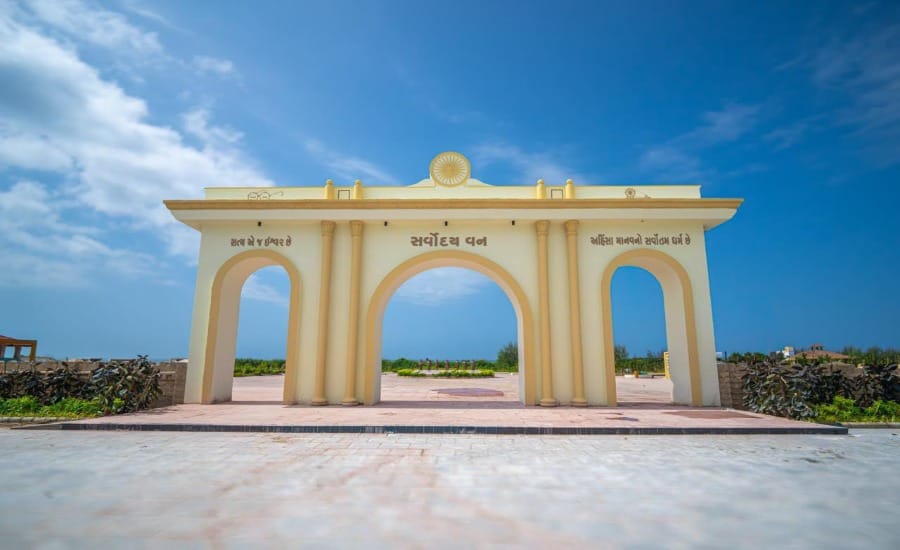
Gandhinagar: Gujarat is set to add another major green and cultural attraction in Porbandar with the state’s 25th Sanskrutik Van (Cultural Forest), developed near Odadar village around Mahatma Gandhi’s philosophy of Sarvodaya.
Chief Minister Bhupendra Patel will inaugurate the 14-hectare Sarvodaya Van on October 1, 2026. Developed at a cost of around ₹20 crore, the forest combines Gandhian values, environmental conservation, local culture, recreation and public awareness.
The initiative traces its roots to 2004, when Prime Minister Narendra Modi, then Chief Minister of Gujarat, launched the Sanskrutik Van initiative. The new forest in Porbandar is designed to connect Gandhi’s ideals with the city’s historical identity and create a space for tourists, students and nature enthusiasts. Recent reports also confirm the 25th forest’s inauguration and its key attractions.
Sarvodaya Van Brings Gandhi’s Ideas Into a Green Space
Sarvodaya Van has been inspired by Gandhi’s vision of universal upliftment and his principles of truth, non-violence, cleanliness, self-reliance and Gram Swaraj.
Different sections of the forest will present these ideas through sculptures, murals, plantations and natural landscapes. Key sections include Mahatma Van, Satya Van, Ahinsa Van, Shanti Van, Sarvodaya Van, Gram Swaraj Eco-Village, Ayush Van, Barda Van Kunj, Matru Van, Rock Garden, Van Kavach and Mission LiFE Garden.
The forest will also depict important episodes from Gandhi’s life, the freedom struggle and his philosophy through artistic and natural elements.
The objective is not limited to recreation. The site will also promote awareness about biodiversity, medicinal plants, environmental conservation and sustainable living while showcasing local culture, handicrafts and rural lifestyles.
From Swagatam Parisar to a Sea-View Garden
The main entrance has been designed around Gujarat’s cultural and heritage identity, giving visitors a traditional welcome.
The Swagatam Parisar is the first major attraction. Spread across about 3,200 square metres, it highlights the contribution of ordinary citizens, including farmers, labourers, women, students and people from different sections of society, to the freedom struggle. Around 1,200 saplings have been planted here.
The Sea-View Garden provides another distinctive feature. Palm trees and gazebos, or Madhulis, create spaces for visitors to enjoy the coastal landscape, including views of the sea, sunrise and sunset. Around 2,000 saplings have been planted in this section.
Gram Swaraj Showcases Rural Life
The Gram Swaraj Eco-Village has been designed around the idea of self-reliant, clean, green and sustainable rural development.
Spread over approximately 3,500 square metres, it showcases rural lifestyles, local handicrafts and traditional agricultural practices. Around 1,000 saplings have been planted in the area.
Another cultural attraction is Krishna-Sudama Vatika, which represents the friendship, affection and devotion associated with Lord Krishna and Sudama. Spread over about 1,000 square metres, the garden has around 600 saplings, a 3D artwork of Krishna and Sudama, and two murals showing their childhood and reunion in Dwarka.
Mahatma Van Traces Gandhi’s Journey
Mahatma Van focuses on Gandhi’s life, thoughts and values. It highlights truth, non-violence, cleanliness, self-reliance and rural development.
One of its key features is the “Mohan to Mahatma” journey, presented through artistic stone murals carved onto stone walls. The section covers around 3,100 square metres and has approximately 600 saplings.
Nearby, Matru Van represents motherhood, maternal affection and respect for nature. It contains shade-giving, medicinal and fruit-bearing trees, along with sculptures showing a mother and daughter planting a tree and a traditional Madhuli hut. The section covers about 2,300 square metres and has around 600 saplings.
Satya, Ahinsa and Shanti Get Dedicated Spaces
Satya Van focuses on truth, one of the central principles associated with Gandhi. It promotes integrity, honesty, ethics and transparency through two murals depicting incidents from his life.
Ahinsa Van presents Gandhi’s message of non-violence and peace. It includes an Ahinsa Stambh and a mural depicting three major Satyagrahas led by Gandhi. Covering around 6,100 square metres, the section has approximately 2,500 saplings.
Shanti Van has been developed around mental peace, nature and environmental conservation. Visitors can use the space for meditation, yoga and exercise. It includes two Hasta Mudras, Panchvatam featuring five specific trees, and a stone-carved Shri Yantra.
Spread across about 7,500 square metres, Shanti Van contains approximately 8,000 saplings.
Barda, Ayush and Rock Gardens Add More Diversity
Barda Van Kunj highlights the Barda mountain range, its flora and the lifestyle of its wildlife.
The Ayush Van focuses on traditional healthcare systems, including Ayurveda, Yoga, Unani and Homeopathy. Medicinal plants and trees such as Tulsi, Neem, Baheda, Bili, Drumstick and Jamun have been planted here.
The Rock Garden combines natural stones, sculptures and artistic installations. It features Gandhi’s Three Monkeys, the Vishwas Vruksh or Tree of Faith, and a Global Peace sculpture. The garden covers around 3,100 square metres and has approximately 2,000 saplings.
Van Kavach and Mission LiFE Promote Sustainability
A 1.5-hectare Van Kavach has been developed to create awareness about forests, biodiversity and tree plantation. Around 18,000 saplings of different species have been planted in this section, along with a watchtower.
The Mission LiFE Garden carries themes linked to the Government of India’s Lifestyle for Environment campaign. Its mural wall focuses on clean and healthy living, sustainable food systems and e-waste recycling.
The forest also has a Sundial Plaza, where a sundial shows time through the movement of the sun’s shadow.
1.25 Lakh Saplings Planted Across the Forest
Around 1.25 lakh saplings of different species have been planted across Sarvodaya Van.
The plantation includes native species such as Banyan, Peepal, Cluster Fig, Indian Beech and Almond, along with coastal-friendly species including Casuarina, Pilu, Portia Tree, Coconut and Kodia.
The project therefore combines cultural storytelling with a substantial green landscape suited to Porbandar’s coastal setting.
Local Artisans and Visitor Facilities
The forest also brings local livelihoods into the visitor experience.
Artisans from Chingriya village will showcase handwoven shawls made using traditional techniques. A cafeteria offering local delicacies and traditional food has also been developed, with the aim of creating self-employment opportunities for women and youth.
Visitors will have access to a natural play area, while a separate play facility has been created for Divyang Jan. A souvenir shop, cafeteria and other public amenities have also been established.
89 Vehicles for Gujarat Forest Department
Alongside the inauguration of Sarvodaya Van, the Gujarat government has allocated 89 vehicles worth ₹11.20 crore to the Forest Department under various schemes during the year.
Chief Minister Bhupendra Patel will flag off these vehicles as part of the programme.
A New Cultural and Environmental Destination for Porbandar
Sarvodaya Van is designed to serve multiple purposes — from environmental awareness and biodiversity conservation to cultural education and recreation.
For students, the forest offers a setting to learn about Gandhi, the freedom struggle, sustainability and traditional rural life. For tourists, its themed gardens, sea views, sculptures, local crafts and recreational facilities add another attraction to Porbandar.
Most importantly, the project seeks to present Gandhi’s ideals through physical spaces and experiences rather than only through historical displays. By combining 1.25 lakh saplings, Gandhian themes, local culture, sustainable living and public amenities, Gujarat’s 25th Sanskrutik Van is positioned as both a green space and a cultural destination.
Read Also: Gujarat Introduces Policy Reliefs for Alang Ship Recycling Industry