Gandhinagar: When Narendra Modi became Gujarat Chief Minister in October 2001, the state was dealing with the aftermath of the devastating Kutch earthquake, along with recurring drought, water scarcity and infrastructure challenges.
Over the next 13 years, across three successive electoral mandates beginning in 2002, 2007 and 2012, Gujarat increasingly became associated with a governance approach that placed infrastructure, investment, agriculture, technology and administrative efficiency at the centre of development.
The experience would later become an important part of Modi’s national political narrative after he moved to New Delhi as Prime Minister in 2014.
The Gujarat experience was not built around one flagship programme. Instead, it brought together physical infrastructure, rural development, industrial investment, digital governance and administrative monitoring into a broader development framework.
Infrastructure as the Foundation of Growth
A central idea behind the approach was that infrastructure should serve as the foundation for economic opportunity.
Roads, electricity networks, irrigation systems, ports and industrial infrastructure were viewed not simply as construction projects but as systems that could connect people and businesses with markets and opportunities.
For rural Gujarat, reliable electricity became an important part of this strategy. The Jyotigram programme became closely associated with efforts to provide more reliable power supply to villages and separate agricultural power requirements from other rural electricity needs.
The broader objective was to improve the quality and predictability of electricity supply while supporting agriculture and rural economic activity.
Read Also: Gujarat CM Bhupendra Patel Links Gandhi’s Ideals to Cleanliness and Self-Reliance
Taking Government Services Closer to Villages
Technology became another important element of Gujarat’s governance approach.
Through e-Gram, village-level centres were developed to provide government and citizen services closer to rural communities. Gujarat’s official e-governance records describe e-Gram as a village-level service delivery system providing services such as certificates, land records, applications for government schemes and other citizen services.
This approach sought to reduce the distance between government offices and citizens.
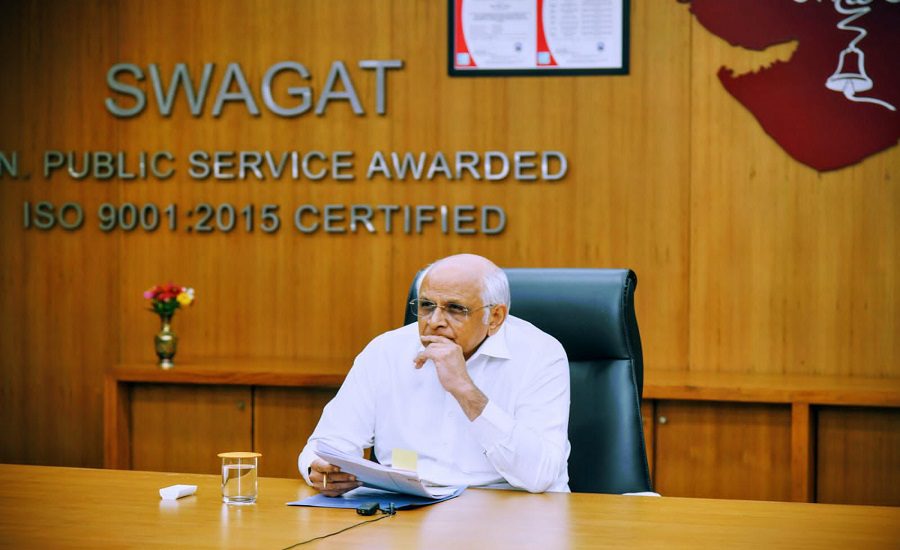
The state also developed SWAGAT, a technology-enabled grievance redressal system. Under the system, grievances could be registered and transmitted electronically to concerned authorities, with officials required to respond within a defined process. The system also maintained records of cases and their responses.
These initiatives reflected a wider shift towards using technology not merely for digitisation, but for monitoring, service delivery and citizen interaction.
Water Security Became a Development Priority
Water management was particularly important in a state where several regions had historically faced serious water stress.
Gujarat’s development strategy placed emphasis on irrigation, watershed development, water conservation and improving the distribution of available water resources.
The broader Panchamrut framework associated with Modi’s Gujarat tenure sought to bring different development priorities together, including water, electricity, education, agriculture and infrastructure. Modi’s official biography describes Panchamrut as a framework for convergent governance.
Water security was therefore linked with other aspects of development rather than treated as an isolated issue.
The emphasis also supported the larger objective of improving agricultural productivity and reducing the vulnerability of rural communities to water shortages.
Agriculture Linked With Wider Economic Growth
Agriculture formed another important part of the development strategy.
The objective was to improve farm productivity through better irrigation, electricity, technology, connectivity and agricultural extension services. The underlying approach was that rural development could not be separated from the wider state economy.
When agricultural incomes and rural infrastructure improve, they can create wider effects through local consumption, employment and small businesses.
This made the rural economy an important part of the larger development narrative rather than treating agriculture separately from industrial growth.
Vibrant Gujarat Put Investment at the Centre
Alongside rural and infrastructure development, Gujarat also sought to strengthen its position as an investment destination.
The Vibrant Gujarat Global Investors’ Summit, launched in 2003, became a major platform for showcasing Gujarat’s industrial and investment potential to domestic and international investors.
The summit grew substantially over subsequent editions. In a later review of its evolution, Prime Minister Modi recalled that the 2003 edition attracted a few hundred participants, while later editions grew to tens of thousands of delegates and participants from countries around the world.
The summit helped establish investment promotion as a prominent component of Gujarat’s development strategy.
Its significance was not limited to the event itself. It also helped create an image of Gujarat as a state seeking investment through infrastructure, industrial capacity and policy-driven governance.
Technology and Administrative Monitoring
The Gujarat approach also placed considerable emphasis on monitoring implementation.
The state’s e-governance architecture included systems for workflow management, digital records, citizen services and administrative monitoring. Gujarat’s Department of Science and Technology describes e-governance as a tool for improving accountability, transparency and administrative effectiveness.
This contributed to the image of a government that emphasised measurable delivery and faster decision-making.
The broader governance philosophy was often associated with the idea of “Maximum Governance, Minimum Government”, a phrase that later became closely linked with Modi’s national political messaging. The Union government has also described several governance practices developed in Gujarat as models that were subsequently replicated elsewhere.
More Than a Single Scheme
The Gujarat model was therefore not one programme or one sector.
Its defining feature was the attempt to connect multiple areas of development:
- Infrastructure and industrial growth
- Rural electrification and agriculture
- Water conservation and irrigation
- Digital governance and citizen services
- Investment promotion and administrative efficiency
The combination created a development narrative in which physical infrastructure, economic growth and governance reforms were presented as mutually reinforcing.
From Gujarat to the National Stage
When Modi left Gujarat in 2014 to become Prime Minister, the term “Gujarat model” had already become a major part of India’s political and economic debate.
The Gujarat experience subsequently became part of the larger national narrative around development, investment, technology-driven governance and public service delivery.
Some of the state’s governance innovations have continued to influence discussions around digital administration and citizen-centric services. Gujarat itself has continued expanding its e-governance infrastructure, including platforms that provide online and assisted access to government services.
The state’s investment-promotion model has also continued to evolve. In 2026, Gujarat’s Vibrant Gujarat Regional Conferences were being used to promote regional industrial potential and attract investment, showing how the original investment-focused approach has developed beyond the flagship summit.
The Larger Legacy of the Gujarat Years
The significance of Modi’s Gujarat tenure lies not simply in individual schemes, but in the attempt to integrate infrastructure, agriculture, industry, technology and administration into a common development framework.
For supporters, the Gujarat experience demonstrated how strong implementation, infrastructure investment and technology could accelerate development. At the same time, the “Gujarat model” has remained a subject of political and economic debate, with its outcomes and wider applicability examined from different perspectives.
Its lasting political significance, however, is clear. The Gujarat years provided Modi with a state-level administrative experience that later became central to his national development narrative.
The larger idea was that governance should be evaluated not only by policies announced, but also by how effectively institutions deliver infrastructure, services and economic opportunities to citizens.
Read Also: Gujarat UCC Bill Gets President Murmu’s Assent, Paving Way for Implementation