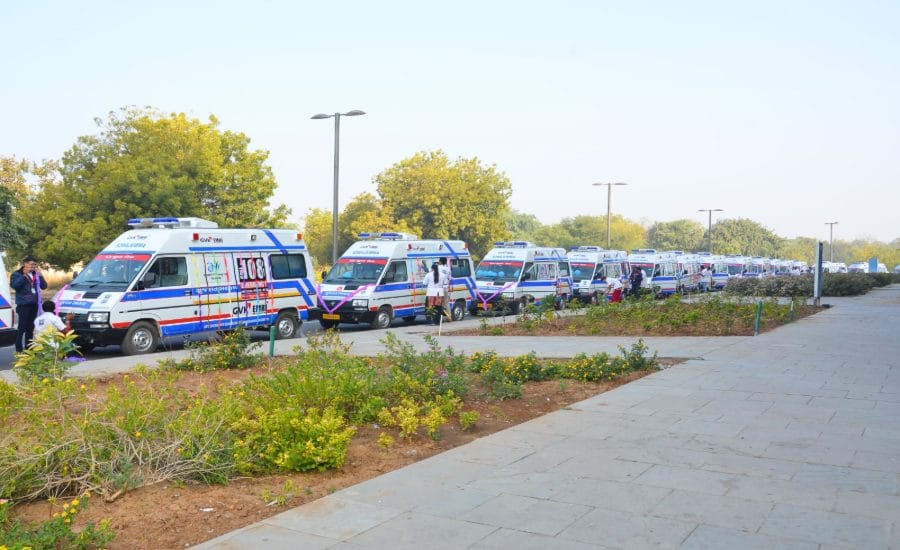
Gandhinagar: Gujarat is expanding emergency healthcare access in its tribal regions with 89 new ambulances, aiming to reduce the average emergency response time in these areas from 18 minutes 32 seconds to around 10 minutes.
The expansion is focused on communities living in remote, hilly and forested areas where difficult terrain, unpaved roads and monsoon-related disruptions can delay emergency medical services.
Under the leadership of Chief Minister Bhupendra Patel, the state government has been taking steps to strengthen healthcare access in remote tribal areas. The latest expansion of the ambulance network is aimed at ensuring that geographical barriers do not delay critical medical assistance.
Bringing Tribal Emergency Response Closer to the State Average
The 108 Emergency Ambulance Service currently records an average response time of around 13 minutes 9 seconds across Gujarat. The average is approximately 9 minutes 55 seconds in urban areas and around 16 minutes 28 seconds in rural areas.
Tribal regions face a greater challenge because of their geography. The current average emergency response time in these areas stands at approximately 18 minutes 32 seconds.
With the addition of the new fleet, Gujarat aims to bring this figure down to around 10 minutes. This would significantly reduce the time taken for ambulances to reach patients during medical emergencies.
The improvement is particularly relevant for remote settlements where the nearest healthcare facility may be located far away and road conditions can affect both ambulance movement and patient transportation.
Read Also: Gujarat Marks PM Modi’s Birthday With HPV Drive, Vaccinates 71,894 Girls in One Day
89 Ambulances Designed for Different Needs
The new fleet will increase the ambulance strength in the identified tribal districts from 553 to 642 vehicles.
The 89 ambulances have been planned according to the medical and geographical requirements of the region. They include:
- 22 Advanced Life Support (ALS) ambulances for critically ill and high-risk patients requiring advanced pre-hospital care.
- 55 Basic Life Support (BLS) ambulances for emergency transportation and essential life-support needs.
- 12 Four-Wheel-Drive (4WD) ambulances for rough terrain, hilly locations, unpaved roads and areas affected by heavy rainfall, flooding and difficult monsoon conditions.
The specialised 4WD vehicles are particularly significant for settlements where conventional ambulances can face difficulties reaching patients.
Focus on the Critical Golden Hour
A faster ambulance response can be important during the critical period following a serious medical emergency, commonly referred to as the Golden Hour.
The expanded network is expected to improve access to timely medical assistance for pregnant women, newborns, children, senior citizens, persons with disabilities and critically ill patients living in remote locations.
Reducing the gap between an emergency call and the arrival of an ambulance can allow patients to receive initial medical assistance sooner and reach an appropriate healthcare facility more quickly.
Faster Reach, Faster Hospitalisation
The initiative is designed to address two important stages of emergency transportation—reaching the patient quickly and transporting the patient to a hospital without unnecessary delay.
This is particularly important in tribal areas where distance and terrain can become major barriers to healthcare access. Increasing the number of ambulances and placing specialised vehicles in challenging locations can strengthen the connection between remote communities and healthcare facilities.
The deployment of ALS, BLS and 4WD ambulances will also allow the emergency network to respond to different types of medical situations while accounting for local geographical conditions.
Strengthening Healthcare in Difficult Terrain
For Gujarat’s tribal communities, emergency healthcare access is closely linked to the ability of the health system to overcome geographical challenges.
Forested areas, hills, scattered settlements and seasonal road disruptions can increase travel time during emergencies. The additional ambulances are intended to improve coverage in such locations and reduce the existing response-time gap between tribal and other areas.
The expansion also supports the broader objective of making emergency healthcare more accessible and equitable for communities living in difficult-to-reach parts of the state.
The procurement process for the new fleet is currently underway and is being managed by the Additional Director of Medical Services, Gandhinagar.
With 89 additional ambulances planned for tribal areas, Gujarat is seeking to make emergency medical assistance faster and more accessible, particularly for people living beyond the reach of conventional healthcare networks.
Read Also: ‘Yojana Doots’ to ‘Innovation Leaders’: Gujarat Puts Youth at Centre of G3Q-2026