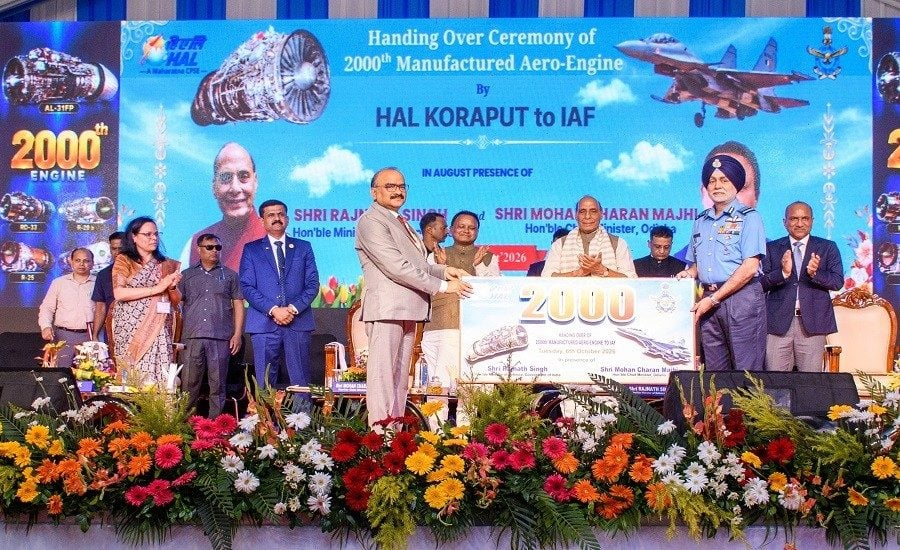
NEW DELHI: Hindustan Aeronautics Limited (HAL) has delivered its 2,000th aero-engine from its Koraput Division, marking a major milestone in India’s aerospace and defence manufacturing journey. Defence Minister Rajnath Singh witnessed the delivery on October 6, 2026, and announced plans to expand the company’s engine production capabilities through new investments.
The milestone marks six decades of engineering and manufacturing expertise at HAL Koraput, which was established in 1964. During the event, the Defence Minister emphasised the need to strengthen India’s indigenous capabilities in the design, development, testing, manufacturing and maintenance of advanced aero-engines.
Rajnath Singh also announced an investment of ₹335 crore to increase the annual production capacity of AL-31FP engines from 30 to 50 units. In addition, HAL will establish a second Shakti engine production line with an investment of ₹218 crore, with the new line expected to manufacture up to 100 engines annually.
HAL Koraput Marks Six Decades of Aero-Engine Manufacturing
The delivery of the 2,000th aero-engine represents a significant achievement for HAL Koraput and highlights its contribution to India’s military aviation capabilities.
Congratulating the engineers, technicians, scientists and skilled workforce, Rajnath Singh said the milestone reflected six decades of accumulated engineering expertise and technological experience.
HAL Koraput has manufactured engines that have powered several frontline military aircraft, including:
- MiG-21
- MiG-27
- MiG-29
- Su-30MKI
The Defence Minister highlighted the importance of both engine production and overhaul in maintaining military preparedness. While new engines provide additional capability, overhaul activities extend the service life of existing engines and support the operational readiness of the armed forces.
HAL Koraput has overhauled more than 9,000 engines so far. Its indigenous repair and overhaul capabilities, component indigenisation efforts and reduced turnaround times have contributed to maintaining critical defence assets.
Read also: Big Boost For Tejas Program: HAL Upgrades Final Trainer Jets With Advanced AESA Radar
HAL to Increase AL-31FP Engine Production Capacity to 50 Annually
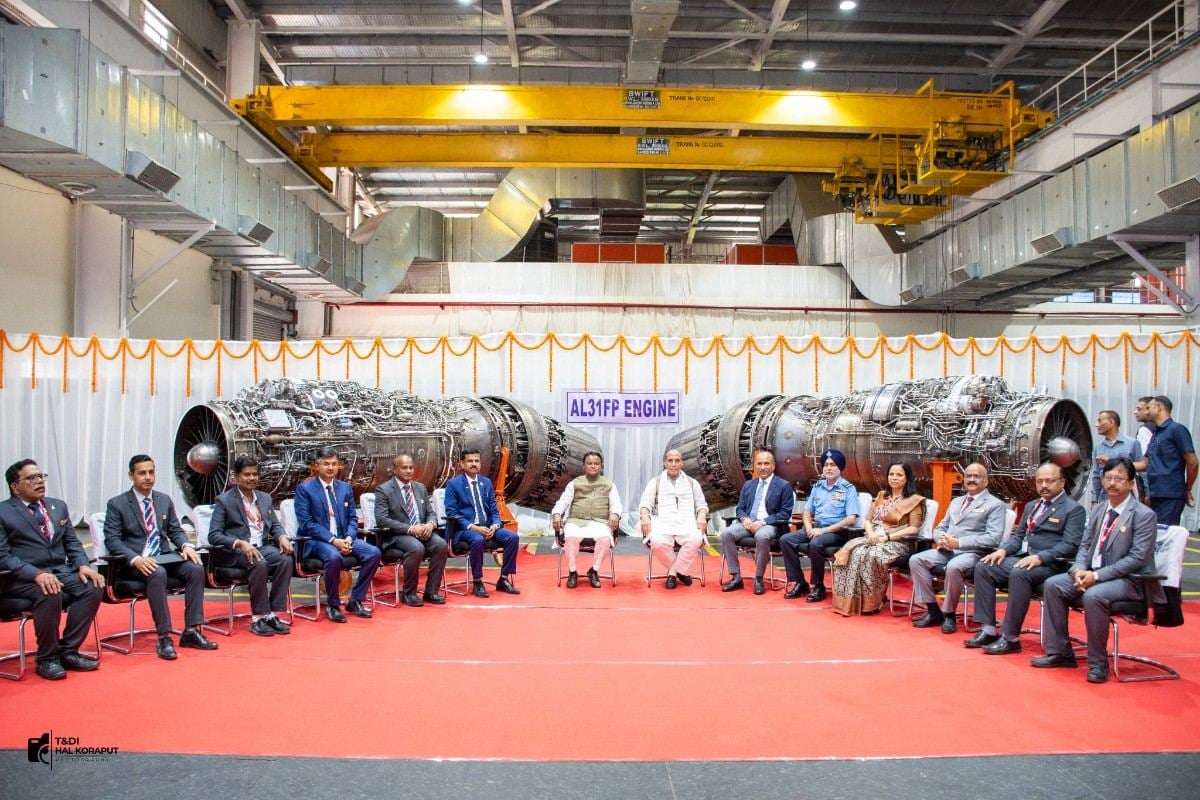
HAL will invest ₹335 crore to increase the annual production capacity of AL-31FP engines from 30 to 50 units, strengthening its ability to meet the requirements of the Indian Air Force.
In 2024, the Government placed an order with HAL for 240 AL-31FP engines for the Su-30MKI fighter aircraft.
Despite global supply-chain disruptions and raw-material challenges, HAL delivered the first engine ahead of schedule. The company has delivered 63 engines against a target of 60 by the end of the second year, according to the information shared at the event.
The planned capacity expansion is expected to support the fulfilment of engine requirements and strengthen domestic manufacturing capabilities for India’s fighter aircraft fleet.
HAL to Establish Second Shakti Engine Production Line by 2028-29
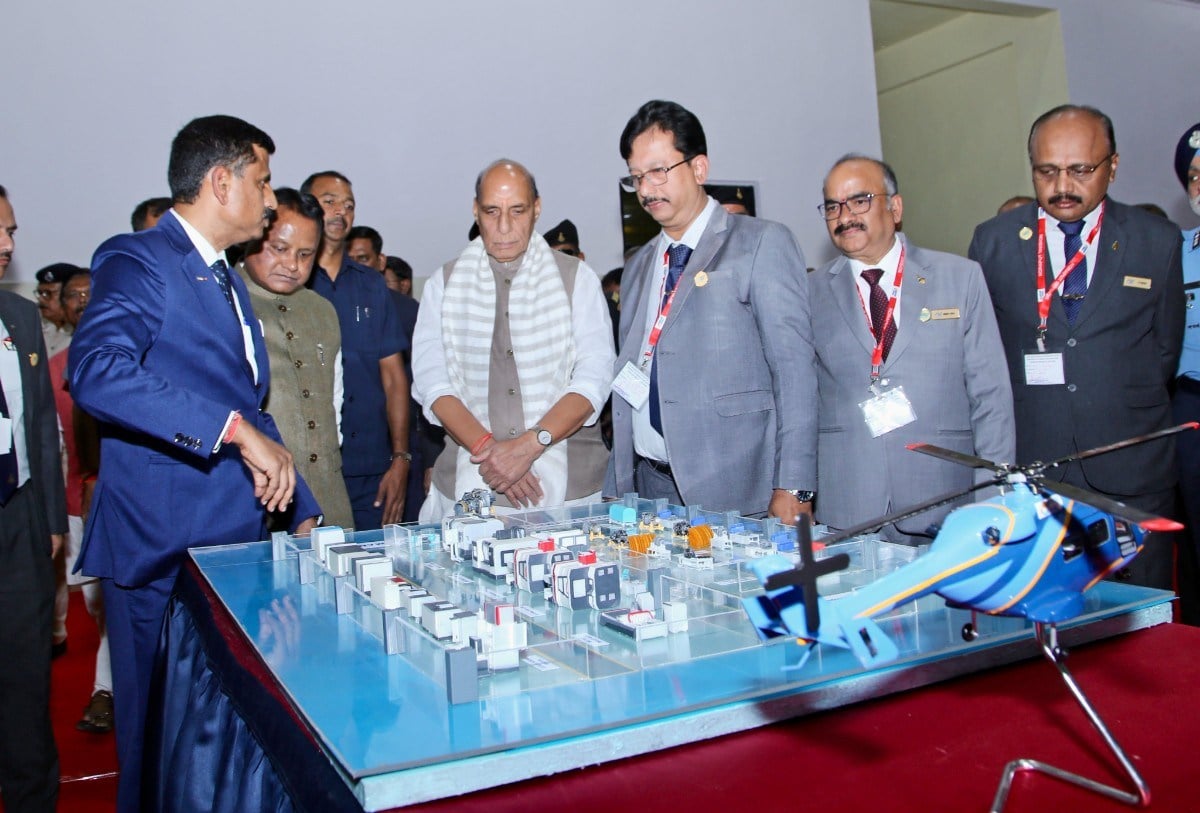
Rajnath Singh announced that HAL would establish a second production line for Shakti engines with an investment of ₹218 crore.
The new production line is scheduled to be fully established by 2028-29 and will have the capacity to manufacture up to 100 engines annually.
The engines will support India’s indigenous helicopter programmes, including:
- Dhruv Advanced Light Helicopter (ALH)
- Prachand Light Combat Helicopter (LCH)
The expansion aims to strengthen the availability of indigenous propulsion systems for India’s helicopter fleet and improve support throughout the engines’ service life.
The Defence Minister emphasised that the armed forces need reliable engines that are available when required, supported throughout their operational lifecycle and upgraded as technology advances.
India Pursues Indigenous High-Thrust Aero-Engine Programme
Rajnath Singh stressed that aerospace self-reliance must extend beyond aircraft platforms to the indigenous design and development of advanced aero-engines.
The government is pursuing an indigenous high-thrust engine programme with an investment of approximately ₹5,000 crore, with relevance to the Advanced Medium Combat Aircraft (AMCA) programme.
Key areas highlighted for strengthening India’s propulsion capabilities include:
- Indigenous engine design and development
- Advanced materials and superalloys
- Precision manufacturing and metallurgy
- Cooling technologies and thermal-barrier coatings
- Engine testing and stringent quality assurance
- Maintenance, Repair and Overhaul (MRO) capabilities
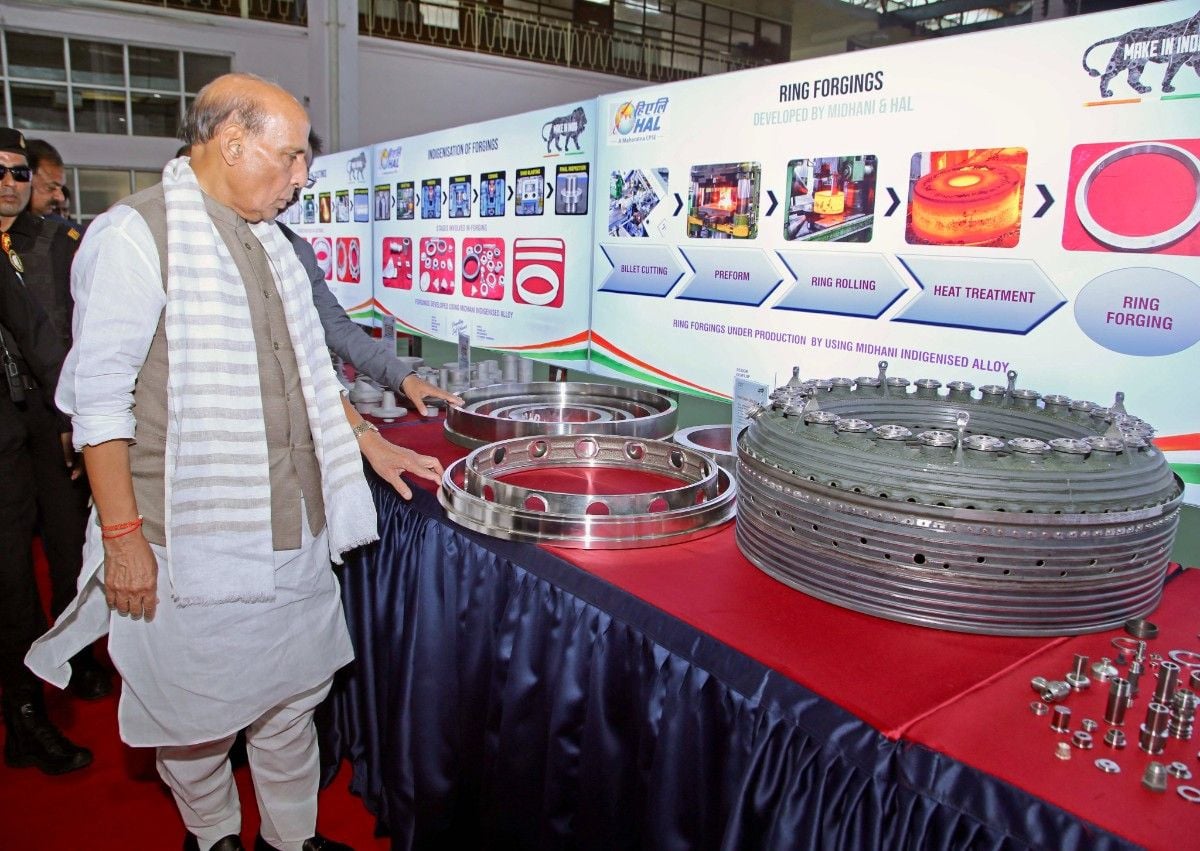
The programme also includes efforts to indigenise raw materials in partnership with Mishra Dhatu Nigam Limited (MIDHANI) and establish India’s first indigenous high-thrust engine testing facility.
The Defence Minister said a self-reliant aerospace ecosystem requires domestic capabilities across the entire propulsion chain, from materials and design to manufacturing, testing and maintenance.
Rajnath Singh Calls for Stronger Indigenous Propulsion Capabilities
Describing the aero-engine as the “heart” of an aircraft, Rajnath Singh said reliable propulsion is essential to fully utilise advanced airframes, radars, weapons and avionics.
He highlighted the technological complexity of aero-engine manufacturing, which requires advanced superalloys, thermal-barrier coatings, sophisticated cooling systems and the ability to operate reliably under extreme conditions.
He also emphasised that developing advanced engines is a long-term undertaking requiring sustained investment, specialised testing facilities, skilled manpower and a strong industrial ecosystem.
According to the Defence Minister, the focus must remain on reliable, repeatable and scalable production, along with continued progress in indigenous design, critical materials and manufacturing technologies.
HAL Urged to Build a Wider Aerospace Propulsion Ecosystem at Koraput
Rajnath Singh called on HAL to develop Koraput beyond an engine production facility into a broader aerospace propulsion ecosystem.
He stressed the importance of integrating micro, small and medium enterprises (MSMEs), start-ups, private industry, academic institutions and research organisations into the country’s propulsion manufacturing network.
The Defence Minister urged HAL to:
- Develop and nurture domestic suppliers.
- Mentor MSMEs and support start-ups.
- Provide advanced technology opportunities to young engineers.
- Collaborate with universities and research institutions.
- Expand indigenous manufacturing of critical engine components.
- Create more opportunities for skilled local youth.
- Improve quality, productivity, indigenisation and delivery timelines.
He said these efforts would help strengthen domestic industrial capabilities and reduce dependence on external sources for critical technologies and components.
Odisha’s Aerospace and Defence Manufacturing Potential Highlighted
The Defence Minister highlighted Odisha’s growing importance in India’s aerospace and defence manufacturing ecosystem.
He noted that the state benefits from its strategic location, long coastline, ports, mineral resources, industrial infrastructure and skilled workforce.
He also referred to strategic infrastructure such as the Defence Research and Development Organisation’s (DRDO) Integrated Test Range at Chandipur, which provides a foundation for further growth in the aerospace and defence sector.
Rajnath Singh appreciated the initiatives taken by the Odisha Government under Chief Minister Mohan Charan Majhi, including approval for an Aerospace and Defence Equipment Manufacturing Complex at Gajamara in Dhenkanal.
He called for greater cooperation between industry, research institutions and local suppliers to expand indigenous manufacturing capabilities and create employment opportunities in the state.
Defence Minister Calls for Higher Standards in Quality and Innovation
Concluding his address, Rajnath Singh urged the HAL Koraput team to use the delivery of the 2,000th aero-engine as a foundation for further progress in India’s aerospace industry.
He called for continued improvements in quality, productivity, indigenisation, innovation and delivery timelines.
He also congratulated the HAL Koraput team, the Indian Air Force, industry partners, MSMEs, scientists, engineers, technicians and the people of Odisha on the achievement.
The event was attended by Odisha Chief Minister Mohan Charan Majhi; Secretary (Defence Production) Sanjeev Kumar; Deputy Chief of the Air Staff Air Marshal Tejpal Singh; HAL Chairman and Managing Director Ravi K.; MIDHANI Chairman and Managing Director Dr S. V. S. Narayana Murty; and Joint Secretary (Aerospace Wing and DOMW) Manisha Chandra.
The milestone and announced capacity expansions underscore the government’s emphasis on developing domestic propulsion technologies and strengthening India’s long-term aerospace and defence manufacturing capabilities.
About Hindustan Aeronautics Limited (HAL)
Hindustan Aeronautics Limited (HAL) is a public sector aerospace and defence company under the Government of India. It is involved in the design, development, manufacture, repair and overhaul of aircraft, helicopters, aero-engines and related aerospace systems. HAL plays an important role in supporting India’s armed forces and advancing indigenous aerospace and defence manufacturing.
Read also: HAL Signs Agreement to Acquire Remaining 50% Stake in HATSOFF From CAE Canada