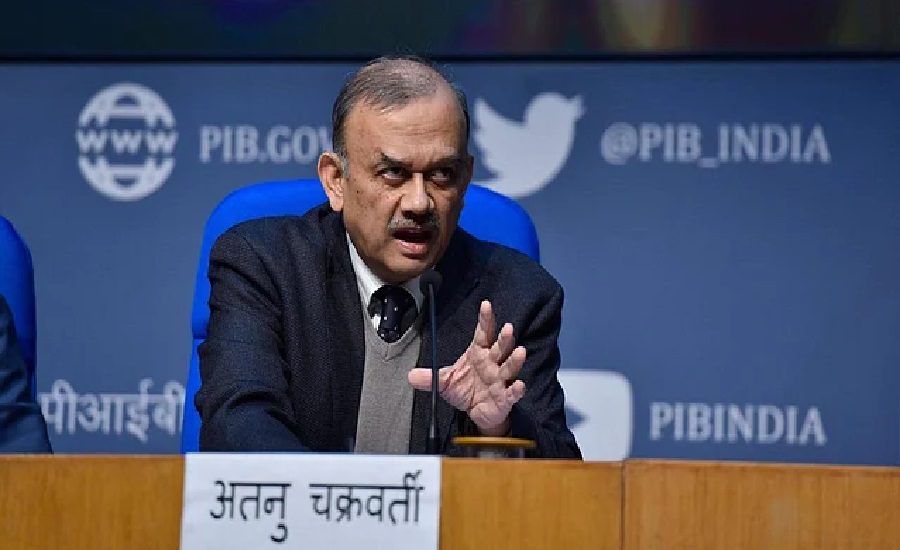
Kolkata: The West Bengal government has officially constituted the 7th State Pay Commission (CPC) and appointed former Union Finance Secretary Atanu Chakraborty (IAS:1985:Gujarat) as its Chairman. The four-member commission will review the pay structure, dearness allowance (DA), pensions, allowances and service conditions of lakhs of state government employees and pensioners.
The move comes just a day after Chief Minister Suvendu Adhikari announced that his government aims to implement the commission’s recommendations during the current financial year (FY 2026-27), fulfilling one of the BJP’s major electoral promises after assuming office in West Bengal.
According to the Finance Department’s resolution issued on July 22, the commission has been asked to submit its recommendations preferably within six months, although the state government may extend the timeline if required.
Atanu Chakraborty to Chair the Four-Member Commission
The newly constituted commission comprises four members:
- Atanu Chakraborty, former IAS officer and former Union Finance Secretary – Chairman
- Partha Mukhopadhyay, Senior Fellow, Centre for Policy Research
- Prof. Partha Pratim Pal, Economist, IIM Calcutta
- Devi Prasad Karanam, Finance Secretary, Government of West Bengal
The commission will operate from Kolkata, though it has been authorised to hold meetings anywhere within West Bengal or even in New Delhi if required.
What Will the 7th State Pay Commission Review?
The commission has been entrusted with a broad mandate covering almost every aspect of government employees’ remuneration and service conditions.
Its Terms of Reference (ToR) include:
- Reviewing salaries, pay scales, allowances and other financial benefits.
- Examining Dearness Allowance (DA) and recommending an appropriate formula for future revisions.
- Rationalising multiple allowances including Special Allowance and Travelling Allowance (TA).
- Recommending revised pension structures and pension fixation for retired employees.
- Reviewing promotion policies and retirement benefits.
- Suggesting measures to improve efficiency, accountability, work culture and work-life balance.
- Designing an emolument structure capable of attracting and retaining talent in government service.
The panel has also been asked to take into account the recommendations of the Centre’s upcoming 8th Central Pay Commission while framing its proposals.
Government Promises Gradual Reduction of DA Gap
Chief Minister Suvendu Adhikari recently reiterated that the government remains committed to reducing the long-standing gap between the Dearness Allowance paid by the Centre and the State.
He clarified that the government would not introduce a sudden increase but would bridge the difference gradually.
“We calculated it carefully and will bridge the difference gradually,” the Chief Minister said, while assuring employees that pending DA dues would also be addressed over time.
The state government had already announced a 20-percentage-point DA hike in the June Budget.
Who is IAS Atanu Chakraborty?
Mr Chakraborty is a 1985-batch IAS officer of the Gujarat cadre and one of India’s most respected economic administrators. During a career spanning over 35 years, he held several of the country’s most important economic policy positions before retiring from the civil services in April 2020.
Following his retirement, he entered the corporate sector and served as Part-time Chairman and Independent Director of HDFC Bank until stepping down in March 2026.
Educational Background
Born on April 5, 1960, Mr Chakraborty comes from Haryana and possesses a strong academic background in engineering, finance and management.
His qualifications include:
- B.Tech in Electronics & Communication Engineering from NIT Kurukshetra
- Post Graduate Diploma in Business Finance from ICFAI Business School
- MBA from the University of Hull, United Kingdom
Distinguished Bureaucratic Career
Leadership in Gujarat Government
During his service in the Gujarat cadre, Chakraborty held several senior administrative positions, including:
- Principal Secretary, Finance Department
- Additional Chief Secretary, Industries and Mines
- Leadership roles in Gujarat State Petroleum Corporation (GSPC)
- Gujarat State Fertilizers & Chemicals (GSFC)
- Gujarat Maritime Board
He earned a reputation for financial discipline, industrial policy reforms and infrastructure development.
Key Roles in the Central Government
At the Centre, Chakraborty occupied several strategic positions.
Director General of Hydrocarbons (2016–2018):
He supervised India’s upstream hydrocarbon sector and regulated exploration activities involving multi-billion-dollar investments.
Secretary, Department of Investment and Public Asset Management (DIPAM) (2018–2019):
He led the government’s disinvestment programme, helping the Centre exceed its annual disinvestment target by mobilising nearly ₹85,000 crore against a target of ₹80,000 crore.
Secretary, Department of Economic Affairs (2019–2020):
As India’s Finance Secretary (Economic Affairs), he played a central role in preparing the Union Budget, managing fiscal policy, sovereign borrowing plans and capital market reforms. He also served on the Central Board of the Reserve Bank of India (RBI) during this period.
Corporate Career After Retirement
After retiring from the IAS, Chakraborty joined HDFC Bank as Part-time Chairman and Independent Director in April 2021 after receiving approval from the Reserve Bank of India.
He was reappointed for a second term in 2024, but resigned in March 2026, stating that certain governance practices within the bank over the previous two years did not align with his personal values and ethical standards.
His resignation attracted considerable attention within India’s banking and corporate governance circles.
Academic and Policy Contributions
Apart from his administrative career, Mr Chakraborty has also contributed to public policy research.
He served as a Global Leadership Fellow at Harvard University’s Lakshmi Mittal and Family South Asia Institute, where his work focused on:
- Public finance
- Infrastructure privatisation
- Corporate governance
- Health and education policy
- Urban development
Major Responsibility Ahead
As Chairman of West Bengal’s 7th State Pay Commission, Atanu Chakraborty will now lead one of the state’s most significant administrative exercises.
The commission’s recommendations will determine the future salary structure, dearness allowance, pensions and service conditions of lakhs of government employees and retirees. It is also expected to play a crucial role in aligning West Bengal’s pay structure more closely with that of the Central Government while balancing the state’s fiscal capacity.