New Delhi: India develops critical high-tech equipment For FAIR has become a major milestone in the country’s scientific journey. Indian scientists and engineers have successfully designed and manufactured advanced accelerator equipment for the Facility for Antiproton and Ion Research (FAIR), a global mega-science project under construction in Darmstadt, Germany. The achievement highlights India’s growing strength in advanced physics research, engineering, and international scientific collaboration.
What Is FAIR Project And Why Is It Important
The Facility for Antiproton and Ion Research (FAIR) is one of the world’s largest and most advanced particle accelerator facilities currently being built in Darmstadt, Germany. The project will help scientists study the structure of matter, the origins of the universe, nuclear physics, plasma physics, and astrophysics.
Read also: Quantum Communication, Satellites and Deep Tech: Inside India and Germany’s New Technology Roadmap
Researchers from around the world are expected to use the facility for cutting-edge scientific experiments. India is a founding member of the FAIR project and one of its major contributors.
India’s Role In The FAIR Project
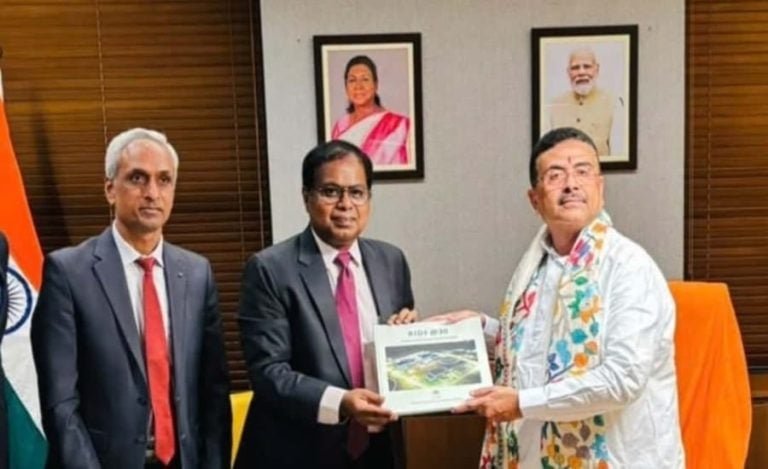
India’s participation is coordinated by the Bose Institute Kolkata, which serves as the country’s nodal institution for FAIR-related activities. Indian scientists, engineers, research laboratories, and industries are contributing advanced equipment as part of India’s in-kind commitment to the project.
High-Tech Equipment Developed By India
India has developed and supplied several critical accelerator components, including:
- High-tech power converters
- Vacuum chambers
- Beam catchers
- Advanced diagnostic cables
- Cryogenic systems
- Next-generation detector technologies
These systems are designed to meet strict international scientific standards and will play an important role in FAIR’s operation.
FAIR Project: Beam Catcher Equipment Reaches Germany
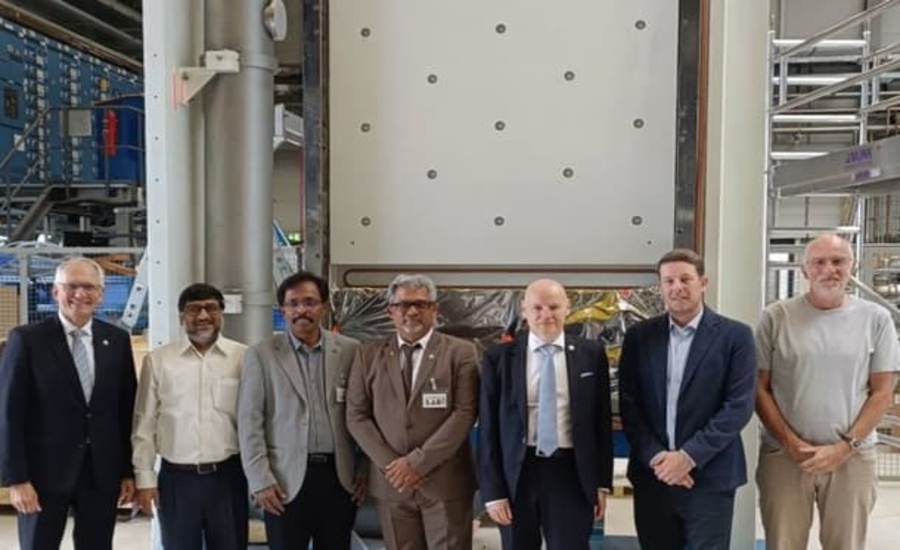
One of India’s major contributions is the Beam Catcher system. The first unit of the Beam Catcher equipment, designed and manufactured entirely in India, has already reached the FAIR site in Germany and is awaiting installation. The equipment is an important part of the beamline and helps manage particle beams used in scientific experiments.
How Indian Scientists Contributed in FAIR Project
Indian engineers have been actively involved in:
Designing Advanced Accelerator Systems
Experts worked on the design and development of highly specialized accelerator components needed for FAIR.
Manufacturing Precision Equipment
Several Indian industries participated in manufacturing equipment with extremely high precision and quality standards.
Supporting Global Scientific Research
Indian researchers are also involved in FAIR experiments related to:
- Nuclear physics
- Astrophysics
- Atomic physics
- Plasma physics
- High-energy particle research
Why This Achievement Matters For India
This achievement strengthens India’s position in global scientific research. It demonstrates that Indian institutions and industries can successfully develop world-class scientific equipment for complex international projects. The project is also expected to create opportunities for Indian researchers, students, engineers, and technology companies in advanced scientific fields.
What are the Benefits Of The FAIR Project
When FAIR becomes operational, scientists will use it to:
Study The Origins Of The Universe
Researchers will investigate how matter formed after the Big Bang and how stars and galaxies evolved.
Advance Nuclear And Particle Physics
The facility will enable experiments that are currently impossible at many existing research centers.
Support Medical And Space Research
Research conducted at FAIR may contribute to future developments in cancer treatment, radiation science, and space exploration technologies.
India’s Growing Presence In Global Science
India’s successful development of critical FAIR equipment reflects the country’s expanding capabilities in advanced science and technology. As a founding member of the FAIR collaboration, India continues to play a significant role in one of the most ambitious international research projects of the modern era.
Read also: India-Germany Submarine Deal 2026: Timeline, Technology, and Strategic Impact Explained