New Delhi: India is preparing to make history with its ambitious deep-sea exploration program and maritime security. The country is all set to send humans 6,000 meters below the ocean surface using its made in India Matsya-6000 submersible.
This groundbreaking mission will make India only the sixth country in the world to achieve crewed deep-sea exploration. The historic dive is part of India’s Samudrayaan mission.
What is Matsya-6000 Submersible?
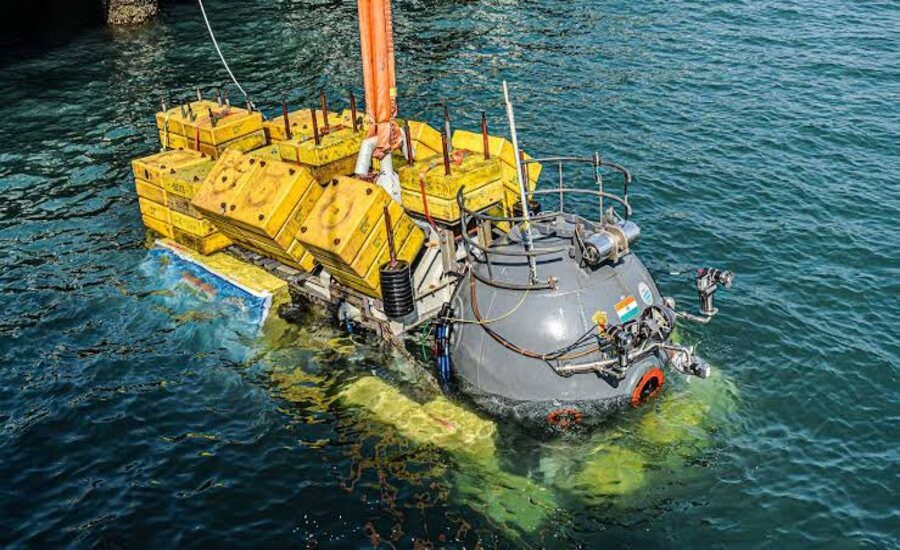
The Matsya-6000 is a state-of-the-art underwater vehicle designed and developed by India’s National Institute of Ocean Technology (NIOT). The name ” Matsya” comes from Sanskrit, meaning ” fish.”
This remarkable submersible can carry three people to depths of 6,000 meters beneath the ocean surface. The vehicle is built with a special titanium alloy sphere that protects crew members from extreme underwater pressure.
The entire submersible weighs approximately 5.5 tons. It measures about 4 meters in length and can operate for up to 12 hours underwater.
What is Samudrayaan Mission of India
The Matsya-6000 is the centerpiece of India’s ambitious Samudrayaan mission. This project aims to explore the deep ocean floor of the Indian Ocean.
The mission focuses on studying marine biodiversity and mineral resources lying on the ocean bed. Scientists believe the Indian Ocean floor contains valuable minerals like polymetallic nodules. The Ministry of Earth Sciences is leading this project with support from various Indian research organizations. The total mission cost is estimated at around Rs 4,077 crore.
Major Importance of Matsya-6000 Submersible for India
- India has a vast coastline of over 7,500 kilometers. The Indian Ocean holds immense strategic and economic importance for the country.
- Deep-sea exploration will help India discover valuable mineral resources on the ocean floor. These resources include rare earth elements, cobalt, and nickel.
- The mission will also strengthen India’s position in marine scientific research. It will create new opportunities for Indian scientists and researchers in oceanography.
- Additionally, this achievement will boost India’s indigenous manufacturing capabilities in advanced marine technology.
Elite Club: Only 5 Countries Have Done This Before
Currently, only five nations have successfully conducted crewed deep-sea missions beyond 5,000 meters. These countries are the United States, Russia, China, Japan, and France.
India will become the sixth member of this exclusive club once the Matsya-6000 mission is completed. This achievement showcases India’s growing capabilities in advanced technology and scientific research.
China recently made headlines with its Fendouzhe submersible, which reached the Mariana Trench. The United States pioneered deep-sea exploration with the famous Trieste submersible in 1960.
Technical Features of Matsya-6000 Submersible
- The Matsya-6000 boasts impressive technical specifications designed for extreme underwater conditions.
- The crew sphere is made from titanium alloy, capable of withstanding pressure of over 600 atmospheres.
- The submersible features advanced life support systems providing oxygen for the three-member crew.
- It includes high-definition cameras for underwater photography and video recording. Powerful LED lights illuminate the dark ocean depths during exploration.
- The vehicle has robotic arms for collecting samples from the ocean floor. Advanced communication systems keep the submersible connected with the surface support team.
Timeline and Testing Phase of Matsya-6000 Submersible
The Matsya-6000 has undergone extensive testing before the crewed mission. NIOT conducted several unmanned test dives to ensure safety and reliability.
- The submersible successfully completed shallow water trials in the Bay of Bengal. Engineers tested all systems including communication, life support, and emergency protocols.
- Deep-water unmanned tests reached depths of 5,500 meters, proving the vehicle’s capabilities. The crewed mission is expected to take place soon, with final preparations underway.
- Scientists have carefully selected the dive location in the Central Indian Ocean Basin. This area is rich in polymetallic nodules and offers significant research opportunities.
Safety Measures and Emergency Systems
Safety is the top priority for the Matsya-6000 mission. The submersible has multiple emergency systems to protect the crew.
- If something goes wrong, the crew sphere can automatically detach and float to the surface.
- The vehicle carries emergency oxygen supplies lasting up to 96 hours.
- An emergency beacon helps rescue teams locate the submersible quickly. The titanium sphere protects crew members even if other systems fail.
- NIOT has developed comprehensive training programs for the crew members. They practice emergency procedures repeatedly to handle any situation underwater.
Economic Benefits of Deep-Sea Exploration
- The ocean floor contains enormous mineral wealth waiting to be discovered. Polymetallic nodules found on the seabed contain valuable metals.
- These nodules include manganese, nickel, cobalt, and copper. India has already secured exploration rights for 75,000 square kilometers in the Central Indian Ocean Basin.
- Mining these resources could reduce India’s dependence on mineral imports. This would strengthen the country’s economy and industrial sector.
- The mission will also create jobs in marine technology, research, and related industries. It opens new avenues for Indian companies in underwater technology manufacturing.
Scientific Research Opportunities
The Matsya-6000 mission will unlock numerous scientific research possibilities. Scientists will study unique marine life forms living in extreme deep-sea conditions.
These organisms have adapted to survive in complete darkness and enormous pressure. Understanding them could lead to breakthroughs in biotechnology and medicine. Researchers will also study underwater geological formations and volcanic activity. This knowledge helps predict earthquakes and tsunamis more accurately.The mission will improve our understanding of ocean currents and their impact on climate. Deep-sea research contributes to better climate change predictions.
Indigenous Technology Development
The Matsya-6000 represents India’s growing self-reliance in advanced technology. NIOT developed the submersible entirely within India using indigenous expertise.
This achievement proves India’s capabilities in complex engineering projects. The project involved collaboration between multiple Indian research institutions and industries. Indian companies manufactured critical components like the titanium sphere and electronic systems. This boosts the ” Make in India” initiative in high-tech sectors.
The technology developed for Matsya-6000 has applications beyond ocean exploration. It can be used in offshore oil exploration, submarine rescue operations, and underwater construction.
Environmental Considerations
- The Matsya-6000 mission follows strict environmental guidelines to protect marine ecosystems. Scientists ensure that exploration activities don’t harm delicate deep-sea habitats.
- The submersible uses clean electric power to minimize pollution. Researchers collect samples carefully to avoid disturbing the ocean floor unnecessarily.
- NIOT works closely with environmental experts to ensure sustainable ocean exploration. The mission aims to balance resource discovery with ecosystem protection.
- Understanding deep-sea environments helps develop better conservation strategies. This knowledge is crucial for protecting ocean biodiversity for future generations.
International Recognition and Collaboration
India’s deep-sea program has attracted international attention and appreciation. Several countries have expressed interest in collaborating with India on ocean research.
The United Nations has recognized India’s efforts in responsible ocean exploration. India participates in international forums discussing deep-sea mining regulations.
This mission enhances India’s reputation as a responsible and capable scientific nation. It opens doors for technology exchanges and joint research projects with other countries.
Indian scientists will share their findings with the global scientific community. This contributes to humanity’s collective knowledge about our planet’s oceans.
Future Plans and Vision
The Matsya-6000 mission is just the beginning of India’s deep-sea exploration journey. NIOT plans to develop more advanced underwater vehicles in the coming years.
Future missions may target even greater depths beyond 6,000 meters. India aims to establish permanent underwater research stations for continuous ocean monitoring. The government is investing heavily in marine technology development. This includes training more scientists and engineers in underwater research.
India’s vision includes sustainable exploitation of ocean resources while protecting marine environments. The country aims to become a global leader in marine technology and oceanography.
Global Context: Deep-Sea Exploration Race
- Countries worldwide are racing to explore and claim ocean resources. The deep sea represents the last unexplored frontier on Earth.
- China has made significant advances with its deep-sea programs in recent years. The United States continues investing in underwater research and technology.
- International laws govern deep-sea mining through the International Seabed Authority. Countries must balance resource extraction with environmental protection.
- India’s Matsya-6000 mission positions the country strategically in this global context. It ensures India has a voice in decisions about ocean resource management.