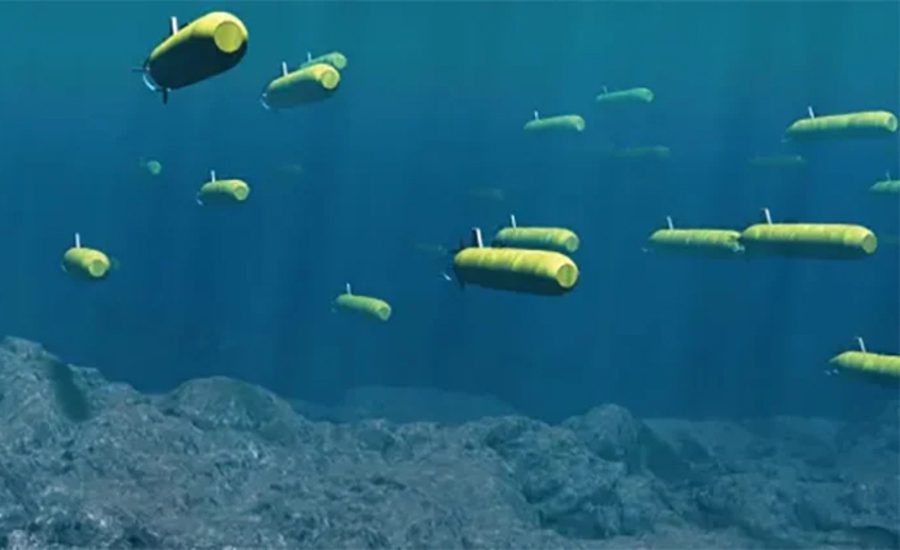
New Delhi: In a major leap for India’s underwater defence capabilities, the DRDO’s NSTL has developed a new-generation man-portable swarm of autonomous underwater vehicles (AUVs) designed specifically for mine-counter measure and reconnaissance missions in coastal waters. The move underscores India’s push for indigenous, lightweight, networked underwater systems capable of rapid deployment from small platforms.
Background of Man-Portable Swarm AUV of DRDO
Maritime mines remain a significant threat in littoral waters and harbour approaches. Traditional mine‐countermeasure (MCM) techniques often rely on large vessels, remotely operated vehicles or fixed sensor networks, which can be expensive, slow and vulnerable in shallow, cluttered waters.
To address this, DRDO’s NSTL has developed a compact “man-portable” AUV swarm architecture to enhance agility, reduce footprint, and increase operational responsiveness.
According to the official MoD release: “a new generation of Man-portable Autonomous Underwater Vehicles (MP-AUVs) have been successfully developed… The system comprises multiple AUVs equipped with side-scan sonar and underwater cameras as primary payloads for real-time detection & classification of mine-like objects.”
A new generation of Man-portable Autonomous Underwater Vehicles (MP-AUVs) have been indigenously designed and developed by the NSTL in collaboration with other labs NPOL, RCI, HEMRL, and DYSL-AT for mine countermeasure missions. The system comprises multiple AUVs equipped with… pic.twitter.com/fyKovZjf60
— DRDO (@DRDO_India) November 15, 2025
The Innovation & Technical Details of DRDO Man-Portable Swarm AUV
The system integrates the following notable features:
- Multi-AUV swarm architecture: Several man-portable AUVs operate in coordinated fashion, enabling distribution of search and mapping loads across a cluster.
- Key payloads: Side-scan sonar for wide-swath seabed imaging, underwater high-resolution camera for optical confirmation of anomalies.
- AI-driven onboard processing: Deep-learning based target recognition algorithms classify mine-like objects autonomously, reducing operator burden and mission time.
- Acoustic communication network: Compact acoustic modems enable inter-AUV data exchange and relay to surface gateways, facilitating swarm coordination and real-time situational awareness.
- Compact, man-portable form‐factor: Designed to be deployable from small craft or shoreline teams, reducing logistical footprint and enabling faster mission turnaround.
Together, these elements make the MP-AUV system far more flexible, scalable and rapid compared to traditional mine-countermeasure platforms.
Importance & Strategic Implications of DRDO Man-Portable Swarm AUV
This development has multiple strategic dimensions:
Enhanced littoral security: For India’s long coastline, island groups and critical harbours, man-portable AUV swarms expand the ability to detect and neutralise underwater threats in shallow, contested waters.
Reduced risk to human assets: Autonomous vehicles mitigate the danger to divers or crewed vessels in mine-infested zones.
Cost and logistics advantage: Man-portable units mean smaller platforms, less support infrastructure and faster deployment – particularly vital in expeditionary operations or remote postings.
Indigenisation: Developed in‐country by DRDO/NSTL and industry partners, this aligns with India’s push for Atmanirbhar (self-reliant) defence manufacturing.
Technology leap: Integration of AI, acoustic networking and swarm coordination places India on a more advanced footing in undersea robotics and networked maritime operations.
Key Challenges & Limitations of Man-Portable Swarm AUV
While promising, some challenges remain:
Operational validation: Field trials have been conducted but full operational deployment will test reliability, endurance, and coordination in complex underwater environments.
Swarm coordination in cluttered environments: Under-water acoustics face propagation issues in shallow, turbid waters; coordinating multiple AUVs robustly remains technically challenging.
Reliability of AI undersea: Deep-learning classification in sonar/optical underwater conditions must handle noise, false positives/negatives and adversarial inputs.
Integration with existing MCM architecture: Ensuring these units interface with surface vessels, disposal vehicles and command networks will require systems engineering.
Logistics and deployment training: While termed “man-portable”, practical force‐load, launch/recover procedures and maintenance in field conditions will need refined protocols.
Way Forward
To fully capitalise on this innovation, the following path is recommended:
- Complete production and induction – With DRDO stating readiness for production in the “next couple of months”.
- Expanded trials in operational conditions – Deploy to varied littoral zones (islands, shallow coasts, channel entrances) to validate performance.
- Integration with networked command and disposal systems – Link with surface vessels (ASVs), disposal AUVs/ROVs and shore‐based command centres for end-to‐end MCM workflow.
- Enhanced industry collaboration – Engage private defence industry partners to scale manufacturing, upkeep and upgrades.
- Continuous innovation – Upgrade modules: longer endurance batteries, improved sensors, more compact deployment platforms, better AI models for underwater target recognition.
- Training & doctrine adaptation – Naval/Coast Guard operations must incorporate these AUVs into MCM doctrine, logistics frameworks and mission planning.
- Export potential exploration – Once matured, this indigenous capability may appeal to friendly maritime-nations in the Indian Ocean Region (IOR) seeking cost-effective MCM options.