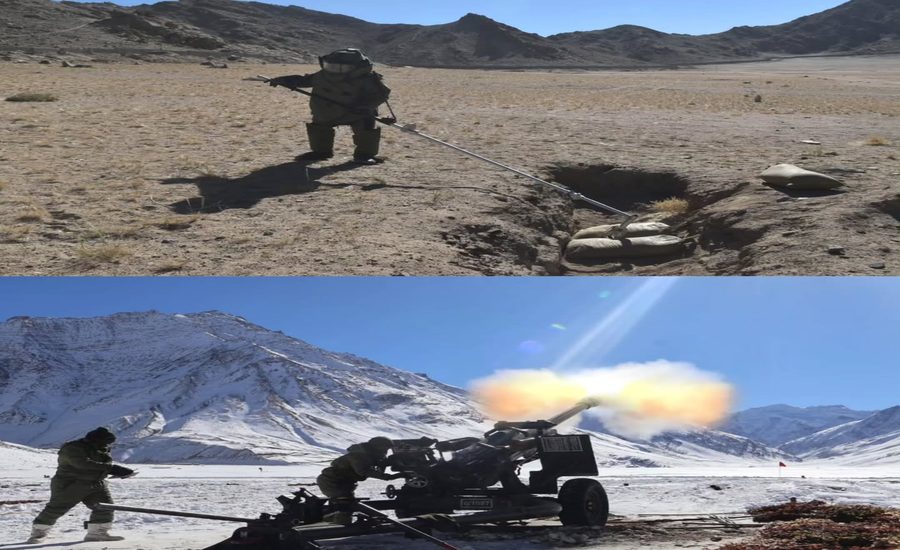
The Indian Army has taken a major leap in modernising its war-fighting posture. The newly formed Rudra Integrated All Arms Brigade—a formation combining infantry, armour, mechanised units, artillery, air-defence and engineers—has completed full operational validation during Exercise Akhand Prahar under the Southern Command.
This achievement signals a strategic shift from the Cold Start doctrine towards a more advanced Cold Strike doctrine, in which the Army emphasises immediate readiness, integrated arms and rapid response rather than slower mobilisation.
Background of Rudra Brigade Cold Strike
The Cold Start doctrine was formulated as India’s answer to lengthy mobilisations and the risk of escalation in the event of conflict with Pakistan. Under that model, surprise and swift limited incursions were to be carried out before the adversary could fully mobilise.
However, evolving threats — from multi-domain warfare (including land, air, cyber and space) to advances in precision strike capabilities — have rendered the older model less adequate.
Analysts have argued the need for faster decision cycles, enhanced integration and persistent readiness.
About the Rudra Brigade Cold Strike
The Rudra Brigade was validated under the leadership of Lieutenant General Dhiraj Seth, who is the Southern Army Commander. He expressed satisfaction with the brigade’s performance and affirmed that the unit is now fully capable of handling multi-domain tasks across varied terrain and mission profiles.
The brigade is formed under the Army’s Southern Command and integrates multiple arms “into a unified, highly mobile formation capable of swift, synchronised operations” according to official statements.
Importance of the Rudra Brigade Cold Strike
1. Faster decision and deployment cycles: Under Cold Strike, the Army is aiming to cut down pre-deployment timelines, enabling more immediate action rather than lengthy mobilisation.
2. Multi-domain synergy: With land, armour, artillery, air-defence and engineers operating as a cohesive unit, the force can conduct highly integrated operations. Exercise Akhand Prahar showcased this jointness in a desert sector.
3. Deterrence posture: By demonstrating readiness and rapid strike capability, India sends a signal to adversaries that its response options are robust. The leap to Cold Strike reinforces India’s strategic depth.
4. Adaptation to contemporary threats: The evolving nature of conflict — drones, robotics, cyber-attacks, precision munitions — demands flexible formations and agile doctrines. This shift positions the Army to meet such challenges.
Key Challenges to Watch
- Rapid deployment in high-intensity scenarios puts a heavy strain on supply chains, maintenance, and support units. Ensuring sustainment of the Rudra Brigade’s tempo will be critical.
- While performance in desert terrain (Thar) has been validated, operations across mountainous regions, jungles, and urban theatres will pose distinct difficulties.
- Achieving seamless coordination between Army, Air Force, and potentially Navy or cyber/space domains remains complex—command structures, training, doctrine must align.
- A rapid strike doctrine runs the risk of unintended escalation — especially in a nuclear-armed region. Clear thresholds and command protocols are essential.
- High readiness levels require continuous training, rigorous maintenance, and fresh doctrine — which impose high demands on personnel and resources.
Key Implications
For India’s western border: The new doctrine enhances India’s options along the India-Pakistan border by improving strike readiness and lowering the time lag between decision and action.
Regional deterrence dynamics: Adversaries will need to account for faster Indian response capabilities, potentially altering their planning and posture.
Military-industrial base: The drive toward jointness and rapid deployment also implies increased demand for indigenous platforms, support equipment, networked systems and logistics solutions.
Strategic messaging: The move signals to allies and adversaries alike that India is pursuing defence reform and modernisation aggressively — a positive for partnerships and a warning for threats.
Evolving doctrine of war: The shift from Cold Start to Cold Strike reflects a broader trend in warfare — integration of domains, speed of decision, and combined arms operations rather than traditional protracted mobilisation.
Way Forward
- Following the Rudra Brigade, similar integrated “all-arms” brigades should be raised and validated across different commands to ensure scalability.
- Validation in desert areas is a strong start; next steps should include high altitude, jungle and urban operational drills under the Cold Strike paradigm.
- Ensuring rapid deployment must be matched with robust rear-area support, supply chain flexibility and maintenance infrastructure.
- The doctrine will require closer coordination between Army, Air Force, Navy, cyber and space assets; joint training, shared command doctrine and communication networks should be further refined.
- With faster operation capabilities comes greater risk of miscalculation. Clear rules of engagement, command-and-control mechanisms and diplomatic coordination must accompany the doctrinal shift.
- The Army should continue emphasising unmanned systems, AI-enabled decision aids, networked firepower and precision logistics to realise the full potential of the Cold Strike model.
Read Also: Revolution in Defence: Indian Army Gets 500 Blast-Resistant 3D-Printed Bunkers Built in Just 7 Days!