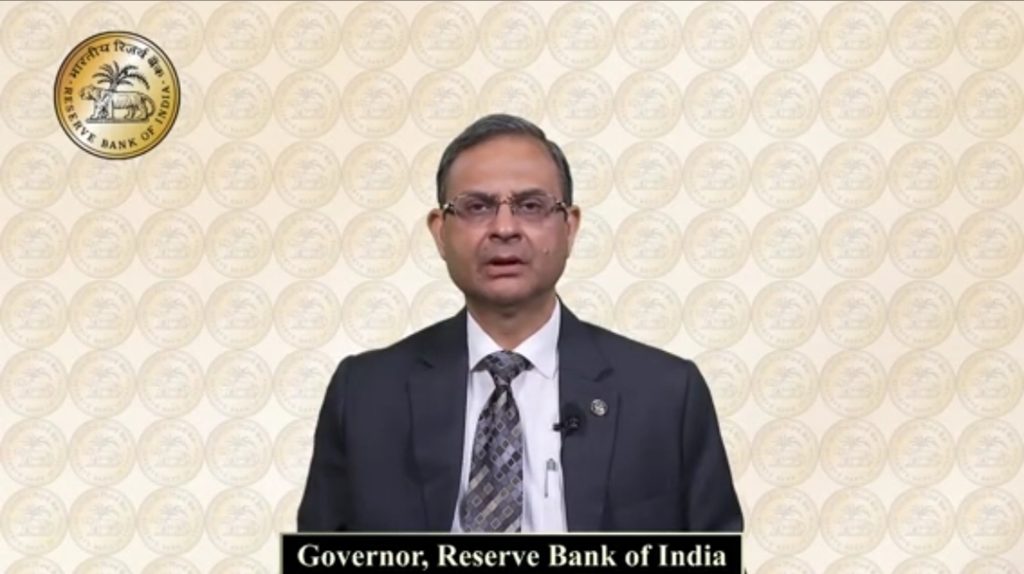
New Delhi: Offering relief to millions of borrowers while maintaining a cautious watch on global economic developments, the Reserve Bank of India (RBI) on Friday decided to keep the benchmark repo rate unchanged at 5.25 per cent. The decision was announced by RBI Governor Sanjay Malhotra, an IAS officer of 1990 batch from Rajasthan cadre, after the conclusion of the Monetary Policy Committee (MPC) meeting held from June 3 to June 5.
The central bank also retained its ‘neutral’ monetary policy stance, signalling that it remains prepared to respond flexibly to evolving domestic and global economic conditions.
The decision comes at a time when heightened geopolitical tensions in West Asia continue to create uncertainty in global financial markets, energy supplies and inflation trends.
No EMI Increase for Borrowers
The RBI’s decision to maintain the repo rate at 5.25 per cent is expected to provide stability to borrowers across the country.
Since the repo rate serves as the benchmark rate at which the RBI lends money to commercial banks, any change in it directly influences lending rates offered by banks and financial institutions.
Read Also: Who Is Rohit Jain? RBI Names Him Deputy Governor, Replaces T. Rabi Sankar
With the status quo maintained:
- Home loan EMIs are unlikely to rise.
- Vehicle loan borrowers will continue to benefit from stable interest rates.
- Personal loan and business loan borrowers are expected to see no immediate increase in borrowing costs.
The move is likely to support household finances and sustain consumer demand amid global economic uncertainty.
RBI Retains Neutral Policy Stance
Alongside the rate decision, the Monetary Policy Committee retained its neutral stance, indicating that future policy actions will depend on incoming economic data and evolving global developments.
Governor Sanjay Malhotra emphasized that while India’s macroeconomic fundamentals remain strong, external risks continue to warrant caution.
According to the RBI, geopolitical developments in West Asia have the potential to affect:
- Global crude oil prices
- Energy supply chains
- International trade flows
- Inflation trajectories across economies
Maintaining a neutral stance allows the central bank to preserve flexibility in responding to any adverse developments.
RBI Projects Strong GDP Growth for FY27
Despite global headwinds, the RBI remains optimistic about India’s growth trajectory.
The central bank has projected real GDP growth at 6.6 per cent for FY27, reflecting confidence in domestic consumption, investment activity and overall macroeconomic stability.
Quarterly GDP Growth Projections
| Quarter | Growth Projection |
|---|
| Q1 FY27 | 6.6% |
| Q2 FY27 | 6.3% |
| Q3 FY27 | 6.5% |
| Q4 FY27 | 6.8% |
The projections suggest that economic activity is expected to remain resilient throughout the fiscal year despite uncertainties in the global environment.
Inflation Outlook Remains Under Watch
The RBI has projected Consumer Price Index (CPI) inflation at 5.1 per cent for FY27.
Quarterly Inflation Forecast
| Quarter | CPI Inflation |
| Q1 FY27 | 4.2% |
| Q2 FY27 | 5.1% |
| Q3 FY27 | 5.9% |
| Q4 FY27 | 5.4% |
The inflation trajectory indicates moderate price pressures in the early part of the fiscal year, followed by a gradual increase during subsequent quarters.
The RBI noted that global commodity prices, particularly crude oil, will remain an important factor influencing future inflation trends.
ASSOCHAM Welcomes RBI Decision
Industry body ASSOCHAM welcomed the RBI’s decision, describing it as a positive step for economic growth and business confidence.
Saurabh Sanyal, Secretary General of ASSOCHAM, said the calibrated decision to keep the policy rate unchanged at 5.25 per cent would strengthen business sentiment and support economic expansion.
According to him, India’s economy is expected to maintain strong growth momentum despite uncertainty in the global economic environment and concerns arising from geopolitical developments in West Asia.
Sanyal said the central bank’s decision reflects a balanced approach that seeks to support growth while ensuring inflation remains within manageable levels.
He further noted that the unchanged rate demonstrates confidence in the strength of the domestic economy while preserving policy flexibility to respond to changing macroeconomic and financial conditions.
Balancing Growth and Inflation
Economists believe the RBI’s latest policy decision reflects a careful balancing act between promoting growth and controlling inflation.
While domestic indicators such as consumption, investment and government spending remain supportive of growth, policymakers remain mindful of risks arising from:
- Geopolitical tensions in West Asia
- Volatility in crude oil prices
- Global trade disruptions
- Inflationary pressures in international markets
By maintaining the current interest rate structure, the RBI has chosen to support economic momentum while retaining room for future action if external risks intensify.
Positive Signal for Economy and Markets
The RBI’s decision is expected to provide stability to both consumers and businesses by ensuring predictable borrowing costs and favourable credit conditions.
For borrowers, the unchanged repo rate means continued relief from rising loan repayments. For businesses, it supports investment planning and financing decisions.
At a broader level, the policy signals confidence in India’s economic resilience and reinforces the view that the country remains well-positioned to navigate global uncertainties while sustaining growth momentum.