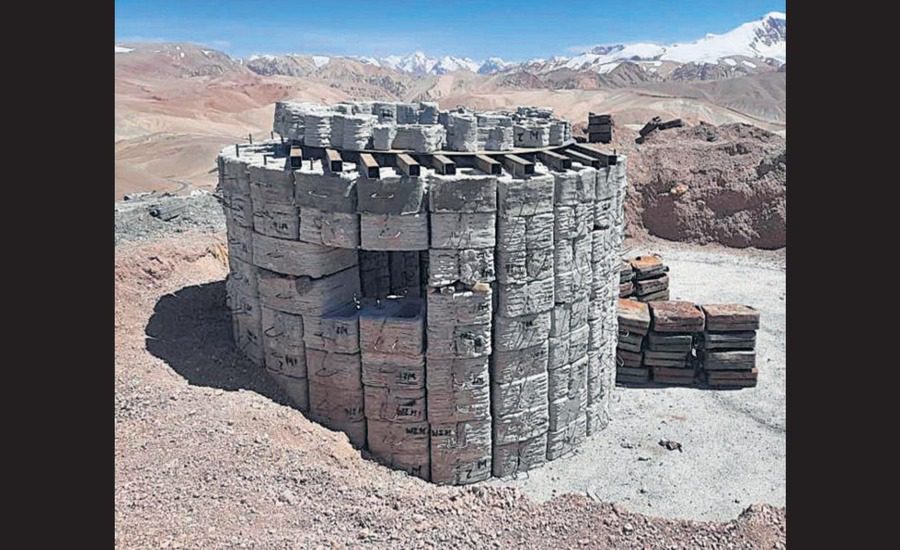
New Delhi/Gujarat: In a significant stride for India’s defence manufacturing and infrastructure, Gujarat-based start-up MiCoB Private Limited has successfully delivered over 500 blast- and impact-resistant 3D-printed bunkers to the Indian Army.
This achievement underscores the growing role of indigenous technology, automation, and rapid construction in fortifying India’s strategic frontiers.
Background of the Story
India has been actively seeking to modernise its defence infrastructure—especially in challenging terrain such as high-altitude mountain zones and harsh desert borders. Traditional bunkers made of reinforced concrete often require weeks to months of construction, heavy logistics, and significant deployment time.
Enter MiCoB, a rapid 3D Concrete Printing (3DCP) technology pioneer with the ability to print large concrete structures in record time, at remote locations. According to the company, its 3D printed bunkers are designed for the most difficult terrains—from mountain peaks to deserts.
The Indian Army’s requirement for rapid, mobile, ruggedised fortifications matched perfectly with MiCoB’s technology. Through collaboration with the defence ecosystem, the start-up’s “3D Permanent Defences (3D PDs)” have now been deployed across border fronts.
Key Details of 3D Printed Bunkers for Indian Army
MiCoB reports more than 500 impact and blast-resistant bunkers delivered to the Indian Army.
- These bunkers were deployed in a variety of extreme environments—from the snow-covered high-altitude terrains of Ladakh to scorching deserts in Rajasthan.
- Each bunker is engineered for optimum ballistic resistance, improved thermal insulation, and enhanced habitability for soldiers stationed in harsh climates.
- One of the major advantages: compared with traditional reinforced-concrete structures that may take up to 45 days to build, MiCoB’s 3D printed bunkers can be constructed in under seven days.
- The technology was validated through rigorous trials, including at the Army’s Pokhran range in 2022 where live weapon trials were conducted.
Importance of 3D Printed Bunkers India’s Defence
Rapid deployment: The ability to erect defensive structures quickly is key in dynamic border situations where operational readiness is critical.
Indigenous manufacturing: Leveraging home-grown start-ups like MiCoB aligns with the “Atmanirbhar Bharat” vision for self-reliant defence manufacturing.
Sustainability and logistics: 3D printing reduces construction waste, lowers dependence on heavy logistics and materials, and minimises environmental impact.
Terrain adaptability: From high altitude to desert zones, the technology adapts to multi-climate conditions—giving a flexibility that traditional structures struggle with.
Strategic signalling: Showcases India’s capability to field advanced defence infrastructure quickly—an important deterrence and morale factor.
Industry Context & Comparisons
- While MiCoB’s delivery marks a major milestone, there are other projects and experiments in India related to 3D-printed military structures:
- For instance, Indian Institute of Technology Hyderabad (IIT-Hyderabad) in collaboration with Simpliforge Creations and the Indian Army constructed a 3D-printed bunker at an altitude of 11,000 feet in Leh, in just five days.
- Earlier Indian defence procurements had already flagged the deployment of modular, 3D-printed bunkers at the Line of Actual Control (LAC) as a future goal.
Thus, MiCoB’s success builds on a broader trend of additive manufacturing and rapid construction in defence infrastructure—but delivering 500-plus units signals a scale-up that is noteworthy.
Implications and What’s Next
Scaling & Future Deployments: With over 500 bunkers delivered, the Indian Army may look to expand 3D-printed fortification units further across vulnerable border sectors.
Upgrades & Modular Add-ons: The next phase may include integration of sensors, surveillance systems, remote monitoring and enhanced automation within these structures.
Export Potential: India’s defence ecosystem may explore exporting this technology to friendly nations facing similar terrain and infrastructure challenges.
Defence Manufacturing Ecosystem Growth: This success should inspire more start-ups and private companies to participate in defence infrastructure, reinforcing the “Make in India” and “Atmanirbhar Bharat” goals.
Maintenance & Lifecycle: While construction time is reduced, ensuring lifecycle durability, maintenance in harsh terrains, and logistics supply chains remain important focus areas.