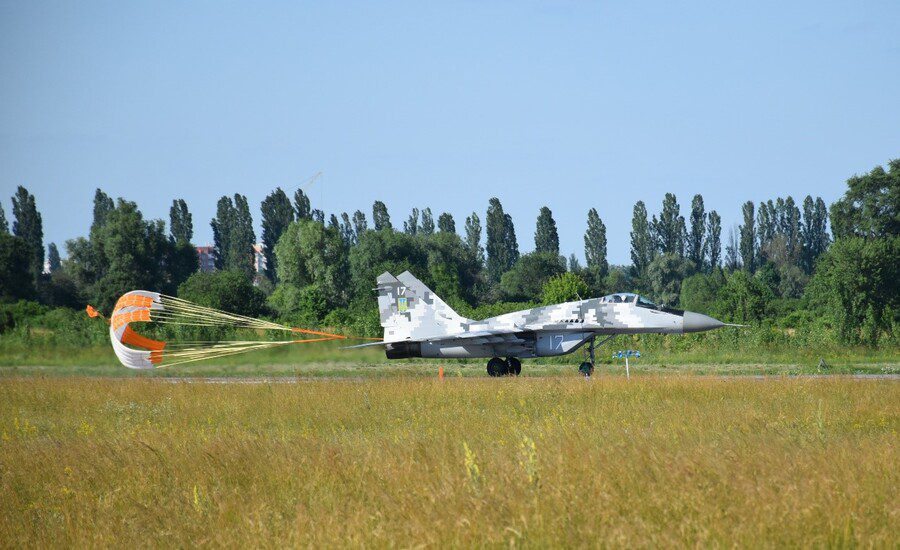
New Delhi: At the 2025 edition of EDEX 2025 (Egypt Defence Expo), Gliders India Limited (GIL) unveiled the first fully indigenous brake-parachute system for the MiG-29 fighter jet — a milestone that marks India’s growing maturity in aerospace safety systems. The debut aims not only at demonstrating self-reliant manufacturing but also at tapping into global markets, with special attention to potential export customers such as the Egyptian Air Force.
This development underscores a broader trend: India’s transition from import-dependence to becoming a reliable exporter of critical aeronautical components and accessories — reinforcing the country’s defence-industrial ambitions under the “Make in India” framework.
Background of MiG-29 Brake Parachute
Gliders India Limited (GIL) — formerly part of the erstwhile Ordnance Parachute Factory (OPF) that dates back to 1941 — is now a dedicated Defence Public Sector Undertaking (DPSU) under the administrative control of India’s Ministry of Defence.
Read also: Make in India Boost: DRDO Fuel-Cell AIP System to Anchor Next-Gen Submarines Under Project-76
Historically, OPF began by repairing parachutes and, over decades, expanded to manufacturing a wide array of parachute systems — from personnel-parachutes to cargo drop systems and safety recovery tools. GIL, post-corporatization in 2021, carries forward this legacy, with a sharpened focus on modern defence-grade parachute systems, aiming for self-reliance and export readiness.
A brake parachute is a specialized parachute system attached to high-performance aircraft. It is deployed during landing or aborted take-offs to rapidly decelerate the aircraft — critical for shortening runway requirements, enhancing safety on shorter or unprepared airstrips, and offering contingency braking for emergency landings.
For a jet like MiG-29, which can have high landing speeds and often operates from a variety of air bases, a reliable brake parachute significantly enhances operational safety and flexibility.
Technical Details of the Indigenous MiG-29 Brake Parachute
According to GIL’s publicly available catalogue, the newly developed brake parachute for MiG-29 features:
- A Unicross-design canopy with a span of approximately 5.76 metres.
- 32 rigging lines — ensuring stable deployment and deceleration.
- Designed for normal landing speeds of up to 180 km/h and emergency landing speeds up to 310 km/h.
Canopy material: Nylon fabric (93 gm, undyed)
Service life: Up to 10 years or until “65 streamings” (deployments), whichever is earlier. However, if used at emergency speed (near 310 km/h), it must be withdrawn post-use.
Compatible not only with MiG-29M/M2 variants but also with older MiG-29B/VB models.
Moreover, the design optimizes weight — thanks to an integrated riser and rigging-line configuration — which helps maintain the aircraft’s overall performance envelope while adding safety.
MiG-29 Brake Parachute: Strategic Importance of Operational and Export Significance
Enhancing Aircraft Safety & Operational Flexibility: The indigenous brake-parachute ensures that MiG-29 jets — whether operating from conventional airbases or shorter/improvised airstrips — can land safely with reduced runway length. This is especially important for operational theaters where infrastructure may be limited or in conflict zones where damaged runways are common. The availability of such a parachute enhances safety margins and gives air forces greater flexibility in basing and deployment.
Reducing Dependence on Imports & Supply-Chain Resilience: Until now, MiG-29 fleets globally largely relied on original Russian brake-parachute systems or imports — often accompanied by long lead times, especially since Russia’s supply chains have been constrained post-2022 due to global geopolitical tensions.
By offering an Indian-made alternative, GIL provides a more stable, cost-effective solution. According to reports from the exhibition, the Indian parachute is 30–35% cheaper than the Russian original, and more importantly, GIL claims it can dispatch spare canopies within 90 days — a stark contrast to the 18–24 month wait times some clients have faced with Russian parts.
Export Potential & Geopolitical Relevance: At EDEX 2025, GIL specifically targeted the Egyptian Air Force — which operates a sizable fleet of MiG-29M/M2 jets (delivered between 2017 and 2020). Egyptian officers reportedly showed keen interest in GIL’s system, evaluating sample canopies and technical documentation.
With Russia’s defence exports facing delays and supply-chain unpredictability, Indian alternatives could become attractive — not just to Egypt but potentially to other MiG-29 operators worldwide. The debut thus signals India’s entry into a niche yet strategically important global market: spare parts and accessory systems for Russian-origin fighter jets.
Furthermore, this aligns with India’s broader defence export ambitions under its self-reliance push. Past export activity by GIL (and its precursor OPF) for parachute systems shows growing global demand for Indian-made defence accessories.
The Road to Debut: Testing & Certification
GIL’s MiG-29 brake-parachute is not a rushed showcase; it represents a culmination of rigorous testing and certification processes:
The parachute underwent ground tests and high-speed sled trials at DRDO-controlled test ranges.
Subsequently, the system was flight-tested on actual aircraft: according to reports, jets of the Indian Air Force flying MiG-29UPG variants carried out landing trials during 2024–2025 to validate operational safety and performance.
The fact that the parachute system meets required deceleration and deployment standards — while being lighter and durable — suggests that quality and reliability standards were central to the development process.
This disciplined development path adds credibility to claims of export-readiness and international competitiveness.
Broader Implications for India’s Defence Industry
The debut of this indigenous MiG-29 brake parachute is more than a product launch — it is a demonstration of structural shifts in India’s defence-industrial ecosystem:
- Maturing aerospace supply chain: With companies like GIL delivering high-spec, export-grade ancillary systems, India is reinforcing its capacity to produce not just weapons platforms, but also the crucial support and safety gear required for them.
- Diversification beyond platforms: While India has often emphasised building or upgrading big-ticket aircraft (fighters, transport aircraft, helicopters), the success of brake-parachutes for MiG-29 (and earlier for jets like SU-30MKI) shows attention to lifecycle support, maintenance, and safety — critical for sustained operations.
- Export-led growth & strategic reach: As geopolitical realignments — particularly Russia–Ukraine conflict — disrupt traditional supply chains, India’s ability to step in with reliable alternatives could strengthen its role as a trusted defence supplier in Africa, Middle East and beyond.
- Cost-efficiency & reliability advantage: By offering cheaper, faster-to-ship, and domestically produced solutions, India is in a strong position to challenge legacy suppliers and capture market share in aftermarket systems and spares.
What Next? Prospects, Challenges & What to Watch
While the global debut at EDEX 2025 is a promising start, certain factors will determine whether GIL’s MiG-29 brake parachute becomes a success story — or remains an interesting showcase:
Export orders & contracts: The real test will be sealing export deals. Initial interest from Egypt is encouraging, but actual procurement, certification under foreign air-force standards, and long-term supply commitments will shape success.
After-sales support and spare supply chain: Critical to long-term credibility will be GIL’s ability to consistently deliver spare canopies and maintenance support — especially under diverse operational conditions faced by foreign air forces.
Regulatory and quality standard compliance: Export customers may demand compliance with international aerospace and defence standards beyond Indian certification; GIL will need to ensure stringent quality assurance to win trust.
Competition and geopolitics: Existing inventory of Russian or other origin parachutes, changing alliances, and shifting budgets may influence adoption. India will need a strong value proposition (cost, delivery schedule, performance) to displace entrenched suppliers.
Expansion into other aircraft & systems: The true potential lies in expanding this indigenous capability to other fighters (and possibly helicopters), recovery systems, and ancillary gear — thereby building a broader exportable ecosystem.
About Gliders India Limited
Gliders India Limited (GIL) is a Defence Public Sector Undertaking (DPSU) under the Ministry of Defence, specializing in the design and production of advanced military parachute systems. Formerly known as the Ordnance Parachute Factory, it carries decades of expertise in personnel, cargo, and aircraft-recovery parachutes. With a strong focus on indigenization and innovation, GIL supplies critical aeronautical safety equipment to the Indian Armed Forces and emerging global defence markets.