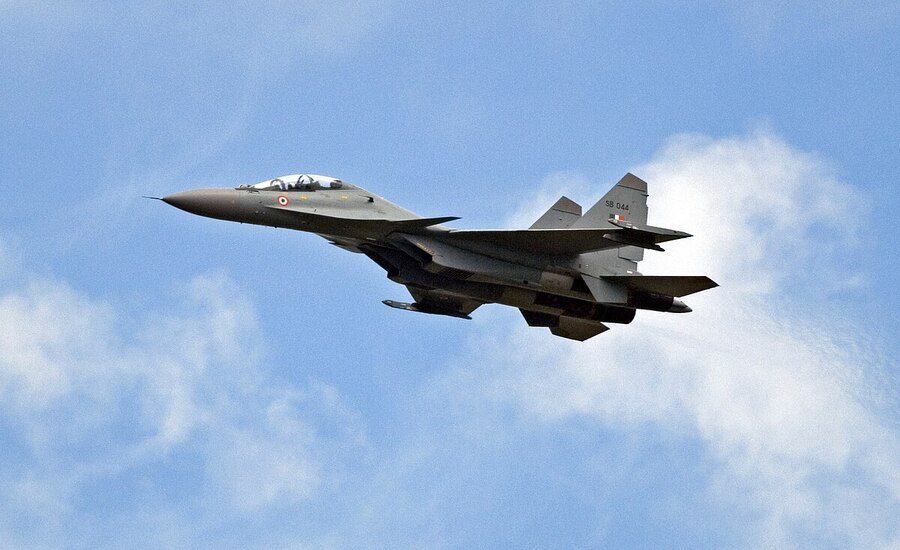
New Delhi: In a significant boost for India’s defence-industrial capability, Chennai-based Data Patterns India Limited has developed the HAWK I series of active electronically scanned array (AESA) radars that are now drawing keen interest from operators of Russian-origin fighters such as the Su‑30MKI and MiG‑29.
This surge of attention comes at a time when several Russian radar systems are reported to be facing reliability and supply-chain issues, making the indigenous solution a timely option.
Background of the Story
Historically, many Indian platforms – especially Su-30MKI and MiG-29 fleets – have relied on Russian-origin radar systems (for example the Zhuk-ME/N007 bars family). However, recent leaks and reports indicate significant reliability concerns: shorter mean times between failures, overheating issues, signal-processor faults and supply-chain disruptions from Russia.
Read also: India’s Bold Sky Revolution: 100 IAF ASPJ Pods to Turn Su-30MKI into an Undetectable Super Sukhoi
Recognising this gap, Data Patterns showcased its HAWK I series during the Aero India 2025 show and has garnered international interest – especially among operators of Russian-origin fighters seeking upgrade pathways.
What is the HAWK I Radar?
HAWK-I 2700 and HAWK-I 900 are the two main variants developed by Data Patterns:
- HAWK-I 2700: Designed for larger airframes like the Su-30MKI. Features ~2,700 transmit/receive modules (TRMs) and GaN (gallium-nitride) semiconductor technology, enabling detection of a 5 m² radar cross-section target out to ~350 km.
- HAWK-I 900: More compact, designed for lighter fighters such as the MiG-29, Tejas Mk1 and MiG-29K. Detection range is cited over 150 km, offering a replacement for older systems.
Both variants are capable of air-to-air, air-to-surface and maritime modes, supporting multi-target tracking, and designed to handle modern electronic warfare threats (ECCM features) and dense jamming environments.
Deep Dive: Technical & Strategic Implications
GaN Technology & Performance Leap: The use of GaN semiconductors is a key highlight; GaN enables higher power output, better thermal stability, and improved detection range compared to legacy GaAs based radars. This makes HAWK I more future-proof.
For example, the HAWK-I 2700’s quoted search range of about 250-350 km, wide field-of-view (up to 100°) and 2,700 TRMs are competitive with many modern western radars.
Market & Retrofit Opportunity: With many countries flying Su-30 and MiG-29 variants but facing ageing systems, the global retrofit market is estimated at US$5-7 billion. Data Patterns aims to capture part of this through this indigenous radar solution.
India’s “Super Sukhoi” Programme: Domestically, India’s programme to upgrade ~272 Su-30MKI aircraft (budgeted at ~₹65,000 crore) could integrate the HAWK-I 2700 radar. That would significantly enhance capability (for example detecting low-observable targets at 200 km+ as claimed).
HAWK I AESA Radar: Key Challenges & Next Steps
Airborne trials: While ground tests are complete (EM compatibility, thermal, signal processing), the radar must undergo airborne validation under real flight dynamics (high-G, vibration, jamming). Data Patterns has requested the IAF to allocate a Su-30MKI test-bed from TACDE.
Integration and certification: Integrating any new radar into a fighter platform involves avionics, cooling, power supply, software compatibility, and certification timelines.
Competition & reliability: Although the HAWK system is promising, historically new systems face teething issues — long-term reliability and support are crucial. Also the legacy Russian radars still need to be operated until replacements fully deploy.
Market positioning: To capture global markets, Data Patterns must demonstrate firm operational deployment, export approvals, support infrastructure and warranty/service systems.
Why HAWK I AESA Radar Matters for India & the World
Strategic autonomy: Developing and deploying indigenous radar systems reduces dependency on foreign suppliers (especially when supply-chains are disrupted by geopolitics).
Cost efficiency: Domestic development often reduces upgrade costs, potentially enabling more fleets to be modernised within budget.
Export potential: Successfully deploying in India opens doors for global defence exports, enhancing India’s profile as a defence-technology provider.
Reliability gap filled: With reported failures of older Russian systems (e.g., the Zhuk-ME) for India’s MiG-29K carriers, the HAWK-I series offers a potential bridge to improved operational readiness.
Key Takeaways
- India’s Data Patterns has developed the HAWK I AESA radar family (HAWK-I 2700 & HAWK-I 900) that are creating strong international interest.
- The interest is driven by reliability and supply-chain issues in older Russian radar systems used on Su-30/MiG-29 aircraft.
- The HAWK series uses modern GaN technology, supports multi-mode tracking capabilities and aims for both domestic (Super Sukhoi) and international retrofit markets.
- Next major milestone as airborne trials and certification via IAF’s test infrastructure.
- If successful, this will mark a significant step for India’s defence-technology self-reliance, cost-efficient upgrades for fighter fleets, and export readiness.
Read also: Revolution in Defence: Indian Army Gets 500 Blast-Resistant 3D-Printed Bunkers Built in Just 7 Days!