New Delhi: India has significantly strengthened its position as a leading global space power over the last three years, successfully conducting 12 launch vehicle missions, placing 11 national satellites and nine international customer satellites into orbit, while achieving several landmark milestones in space exploration and launch technology.
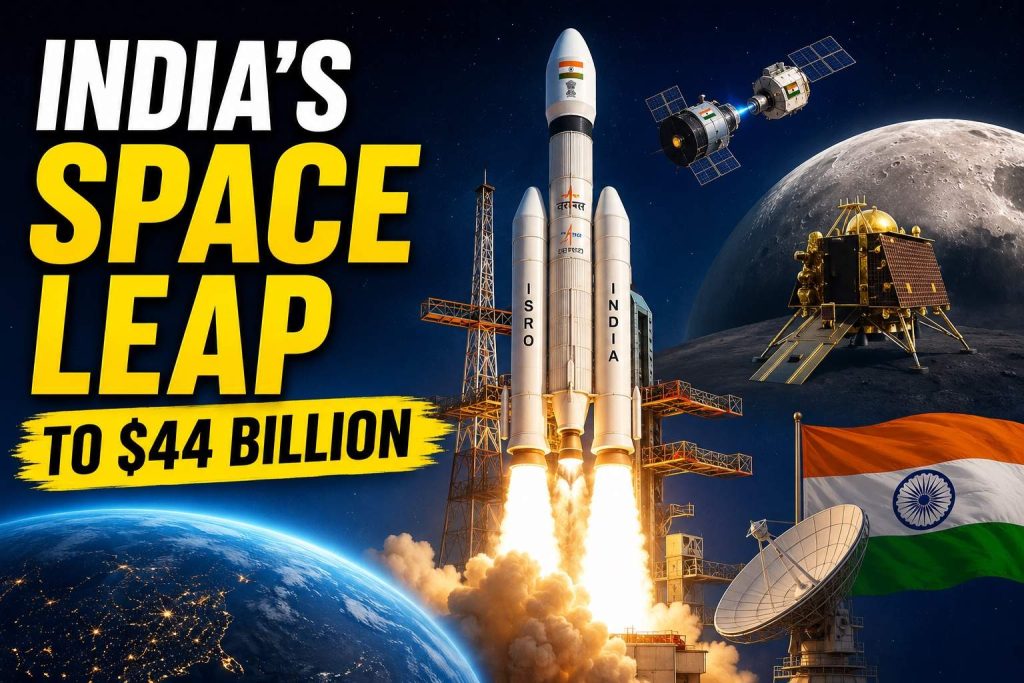
Sharing the details in a written reply in the Rajya Sabha, Union Minister of State for the Prime Minister’s Office, Personnel, Public Grievances and Pensions, Atomic Energy and Space Dr. Jitendra Singh highlighted India’s rapid progress in launch capabilities, infrastructure expansion and private sector participation. He said the country is now working towards expanding its space economy to USD 44 billion by 2033.
Major Space Milestones in the Last Three Years
Between July 2023 and June 2026, India achieved several historic accomplishments that enhanced its global standing in space science and technology.
Read Also: India Tightens ISRO Exit Rules to Protect Gaganyaan and Future Space Missions
Among the key achievements were:
- Chandrayaan-3 made India the first country to successfully soft-land near the Moon’s south pole.
- Aditya-L1, India’s first solar observatory mission, was successfully launched aboard PSLV.
- India completed its 100th launch from the Satish Dhawan Space Centre (Sriharikota).
- Through the SPADEX mission, India became the fourth nation in the world to demonstrate space docking and undocking technology.
- ISRO completed the development of the Small Satellite Launch Vehicle (SSLV) after its third developmental flight and transferred the technology to Indian industry.
- The joint NASA-ISRO Synthetic Aperture Radar (NISAR) mission was successfully launched using India’s GSLV rocket.
- India launched the heaviest satellite to Geostationary Transfer Orbit (GTO) from Indian soil through the CMS-03 mission using LVM3.
- In the following LVM3 mission, India launched the heaviest satellite ever from Indian soil for a United States customer.
Four Operational Launch Vehicles Power India’s Space Programme
The Department of Space currently operates four indigenous launch vehicles:
- Polar Satellite Launch Vehicle (PSLV)
- Geosynchronous Satellite Launch Vehicle (GSLV)
- LVM3 (formerly GSLV Mk III)
- Small Satellite Launch Vehicle (SSLV)
These launch vehicles support missions related to:
- Earth observation
- Communication satellites
- Navigation systems
- Space science and exploration
- Commercial launches for domestic and international customers
Launch Infrastructure Set for Major Expansion
To meet growing launch demand and future missions, the Government has approved several infrastructure projects.
Third Launch Pad at Sriharikota
The Centre has approved a Third Launch Pad at Satish Dhawan Space Centre (SDSC), Sriharikota, Andhra Pradesh.
The new facility will:
- Support future Next Generation Launch Vehicles (NGLV)
- Serve as a standby facility for the existing Second Launch Pad
- Increase launch frequency and operational flexibility
Second Rocket Launch Site in Tamil Nadu
Construction of the SSLV Launch Complex at Kulasekarapattinam, Tamil Nadu, is progressing steadily.
The facility will:
- Serve as India’s second rocket launch site
- Support launches of Small Satellite Launch Vehicles
- Facilitate launches by private space start-ups and Non-Government Entities (NGEs)
- Boost commercial launch capacity
According to the government, the two existing launch pads, together with the upcoming third launch pad and the Kulasekarapattinam launch complex, will provide sufficient launch capacity for India’s growing space ambitions.
Government Boosts Private Space Sector
The government has introduced multiple reforms to strengthen India’s private space ecosystem.
Some of the major initiatives include:
- Allowing private companies to establish temporary testing facilities within ISRO campuses
- Providing access to critical ISRO infrastructure
- Reducing development costs and testing timelines for private launch systems
- Financial assistance for start-ups and MSMEs
- Simplified authorization and regulatory approvals through IN-SPACe
- Skill development programmes
- Promotion of indigenous technology development
- Commercialisation of ISRO technologies
- Development of space manufacturing clusters to strengthen domestic supply chains
These measures are aimed at making India a globally competitive destination for commercial space activities.
NSIL’s Launch Revenue
The government also shared revenue earned by NewSpace India Limited (NSIL) through launch services.
| Financial Year | Revenue (₹ lakh) |
|---|---|
| 2024-25 | 44,743.13 |
| 2023-24 | 21,821.10 |
| 2022-23 | 1,16,613.16 |
ISRO Working on Next-Generation Technologies
ISRO is currently developing several advanced technologies that are expected to shape the future of India’s launch capabilities.
These include:
- 200-ton thrust Semi-Cryogenic Engine
- Semi-cryogenic booster stage for LVM3
- Reusable booster stage using Vertical Take-Off and Vertical Landing (VTVL) technology
- High-thrust LOX-Methane Engine
- Partially reusable Next Generation Launch Vehicle (NGLV)
- Winged Body Orbital Re-entry Vehicle (ORV) capable of runway landings
- Air-breathing propulsion systems and related technology demonstrators
These technologies are expected to significantly improve payload capacity, reduce launch costs and enable reusable launch systems.
India Targets $44 Billion Space Economy
The Indian National Space Promotion and Authorisation Centre (IN-SPACe) has prepared a long-term roadmap to increase India’s participation in the global space industry.
Under this vision:
- India’s space economy is targeted to reach USD 44 billion by 2033
- Greater focus will be placed on infrastructure creation
- Private sector participation will be expanded
- Manufacturing capabilities will be strengthened
- Innovation and indigenous technology development will be promoted
- India aims to emerge as a globally competitive space manufacturing and launch hub
The government believes that continued investment in launch infrastructure, advanced technologies and private participation will play a crucial role in achieving this ambitious target.
Read also: What Is ISRO New C32 Cryogenic Stage? LVM3-M7 Upgrade Explained