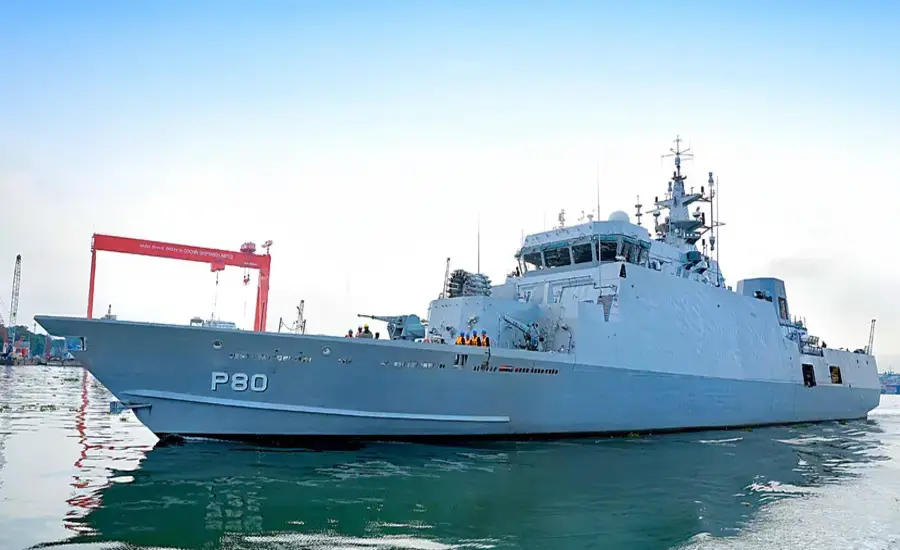
New Delhi: In a significant milestone for India’s maritime security, the Indian Navy will formally commission the warship INS Mahe at the Naval Dockyard, Mumbai, on 24 November 2025. Built by Cochin Shipyard Ltd. Kochi, this vessel is the first of eight in the Mahe-class Anti-Submarine Warfare Shallow Water Craft (ASW-SWC) series.
Background of INS Mahe commissioning
India’s push for advanced shallow-water anti-submarine capability stems from the need to address submarine threats in littoral zones, coastal approaches and near-sea chokepoints. Under the “Make in India” / Aatmanirbhar Bharat initiative, the Navy contracted for 16 ASW-SWC vessels — eight each by CSL and GRSE.
The contract to CSL for eight vessels was signed in April 2019 and the first ship was delivered on 23 October 2025.
About the INS Mahe
Name: INS Mahe, named after the historic coastal-town of Mahe on Malabar Coast.
Builder: Cochin Shipyard Ltd., Kochi.
Indigenous Content: Over 80 % of the components are Indian-made, a strong marker of self-reliance.
Role & Capabilities: Equipped to hunt submarines, conduct coastal patrols, secure maritime approaches, operate in shallow waters with stealth, mobility and advanced sensors.
Weaponry & Sensors: Includes torpedoes, multi-functional anti-submarine rockets, advanced radars and sonars.
Symbolism: The ship’s crest features the “Urumi” (a flexible sword of Kalaripayattu), symbolising agility, precision and lethal grace.
Importance of INS Mahe commissioning
1. Boost to Coastal & Littoral Defence: With rising submarine capabilities in the region, the Mahe-class strengthens India’s ability to protect shallow maritime zones and vital sea lanes.
2. Indigenous Shipbuilding Leap: This marks a concrete outcome of India’s self-reliance policy in defence manufacturing, signalling that complex warships can be built in India.
3. Fleet Modernisation: Replacing older vessels and adding new-generation shallow-water combatants improves operational readiness and fleet diversity.
4. Strategic Messaging: The commissioning at Mumbai underscores India’s strategic intent to secure its western sea-approach and maritime interests in the Indian Ocean-region.
Key Challenges
- Building eight advanced vessels demands tight adherence to timelines, quality standards and integration of systems — delays could hamper capability roll-out.
- Ensuring high performance of indigenous sensors, weapons and stealth features remains complex; coordination between multiple suppliers and shipyards is required.
- Advanced warships require rigorous maintenance regimes, logistic support and trained crew to deliver on promise.
- As more vessels come online, the Navy must integrate them into existing doctrine, training frameworks and maintain readiness alongside legacy fleets.
Key Implications
- Regionally, the commissioning sends a message of India’s enhanced under-sea warfare posture, likely influencing adversary planning.
- For the defence manufacturing ecosystem, it creates momentum for domestic supply-chains, component-industries and value-engineering.
- It also raises expectations for upcoming ships in the series, making the success of INS Mahe a litmus test for future deliveries.
- Operationally, Navy task forces will soon have fresh assets capable of shallow-water submarine detection and neutralisation — reinforcing deterrence.
Way Forward
- Timely commissioning of the remaining seven vessels in the series will amplify capability.
- Incorporate next-gen sensors, automation, digital integration and crew training to keep pace with evolving threats.
- Ensure domestic industries supply quality components, reduce imports and ensure maintenance efficiency.
- Update naval doctrine for shallow-water ASW operations, train crews on new systems and integrate these vessels into multi-domain task forces.
- Allocate budget and logistics planning for long-term maintenance, spares, refits and mid-life upgrades to maximise return on investment.