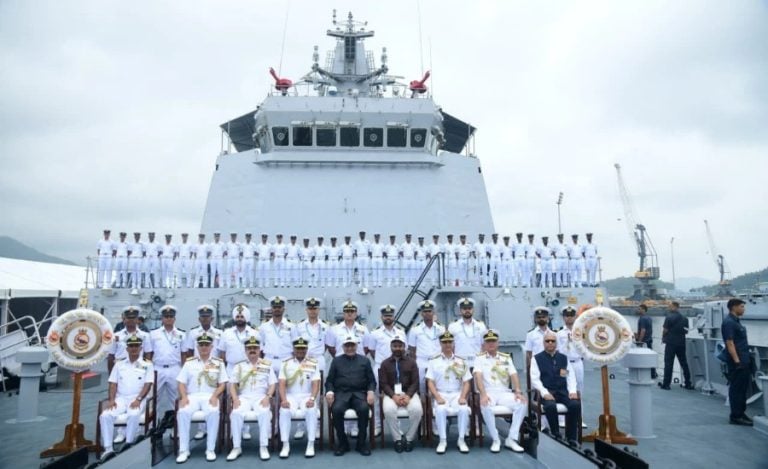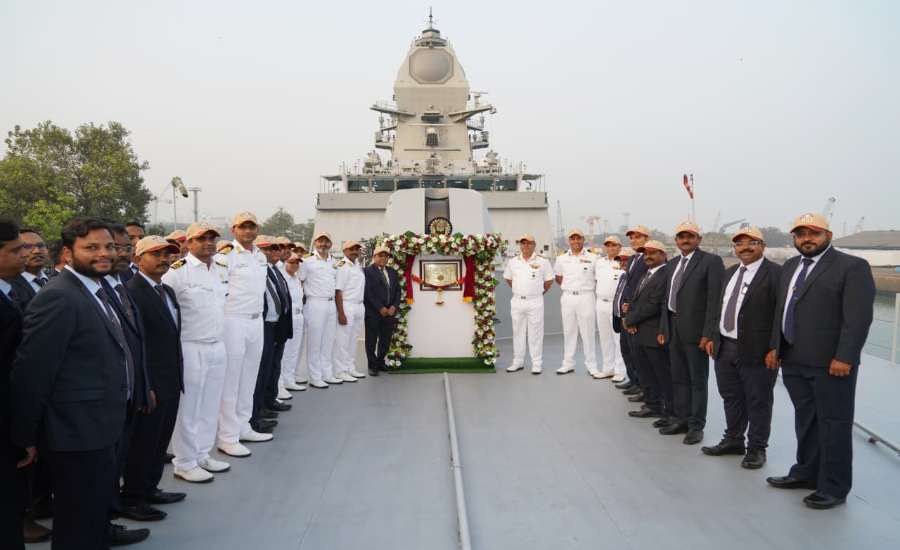
New Delhi: On 28 November 2025, the Mazagon Dock Shipbuilders Ltd (MDL), Mumbai handed over Taragiri (Yard 12653) — the fourth ship of the Nilgiri-class frigate (2019) (Project 17A) — to the Indian Navy, according to an official release by the Ministry of Defence, Government of India. The delivery underscores a major stride in India’s pursuit of self-reliance in advanced warship design and construction.
Taragiri is the third P-17A frigate built by MDL, and its induction further fortifies the Indian Navy’s surface combat fleet.
Background of Project 17A
The present-day Taragiri revives the name of the erstwhile INS Taragiri, a Leander-class frigate that served the Indian Navy from 16 May 1980 to 27 June 2013, accumulating 33 years of service.
Read also: Indian Navy to Commission Indigenous ASW Vessel ‘Mahe’ , Boosting Coastal Defence Capabilities
By adopting this storied name, the new Taragiri not only inherits a legacy but also embodies a significant qualitative leap — in stealth, automation, firepower, and survivability.
The Ministry describes the new vessel as “a symbol of Aatmanirbhar Bharat in warship building.”
What Sets Project 17A Frigates Apart
Stealth & Design Innovation: The Nilgiri-class (Project 17A) is the Indian Navy’s answer to modern maritime threats — a new generation of stealth-guided missile frigates. Designed by the Warship Design Bureau (WDB) and supervised by the Warship Overseeing Team (Mumbai), these ships feature low radar cross-section (RCS) hull designs and reduced infrared signatures, rendering them far less detectable to adversaries’ sensors.
The class is larger than their predecessors (the P-17 “Shivalik” class), with better displacement and overall design enhancements to accommodate advanced weaponry and sensor suites.
Propulsion & Onboard Systems: Taragiri — like other P-17A vessels — is powered by a Combined Diesel or Gas (CODOG) propulsion system. This includes a diesel engine for cruising and a gas turbine for high-speed dashes. Each shaft drives a Controllable Pitch Propeller (CPP), controlled by a modern Integrated Platform Management System (IPMS) to a smooth, reliable maneuverability and efficiency across diverse operational scenarios.
Advanced Weapons and Sensors Suite: The combat package on Taragiri underlines its multi-mission capability.
Key features include:
- BrahMos missile (supersonic surface-to-surface missile) for striking enemy ships and surface targets.
- MF-STAR radar — a modern multi-function radar for air and surface surveillance and tracking.
- MRSAM (Medium Range Surface-to-Air Missiles) for air defence against aircraft and missile threats.
- A 76 mm Super Rapid Gun Mount (SRGM) for surface combat and shore bombardment.
- Close-in Weapon Systems (CIWS) — 30 mm and 12.7 mm guns — for last-ditch defence against aerial or surface threats.
- Anti-submarine warfare (ASW) capability: rockets and torpedoes to neutralize underwater threats.
This robust suite makes Taragiri a truly multi-role platform — capable of surface warfare, anti-air operations, and anti-submarine tasks — aligning with evolving maritime security challenges.
Speed, Efficiency and Indigenisation — Delivering on Promises
A significant achievement with Taragiri has been the reduction in construction time. Thanks to streamlined processes and lessons learned from earlier ships, MDL compressed Taragiri’s build period to 81 months, down from the 93 months taken for the first-of-class vessel, the lead ship INS Nilgiri.
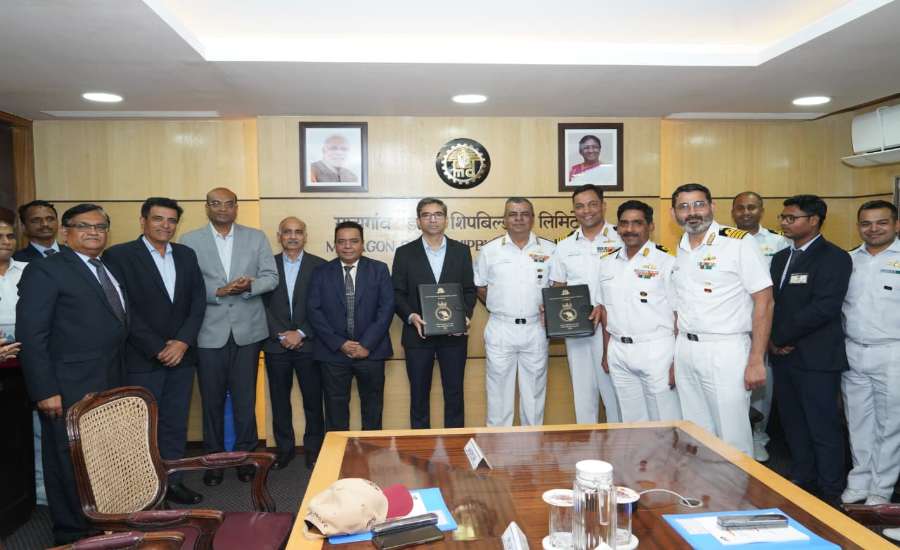
Moreover, the project maintains a high level of domestic input — around 75% indigenous content — in line with the government’s push for self-reliant defence manufacturing. Over 200 MSMEs (Micro, Small & Medium Enterprises) participated in the supply chain, generating roughly 4,000 direct jobs and over 10,000 indirect employment opportunities.
The delivery also signals progress on the broader P-17A program: out of seven planned Nilgiri-class frigates, Taragiri is the fourth to be delivered — and currently the third built by MDL. The remaining vessels (one at MDL and two at Garden Reach Shipbuilders & Engineers Ltd — GRSE) are slated for progressive delivery by August 2026.
Strategic Significance of Project 17A
Enhanced Maritime Security & Deterrence: With its stealth, long-range strike capabilities (BrahMos), and strong air and anti-submarine defence — Taragiri adds a formidable layer to India’s maritime deterrence posture, vital amid rising strategic competition in the Indian Ocean Region (IOR).
Force Multiplier for Task Forces: As part of a future Carrier Battle Group (CBG) or other naval task forces, such frigates provide escort, air defence, surface strike and ASW cover — enabling flexible mission profiles from peacetime presence deployments to high-intensity conflict roles.
Accelerated Indigenous Warship Capability: The pace and quality of construction reflect a maturing domestic shipbuilding ecosystem. High indigenisation content also strengthens supply-chain resilience and supports defence-industrial growth, especially among MSMEs.
Symbol of ‘Aatmanirbhar Bharat’ in Defence: Taragiri exemplifies the government’s push for self-reliance in defence manufacturing, reducing dependency on foreign suppliers for critical platforms.
What’s Next: The Road Ahead for Project 17A
- The P-17A programme is now more than halfway complete. Remaining ships are on track for delivery by mid-2026.
- Once all seven ships are operational, the Indian Navy’s surface combat cadre will see a major modernization, with more stealth-enabled, multi-mission frigates replacing aging vessels.
- The experience and infrastructure built during P-17A construction — from modular shipbuilding methods to MSME participation — could pave the way for future indigenous projects like the expected upcoming Project 17B frigate series.
About Mazagon Dock Shipbuilders Ltd
Mazagon Dock Shipbuilders Ltd (MDL) is India’s premier warship and submarine-building shipyard, located in Mumbai. Established in 1934, MDL has grown into the country’s leading defence public sector undertaking (DPSU) specializing in complex naval platforms.
It has delivered frontline warships including destroyers, frigates, corvettes, and advanced submarines to the Indian Navy. MDL plays a pivotal role in India’s maritime self-reliance under Aatmanirbhar Bharat, with strong indigenous capability and collaboration with hundreds of MSMEs.
Renowned for its quality, innovation, and modular construction techniques, MDL continues to strengthen India’s naval modernisation program.