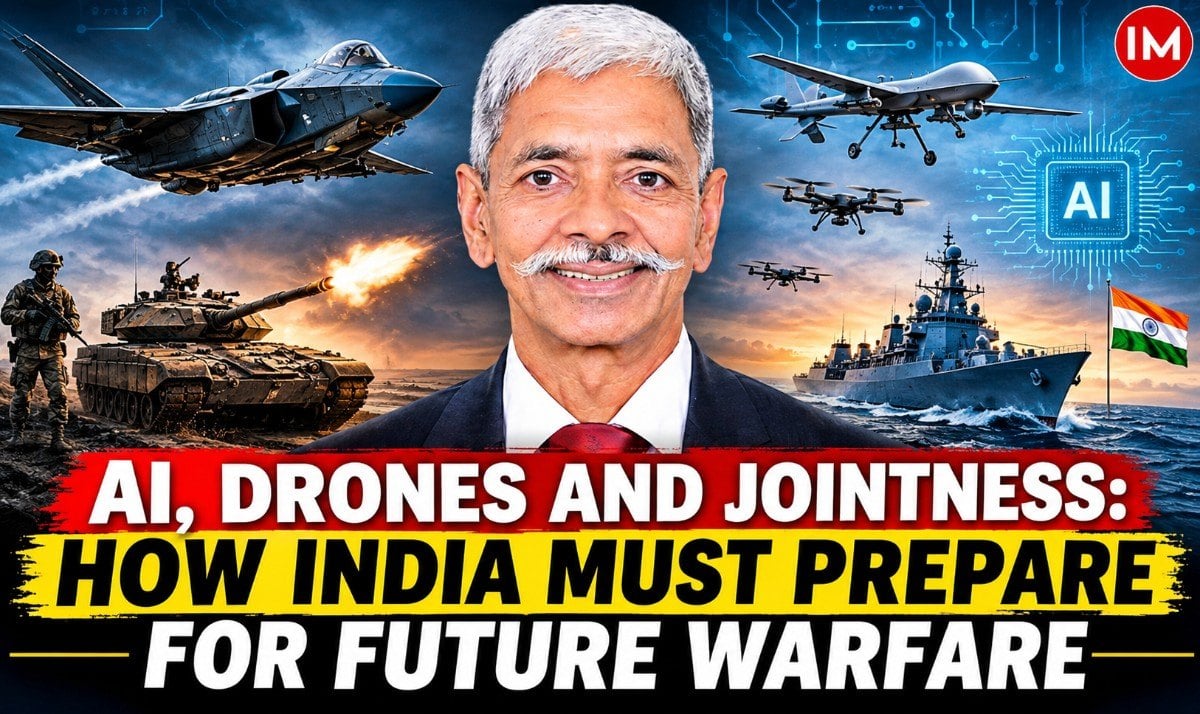
A country may possess sophisticated fighter aircraft, missiles, warships and surveillance systems. Yet, if its intelligence networks cannot connect, its communications can be disrupted and its forces cannot operate together, how much of that military strength can it actually bring to bear?
This is the question India must confront.
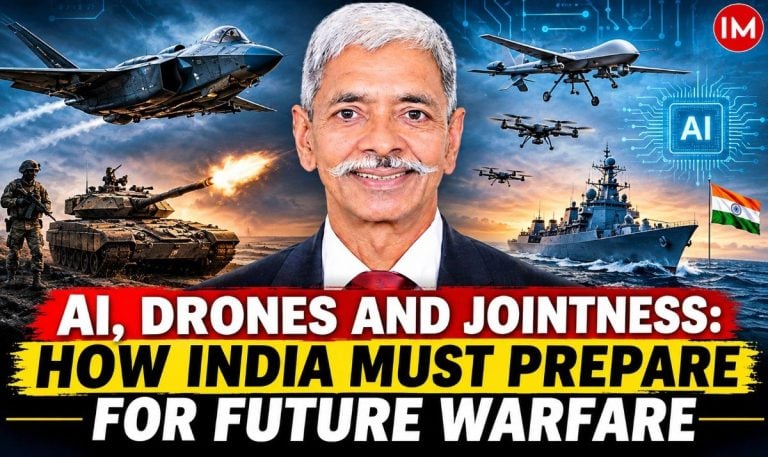
The character of warfare is changing faster than many military institutions can adapt. The battlefield is no longer confined to land, sea and air. It extends into cyberspace, the electromagnetic spectrum, space and the information domain. Artificial intelligence, unmanned platforms, precision weapons and real-time intelligence are changing how wars are fought and, more importantly, how they can be prevented.
For India, the challenge is not simply to acquire better weapons. It is to build a military capability that can identify a threat early, make decisions faster, integrate its forces and impose costs on an adversary before a conflict escalates.
In military terms, the objective must be to win the war before the first shot is fired.
The warning from contemporary conflicts
The Russia-Ukraine war has demonstrated how drones, electronic warfare, precision strikes and intelligence networks can influence battlefield outcomes. The conflicts in West Asia have reinforced another lesson: relatively inexpensive unmanned systems can challenge sophisticated air-defence networks and impose disproportionate costs on an opponent.
The traditional equation between military expenditure and battlefield advantage is being questioned.
Also Read – India’s Per-Capita Emissions Argument: A Case for Climate Justice or an Excuse for Inaction?
A costly weapon system can be threatened by a relatively inexpensive drone. A well-defended installation can become vulnerable if its surveillance and communication networks are compromised. The ability to detect, interpret and respond to a threat is becoming as important as the firepower available to destroy it.
India cannot afford to view these developments as distant lessons.
Operation Sindoor reinforced the importance of intelligence, precision engagement, layered air defence and coordinated operational responses. It also underlined the need to anticipate an adversary’s next move rather than remain confined to reacting to the previous one.
Sun Tzu’s enduring lesson remains relevant: victory is shaped by preparation and positioning well before armies engage.
The Air Force has sent an important signal
The Air Force Commanders’ Conference held in New Delhi on 12 November 2026 deserves attention beyond the Air Force itself.
Defence Minister Rajnath Singh emphasised technological superiority, intelligence and surveillance, jointness and the importance of maintaining the element of surprise. He also launched indigenous artificial intelligence applications developed by the Indian Air Force’s UDAAN initiative for operational, administrative and aerospace safety applications. These applications operate on the IAF’s secure network.
This is a meaningful development. It demonstrates that AI is moving beyond experimentation towards practical institutional application.
But the larger opportunity lies ahead.
AI must increasingly support intelligence assessment, threat identification, predictive maintenance, logistics planning, surveillance and faster decision-making. Its role should not be restricted to automating routine administrative processes.
There is, however, a caution. Artificial intelligence must strengthen military judgement, not replace it. Commanders must retain the ability to question machine-generated assessments, recognise deception and exercise independent judgement when technology fails.
A military that becomes dependent on algorithms without developing human expertise could create a new vulnerability.
Drones have changed the cost of warfare
The growing use of unmanned aerial systems presents a challenge that India must address at scale.
Surveillance drones, loitering munitions and autonomous systems have changed the economics of battlefield operations. They offer persistence, reach and relatively low-cost precision. They also expose conventional military installations, logistics columns and critical infrastructure to new forms of attack.
India therefore needs an integrated counter-drone architecture.
Detection, identification, jamming, interception and destruction must operate as part of a common system. No single weapon or sensor can provide a complete answer.
My recent analysis published in the Business Standard Blueprint ( November Edition) – “We Should Get a Counter UAS Soon” highlights the changing character of warfare and demands a fundamental rethink of India’s air-defence preparedness.
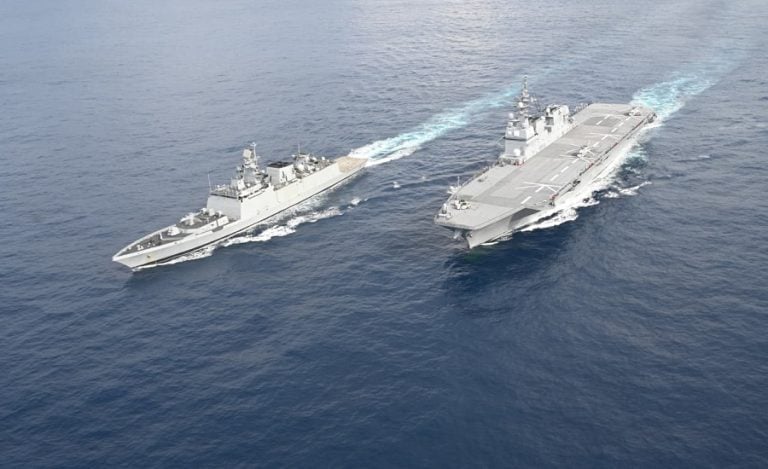
The Army, Navy and Air Force must develop common operating procedures while retaining capabilities suited to their respective operational environments.
Equally important is indigenous production. Indian start-ups, defence manufacturers and research institutions should be encouraged to develop affordable drones, navigation systems, secure communication links, swarm technologies and counter-UAS solutions.
The opportunity for Indian industry is substantial. But production numbers alone cannot be the measure of success. Reliability, interoperability, electronic resilience and operational performance must determine induction.
Integration must replace institutional silos
One of India’s most important military reforms must be a shift from individual Service excellence to integrated combat effectiveness.
The three Services have developed considerable professional competence. Yet future operations will increasingly demand simultaneous action across multiple domains.
Consider a possible operational situation. A satellite identifies unusual activity. An unmanned platform develops the surveillance picture. Ground-based radar confirms the threat. Intelligence agencies assess its significance. Command networks distribute the information, and the appropriate Service responds.
How quickly can this entire chain function?
The answer will depend on interoperability, secure communications, common data standards and clearly defined command responsibilities.
Jointness cannot remain a conference theme or an organisational aspiration. It must become an operational habit.
Theatre-level integration, common intelligence architecture, joint planning and coordinated logistics deserve sustained attention. So does the difficult business of aligning Service-specific requirements with national military objectives.
This is not about reducing the importance of individual Services. It is about ensuring that their capabilities produce a combined effect greater than the sum of their parts.
India’s indigenous capability must move faster
Recent developments offer encouraging signs.
The successful flight test of the indigenously developed Pralay quasi-ballistic missile on 5 November 2026, as part of user evaluation trials, is one such milestone. DRDO confirmed that all test objectives were achieved, with Bharat Dynamics Limited participating as a development-cum-production partner. The Ministry of Defence indicated that induction had become imminent.
Similarly, the government’s November 2026 contracts for eight Next Generation Corvettes, to be designed by the Indian Navy and constructed by GRSE and Goa Shipyard, demonstrate the growing role of domestic industrial capability in naval modernisation.
India needs to move beyond assembling individual platforms towards owning the technologies, software, sensors, electronic components and systems integration that make them operationally effective.
DRDO must remain central to this effort, but its role should increasingly include connecting research with industry, supporting technology transfer, enabling testing and helping Indian manufacturers scale successful products.
The private sector, particularly smaller technology enterprises, must have a meaningful place in this ecosystem. Government procurement should reward innovation, reliability and timely delivery rather than simply the completion of contractual milestones.
Training and doctrine must catch up
Technology without trained people is an expensive liability.
The next generation of military personnel must understand data interpretation, unmanned operations, electronic warfare, cyber security, AI-assisted decision-making and operations in a contested electromagnetic environment.
Training institutions must adapt accordingly. Simulators, joint exercises, red-team assessments and realistic electronic-warfare scenarios should become integral to professional military education.
Commanders must learn to operate when communication links are disrupted, intelligence is incomplete and automated systems produce conflicting assessments.
There is also a doctrinal issue.
India’s military planning must move from a predominantly platform-oriented approach towards integrated, multi-domain operations. This requires a doctrine that combines conventional deterrence with information superiority, technological adaptability, precision response and the ability to sustain operations under disruption.
We must also prepare for ambiguity. Not every conflict will begin with a formal declaration of war. Cyberattacks, disinformation, economic coercion and attacks on critical infrastructure may precede or accompany conventional military action.
The distinction between peace and conflict is becoming less clear.
Preparedness is a national responsibility
Having served in the Indian Army for 36 years, I have seen that operational success rarely depends on one weapon or one commander. It comes from the coordination of men, equipment, intelligence, logistics, training and leadership.
A well-equipped formation can still become ineffective if its communication network fails or its logistics chain breaks down.
The same principle applies at the national level.
Defence preparedness must involve government, industry, academia, scientific institutions and the Armed Forces. Critical infrastructure, energy security, telecommunications, semiconductor capability and domestic manufacturing are all connected to national security.
Indian companies entering the defence ecosystem must understand that they are not merely supplying equipment. They are contributing to national resilience.
Boards and corporate leadership must therefore factor defence supply-chain security, cyber resilience, technology dependencies and continuity of operations into their governance priorities.
The real test lies ahead
India does not need to replicate every military technology developed elsewhere. Nor should self-reliance become an argument for technological isolation.
We need carefully chosen international partnerships, but these must strengthen domestic capability and preserve freedom of action.
The larger task is to build a military that can see further, decide faster, operate jointly and sustain itself under pressure.
The next conflict may be decided by intelligence before a missile is launched, by electronic warfare before an aircraft enters contested airspace, or by a disrupted supply chain before troops reach the battlefield.
That is why India’s next strategic challenge is not simply to prepare for war. It is to develop the capability to deter aggression, deny an adversary the advantage of surprise and prevail if deterrence fails.
The strongest military is not necessarily the one that fires first. It is the one that has prepared so thoroughly that the adversary finds little opportunity to strike.
India must build that capability now. Not when the crisis arrives, but well before it.
About the Author – (Colonel M V Shashidhar (Retd) is a military veteran with over three decades of professional experience and frontline command exposure. He is a Defence and Strategic Affairs Expert, an IICA-certified Independent Director, an ESG Advocate and a Governance Thought Leader.)
Disclaimer—(The views and opinions expressed in this article are solely those of the author and do not necessarily reflect the views of Indian Masterminds. For feedback or queries, please write to [email protected].)
Also Read – Meet the Former IPS Officer Who Left Policing, Studied at Wharton and Became an Entrepreneur