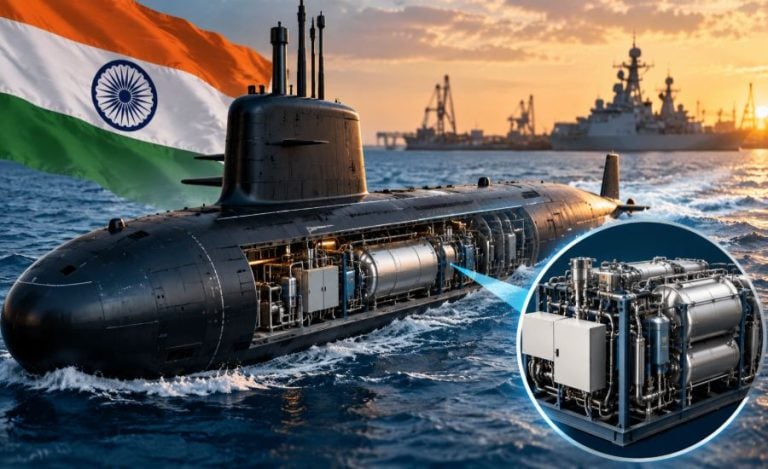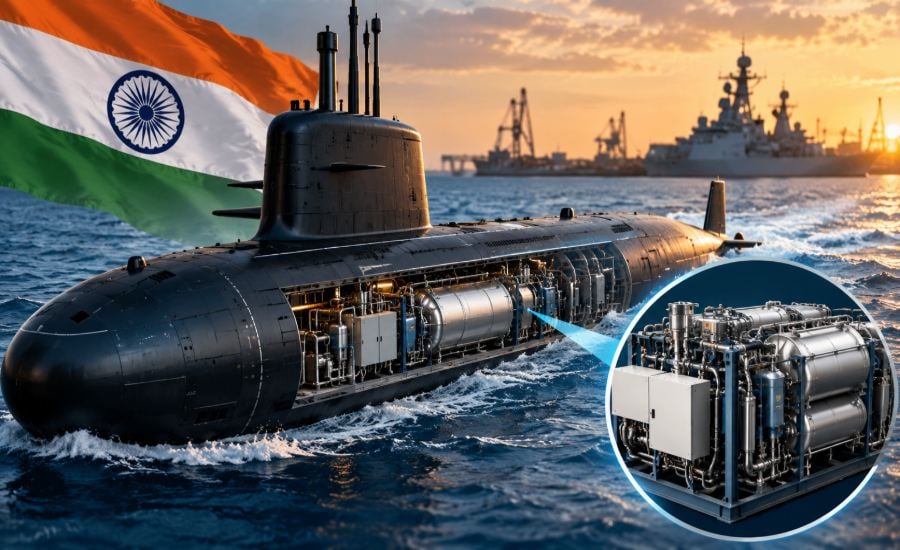
New Delhi: India’s indigenous Air Independent Propulsion system for Navy submarines has entered a new phase of testing. The system is designed to help Indian Navy diesel-electric submarines stay underwater for longer periods without depending on atmospheric oxygen.
The Defence Research and Development Organisation (DRDO) has developed the technology through its Naval Materials Research Laboratory (NMRL). The latest development is an important step towards improving India’s underwater defence capabilities.
Latest Update on Indigenous Air Independent Propulsion System
The Indian Navy’s indigenous AIP system reached a major milestone on October 24, 2026, with the inauguration of the Setting To Work Phase-2 (STW-2) activity. The event took place at Larsen & Toubro’s AM Naik Heavy Engineering Complex in Hazira, Gujarat.
Read also: How Indian Navy is Planning to Counter Advanced Drone Threats
The energy module of the AIP system is being prepared for power generation and further testing. This phase will help check the system’s performance before its planned installation on a submarine.
What Is The Indigenous Air Independent Propulsion System
Air Independent Propulsion (AIP) is a technology that allows conventional diesel-electric submarines to generate power underwater without regularly depending on outside air. Normally, diesel-electric submarines need atmospheric oxygen to run their diesel engines and recharge their batteries.
An AIP system reduces this dependence and helps submarines remain underwater for longer periods. This can improve their ability to operate quietly and reduce the need to surface or use a snorkel.
DRDO Develops AIP Technology For Indian Navy
The indigenous AIP system has been developed by the Naval Materials Research Laboratory (NMRL), which works under the Defence Research and Development Organisation. The technology is designed to improve the underwater endurance of conventional submarines.
The programme brings together DRDO’s scientific research, industrial manufacturing and the Indian Navy’s operational requirements. It is also part of India’s wider effort to develop important defence technologies within the country.
Defence Secretary Inaugurates Indigenous Air Independent Propulsion System Phase-2 Activity
Defence Secretary Rajesh Kumar Singh inaugurated the Setting To Work Phase-2 activity virtually. He also holds additional responsibilities as the Chairman of DRDO and Secretary of the Department of Defence Research and Development.
Vice Admiral B. Sivakumar, Chief of Materiel of the Indian Navy, and Dr R. Balamuralikrishnan, Director General of Naval Systems and Materials at DRDO, attended the event at Hazira.
The Defence Secretary congratulated DRDO scientists and industry partners for their work on the indigenous AIP programme. He also appreciated the Indian Navy’s support in testing and validating the system during different stages of development.
AIP Energy Module To Undergo Power Generation Tests
The next phase will focus on energising the AIP energy module for power production. The module will undergo detailed testing according to the Indian Navy’s safety and technical requirements.
These tests will help confirm whether the system can generate power safely and perform as expected. Special attention will be given to safety because the technology involves hydrogen and fuel-cell systems.
Kalvari-Class Submarine Integration Planned For 2027
After successful completion of the required tests, the AIP energy module is expected to be handed over to Mazagon Dock Shipbuilders Limited (MDL). The system is planned for integration into a Kalvari-class submarine in early 2027.
The integration will be an important step towards bringing the indigenous AIP technology closer to use by the Indian Navy. However, the system must complete the required testing and integration process before it can become operational.
How Indigenous Air Independent Propulsion System Can Improve Submarine Operations
The indigenous AIP system is expected to improve the underwater endurance of Indian Navy submarines. By reducing dependence on atmospheric oxygen, it can help submarines remain submerged for longer periods.
This can reduce the need for frequent snorkeling and improve their ability to operate without exposing themselves unnecessarily. The technology is also expected to strengthen the Navy’s underwater operational capabilities.
Read also: DRDO IRDE Telescope Project: Key Features, Specifications And Mission Explained
FAQs
The indigenous AIP system has been developed by the Naval Materials Research Laboratory (NMRL), which operates under the Defence Research and Development Organisation (DRDO).
India’s indigenous AIP system is a technology developed by DRDO’s Naval Materials Research Laboratory. It helps diesel-electric submarines generate power underwater and remain submerged for longer periods.
The AIP energy module is expected to undergo power generation tests before being handed over to Mazagon Dock Shipbuilders Limited for planned integration with a Kalvari-class submarine in early 2027.