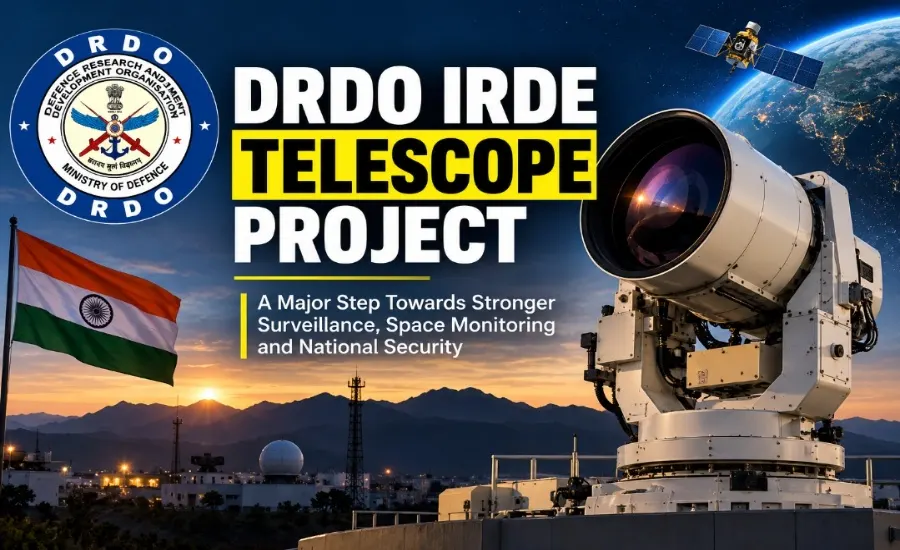
New Delhi: India is taking another step towards strengthening its space surveillance capabilities. The Defence Research and Development Organisation (DRDO), through its Instruments Research & Development Establishment (IRDE), is developing an indigenous ultra-wide field telescope array for space surveillance.
The system is designed to detect and track objects in Earth’s orbit, including satellites and space debris. The project aims to improve India’s ability to monitor activity in space and strengthen its domestic defence technology capabilities.
Details of DRDO IRDE Telescope Project
The telescope array is being developed to observe a wide area of the sky and track objects moving around Earth. According to the report published on October 19, 2026, the project involves an industry partner that will manufacture the optical systems under IRDE’s design review and technical supervision.
Read also: How DRDO’s New 500-Watt Laser Technology That Could Make Indian Missiles More Deadly
The system is expected to support India’s growing need for reliable space surveillance as more satellites and other objects enter Earth’s orbit.
How The DRDO IRDE Telescope Project Will Work
The proposed telescope array will combine several optical instruments to observe a large section of the sky. Its wide viewing area is intended to help identify and track orbital objects more efficiently.
Four Reflective Telescopes In Each System
According to the report, each telescope system will include four off-axis reflective telescopes, each with a 250 mm aperture and an f/1.64 optical design.
These telescopes are designed to provide a wide field of view of approximately 12 degrees. This could allow the system to monitor a larger portion of the sky than a narrow-field telescope.
Additional Refractive Telescopes
Each system will also include two 50 mm refractive telescopes. These instruments will provide a field of view of approximately 48 degrees.
The wider viewing area is intended to support broad-area sky monitoring and the rapid detection of orbital objects.
Visible And Infrared Observation
The optical design reportedly includes a dichroic beam splitter. This component separates visible light from short-wave infrared (SWIR) light.
Using these two wavelength ranges could allow the system to collect different types of optical information under varying lighting conditions. It may also help improve object detection and tracking.
Why Space Surveillance Is Important For India
Space surveillance, also known as Space Situational Awareness (SSA), involves detecting, identifying and tracking objects in space.
It is important because satellites support communication, navigation, weather forecasting, national security and many other essential services.
As the number of satellites increases, monitoring their movements becomes more important for identifying possible collision risks and understanding activity in Earth’s orbit.
Tracking Satellites And Space Debris
Satellites and space debris travel at high speeds. Even small fragments can damage or destroy an operational spacecraft during a collision.
A capable ground-based telescope network can help identify objects, follow their movements and provide information that supports orbital monitoring and collision-risk assessment.
Supporting India’s Space Security
Indigenous surveillance systems could help India develop its own space-monitoring capabilities and reduce dependence on external tracking resources.
DRDO’s official technology information identifies space situational awareness as an area that includes optical sensors and technologies for detecting and tracking satellites in low Earth orbit.
The new telescope array could support this broader national objective if it completes development and enters operational service.
DRDO IRDE Telescope Project Timeline And Development Plan
The report outlines a phased development schedule for the telescope array.
- Prototype Delivery: One prototype system is expected within 18 months of the contract award.
- Operational System: A fully functional operational unit is planned for the 24-month mark.
- Industrial Partnership: An industry partner will manufacture the optical systems under IRDE’s technical oversight.
These timelines are reported project targets. They should not be interpreted as confirmation that the telescope array is already operational.
FAQs
The purpose is to observe orbital objects, monitor their movements and improve space situational awareness. Such systems can support satellite monitoring, space security and the assessment of potential collision risks.
DRDO’s reported telescope array is a ground-based optical surveillance system being developed by IRDE to detect and track objects in Earth’s orbit, including satellites and space debris.
According to the report, a prototype is expected within 18 months of the contract award, followed by a fully functional operational unit at the 24-month mark. The schedule is a reported target, not confirmation of operational deployment.