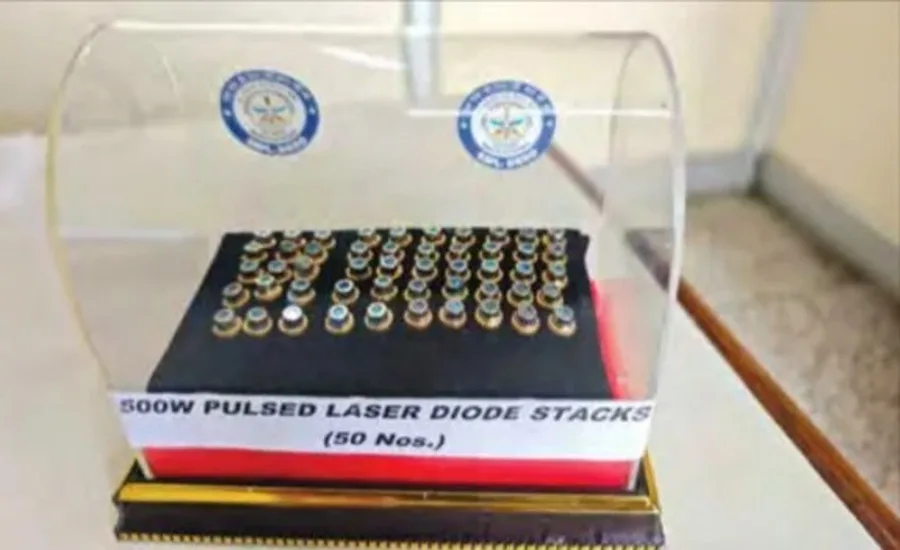
New Delhi: India has achieved a major defence technology milestone as DRDO developed the 500-Watt pulsed laser diode stacks for QRSAM And NGARM missile systems. The development strengthens the country’s indigenous missile capabilities and supports the government’s push for self-reliance in critical defence technologies. The achievement was announced through official DRDO sources and involves advanced laser components that will be used in modern missile proximity fuzes.
The technology has been developed by the Solid State Physics Laboratory (SSPL), a DRDO laboratory based in Delhi. The newly developed laser diode stacks are expected to enhance the effectiveness and precision of Indian missile systems.
Details of DRDO 500-Watt Pulsed Laser Diode Stacks
The Solid State Physics Laboratory (SSPL) has successfully designed and packaged 500-watt pulsed laser diode stacks operating at a wavelength of 905 nanometres (nm). These are high-power laser components used in advanced laser proximity fuze systems.
According to DRDO, these laser diode stacks are critical for the functioning of proximity fuzes used in several missile systems, including the Quick Reaction Surface-to-Air Missile (QRSAM) and the Next-Generation Anti-Radiation Missile (NGARM).
What Is A Laser Proximity Fuze
A laser proximity fuze is an electronic system that helps a missile determine how close it is to a target.
The fuze emits laser beams and measures the reflected signals from the target. Based on this information, the missile can calculate the ideal moment to detonate its warhead.
Why It Is Important
This technology allows a missile to explode at the most effective distance rather than requiring a direct hit. As a result, the chances of destroying fast-moving aircraft, drones, radar systems, and other airborne threats increase significantly.
DRDO 500-Watt Pulsed Laser Diode Stacks: Support For QRSAM And NGARM Programmes
The Quick Reaction Surface-to-Air Missile (QRSAM) is an indigenous air defence system developed by DRDO for the Indian Army. It is designed to quickly detect, track, and engage aerial threats under all-weather conditions.
NGARM Missile System
The Next-Generation Anti-Radiation Missile (NGARM), also known as Rudram, is designed to destroy enemy radar installations and air defence systems. The new laser diode stacks will contribute to improving the missile’s fuze performance and operational effectiveness.
Prototype Delivery To IRDE
As part of the development programme, SSPL has delivered 50 prototype laser diode stacks to the Instruments Research and Development Establishment (IRDE) in Dehradun. The prototypes will undergo detailed trials and evaluation before their integration into operational systems.
Official Handover Ceremony
The delivery ceremony was attended by senior scientists from both laboratories. The exchange took place between Dr. Anesh Kumar Sharma, Director of SSPL, and Dr. Ajay Kumar, Director of IRDE, in the presence of senior DRDO officials and scientists.
Advanced Engineering Behind The DRDO 500-Watt Pulsed Laser Diode Stacks
The 500-watt output has been achieved by stacking multiple laser diode chips together in a compact configuration. This design enables the system to generate high-power laser pulses while maintaining reliability and efficiency. The components have undergone extensive characterisation and testing to ensure consistent performance under demanding operational conditions.
What is the Importance of DRDO 500-Watt Pulsed Laser Diode Stacks
The successful development reduces dependence on imported defence technologies. It strengthens India’s ability to manufacture critical missile components within the country and supports the vision of Aatmanirbhar Bharat in defence production.
Better Missile Performance
High-quality proximity fuzes play a vital role in missile effectiveness. The indigenous laser diode stacks are expected to improve target engagement accuracy and increase the operational capability of future missile systems.
Read also: How DRDO Plans To Build India’s Next-Generation Electronic Warfare Edge through SHIELD Program
FAQs
A laser proximity fuze measures the distance between a missile and its target and triggers detonation at the most effective point for maximum damage.
DRDO’s Solid State Physics Laboratory has developed 500-watt pulsed laser diode stacks that will be used in laser proximity fuzes for QRSAM, NGARM, and other missile systems.
The Instruments Research and Development Establishment (IRDE) in Dehradun received 50 prototype laser diode stacks for trials and evaluation.