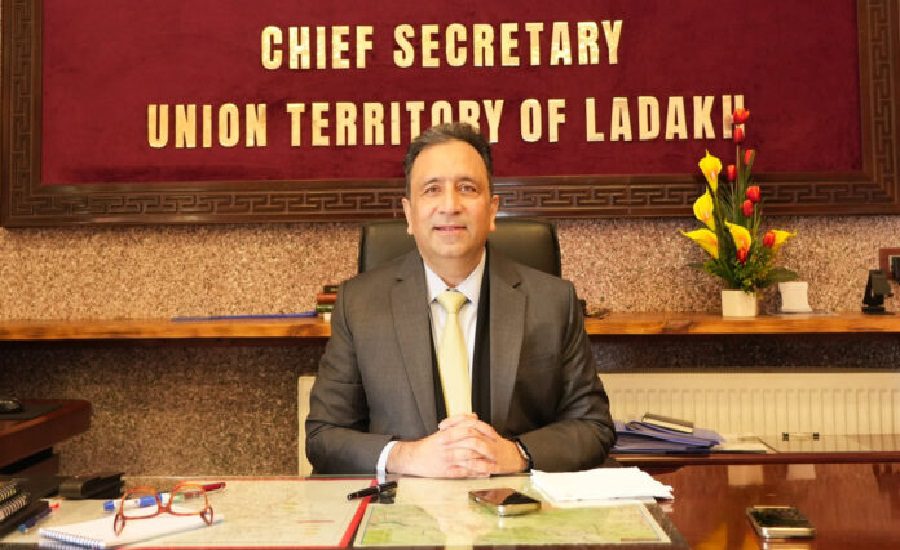
Leh: Ladakh Chief Secretary Ashish Kundra, an IAS officer of 1996 batch, has highlighted infrastructure projects worth approximately ₹3,350 crore dedicated to the Union Territory by Prime Minister Narendra Modi on October 15, while outlining significant progress in discussions with the Ministry of Home Affairs (MHA) over constitutional safeguards and a proposed democratic framework for the region.
Addressing the developments, Mr Kundra said the infrastructure initiatives would strengthen connectivity, power generation, water conservation and public services across Ladakh. He also described the ongoing discussions between Ladakh’s representatives and the Central Government as constructive, with a detailed framework document shared by the MHA on October 16.
The proposed framework envisages a two-stage process involving a constitutional amendment followed by a regulation under Article 240 of the Constitution. It includes provisions under consideration for a directly elected Union Territory-level body and safeguards relating to land, natural resources and cultural identity.
However, the Chief Secretary clarified that the document is intended to facilitate further consultations and does not represent a finalised legislative arrangement.
₹3,350 Crore Infrastructure Projects Dedicated to Ladakh
Mr Kundra said infrastructure projects worth approximately ₹3,350 crore were dedicated to the people of Ladakh during the Prime Minister’s programme on October 15.
Around 10,000 people from all seven districts of Ladakh participated virtually in the event, reflecting the geographical reach of the initiatives.
The projects cover important sectors, including aviation, road connectivity and renewable energy, with the objective of improving accessibility and supporting economic development in the mountainous Union Territory.
The Chief Secretary said these developments were particularly important given Ladakh’s challenging terrain, remote settlements and dependence on reliable transport and energy infrastructure.
Leh Airport Terminal Completed at ₹640 Crore, Flight Operations Begin
Among the major achievements highlighted was the completion of the new Leh Airport Terminal, developed at an estimated cost of ₹640 crore.
According to the Chief Secretary, flight operations from the terminal commenced on October 16, a day after the infrastructure projects were dedicated to the region.
The terminal is expected to strengthen air connectivity and improve passenger facilities in Leh, which serves as an important gateway to Ladakh.
Improved aviation infrastructure is especially significant for the region because difficult terrain and seasonal weather conditions can affect surface connectivity.
Zanskar Connectivity Improves: Leh Travel Time Reduced from 12 Hours to Three
Another major development highlighted by Mr Kundra was the improvement in connectivity between Leh and Zanskar.
According to the Chief Secretary, the travel time between the two locations has been reduced from nearly 12 hours to approximately three hours.
The improvement represents a substantial change in accessibility for residents of Zanskar, a region where difficult terrain and long journeys have historically posed challenges.
Better road connectivity is expected to facilitate movement for residents, improve access to services and support tourism and economic activities.
9 MW Hanu Hydropower Project Commissioned, Combined Capacity Reaches 18 MW
The Chief Secretary also highlighted the commissioning of the 9 MW Hanu Hydropower Project.
With this development, the combined installed capacity of the Dha and Hanu hydropower projects has reached 18 MW.
The additional generation capacity is an important step towards strengthening Ladakh’s energy infrastructure and supporting electricity availability in remote areas.
Given the Union Territory’s geographical conditions, the development of locally available energy resources remains an important component of infrastructure planning.
Amrit Sarovars Increased from 40 to 100 Across Ladakh
Water conservation was another major focus of the Chief Secretary’s remarks.
Mr Kundra said that, responding to public demand, the Lieutenant Governor had directed an increase in the number of Amrit Sarovars planned across Ladakh from 40 to 100.
The decision reflects the importance of water conservation and sustainable resource management in the region.
The expansion of the initiative is intended to strengthen water conservation efforts across different parts of the Union Territory.
The Chief Secretary also highlighted the Petroglyph Park along the Indus as an important initiative for preserving and showcasing Ladakh’s archaeological heritage.
The park is intended to draw attention to the region’s historical connections with the Silk Route and its rich cultural legacy.
MHA Shares Constitutional Safeguards Framework with Ladakh Representatives
Alongside the infrastructure achievements, Mr Kundra provided an update on the ongoing discussions between the Ministry of Home Affairs and representatives of Ladakh concerning constitutional safeguards and democratic representation.
He described the successive meetings as constructive and said they had resulted in tangible progress towards addressing the aspirations of the people.
Following discussions held on October 15, the MHA shared a detailed framework document with Ladakh’s representatives on October 16.
The document outlines a possible institutional arrangement for the Union Territory, including provisions for a directly elected body at the UT level and safeguards concerning land, natural resources, culture and other matters raised during the discussions.
Mr Kundra stressed that the framework remains a proposal and requires further examination and deliberation.
Constitutional Amendment and Article 240 Regulation Proposed
According to the Chief Secretary, the framework shared by the MHA envisages a two-stage approach.
The first stage would involve a constitutional amendment, while the second would provide for a subsequent regulation under Article 240 of the Constitution.
Article 240 empowers the President to make regulations for the peace, progress and good government of specified Union Territories, including Ladakh, subject to constitutional provisions.
The proposed arrangement is intended to address demands for democratic representation and constitutional protections while taking into account Ladakh’s distinctive administrative and geographical circumstances.
However, Mr Kundra clarified that the proposed constitutional provisions and subsequent regulatory framework would have to undergo detailed scrutiny before any final decision.
The sharing of the document does not mean that a constitutional amendment has been passed or that the proposed elected body has been formally established.
What Will Ladakh’s Proposed Elected UT-Level Body Look Like?
One of the most important elements of the proposed framework is the possibility of establishing a directly elected body at the Union Territory level.
However, the Chief Secretary said several institutional questions remain unresolved.
These include the name and composition of the proposed body, the method of election and the representation of women and underrepresented communities.
Other issues requiring examination include whether the body should have nominated or ex-officio members, which authority would conduct its elections and how constituencies would be delimited.
Questions relating to electoral rolls, the tenure of elected representatives and the relationship between the proposed institution and existing local bodies also remain open.
Particular attention would need to be given to its relationship with the Ladakh Autonomous Hill Development Councils (LAHDCs), Panchayats and municipalities.
Mr Kundra said these issues require detailed discussions to ensure that any new institution operates within a clear and workable administrative framework.
Ladakh’s Scheduled Tribe Reservation Increased to 84%
The Chief Secretary also outlined measures already undertaken by the Central Government in response to the aspirations of Ladakh’s residents.
Among these, he highlighted the enhancement of Scheduled Tribe reservation to 84 per cent.
The measure was presented as an important step towards addressing the representation of tribal communities in the Union Territory.
Mr Kundra also referred to recruitment through UPSC for Group A medical posts.
According to the figures shared, 107 local candidates were recruited against 109 Group A doctor vacancies, reflecting the emphasis on local participation in government services.
Bhoti and Purgi Recognised as Official Languages
The Chief Secretary highlighted the recognition of Bhoti and Purgi as official languages as another significant development.
Language recognition is an important issue in Ladakh, where cultural preservation and the protection of local identity have been central to discussions over constitutional safeguards.
The recognition of these languages was presented as part of the measures undertaken to address the cultural aspirations of the region’s people.
Mr Kundra also pointed to the provision of one-third reservation for women in the Ladakh Autonomous Hill Development Councils.
The measure aims to strengthen women’s representation in local democratic institutions and increase their participation in decision-making.
High Court Bench Established in Leh to Improve Access to Justice
Another significant development highlighted by the Chief Secretary was the establishment of a High Court Bench in Leh.
Mr Kundra described the initiative as a major milestone in improving access to justice for the people of Ladakh.
The occasion was attended by the Chief Justice and judges of the High Court of Jammu & Kashmir and Ladakh, along with the Attorney General of India.
According to the Chief Secretary, the initiative was operationalised within a period of two months.
He said the presence of a High Court Bench in Leh would substantially reduce the need for litigants and other stakeholders to travel to Jammu or Srinagar to access High Court services.
Given Ladakh’s vast distances and difficult geographical conditions, the facility is expected to make judicial services more accessible to residents.
Mr Kundra described the initiative as a proactive measure by the Government of India, reflecting its sensitivity to the region’s geographical challenges and its commitment to bringing justice closer to the people.
Constitutional Safeguards Require Broad-Based Consensus: Ashish Kundra
While acknowledging the progress achieved in discussions with the Ministry of Home Affairs, the Chief Secretary emphasised that the remaining constitutional and institutional questions could not be resolved unilaterally.
He said a balanced and workable arrangement would require broad-based consensus among Ladakh’s political leadership, community representatives and other stakeholders.
The objective, he explained, was to develop a framework that reflects the democratic aspirations of the people while ensuring institutional clarity and accommodating Ladakh’s distinctive geographical, cultural and administrative circumstances.
Mr Kundra urged stakeholders to approach the ongoing consultations constructively and work towards mutually acceptable solutions.
He expressed hope that the outstanding issues would be addressed through continued dialogue over the coming weeks and months.
The developments outlined by the Chief Secretary indicate progress on two important fronts for Ladakh: infrastructure expansion aimed at improving everyday connectivity and services, and continuing negotiations over the region’s future democratic and constitutional arrangements.
While several infrastructure projects have already been completed or commissioned, the proposed constitutional framework remains under discussion, with its final structure dependent on further consultations and the necessary legal processes.
SEO Tags: