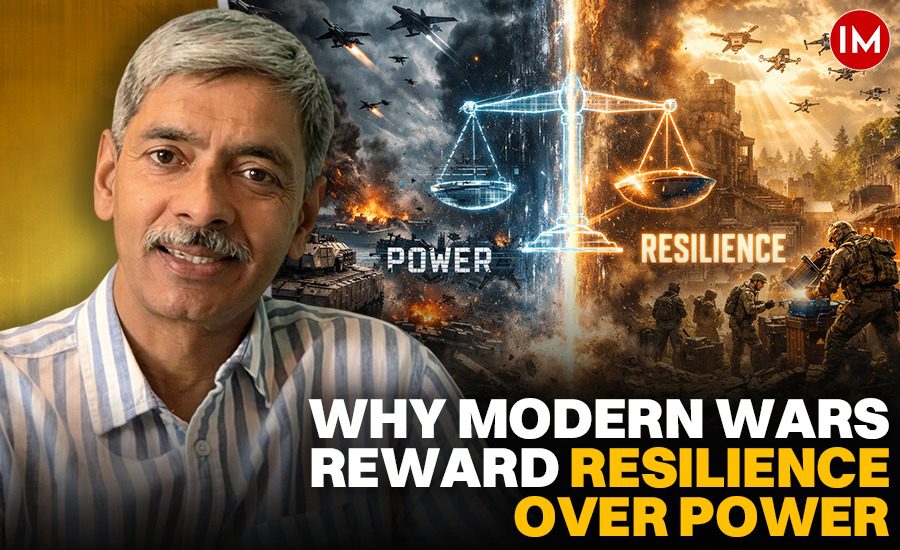
“Wars are no longer decided by who strikes first but by who keeps showing up after being hit.”
This uncomfortable truth now visible from the battered frontlines of Ukraine to the hardened strategic depth of Iran. The former now over four years and the latter just over forty days.
Both conflicts still far from finished.
Two conflicts. Different triggers. Different tempos. Yet, they converge on a single operational logic.
ADAPT SCALE SUSTAIN
Not as a slogan but as a survival architecture.
A SHIFT WE FAILED TO NOTICE UNTIL NOW
Did Ukraine and Iran plan this doctrine? The answer obviously is not.
They were forced into it.
Ukraine faced a much larger and better-equipped adversary. Iran on the other hand absorbed precision strikes from technologically superior coalitions. Neither had the luxury of conventional dominance.
So, did they do something more important. Yes, they changed the rules mid-conflict. And that’s where modern warfare is heading. Not linear campaigns. Not decisive battles. But continuous adaptation under fire.
UKRAINE : LEARNING WHILE BLEEDING
Ukraine’s early days were marked by urgency almost chaos, devastation, and confusion. A nation that was unable to stand to the might of a superior and formidable adversary . But here comes the pivot.
Instead of stabilizing first and innovating later, Ukraine did both simultaneously.
Commercial drones became tactical weapons. Software engineers became force multipliers. Feedback loops shortened drastically. What failed in the morning was fixed by evening. Never heard of any military doing it before? Right. Then came scale.
Ukraine did not aim for perfection. It aimed for volume with purpose. Thousands of low-cost drones began shaping the battlefield neutralizing armour, disrupting logistics, even influencing troop movement.
And sustainment?
DECENTRALIZATION
Units operated with autonomy. Supply chains diversified. Innovation was not top-down, it was everywhere. The result is telling. A conventionally weaker force not only survived but dragged a superior adversary into a prolonged contest of exhaustion.
IRAN : STABILITY UNDER SHOCK, STRATEGY UNDER PRESSURE
Iran’s test was different. It was not gradual. It was immediate, sudden, intense, and precise. Decapitation strikes. Strategic targeting. Signalling dominance. The expectation was disruption if not collapse.
But Iran absorbed the shock. That is the first layer of modern resilience—not retaliation, but stability under attack. Then came calibrated escalation. Missiles. Drone swarms. Distributed air defence. Proxy activation.
Iran did not seek dominance. It sought denial and persistence. So, how does a sanctioned state sustain conflict against superior adversaries? By redefining efficiency.
Iran scaled systems that were
- Good enough, not perfect.
- Replaceable, not precious.
- Indigenous, not dependent.
And sustainment?
DEATH AND DISPERSION
Underground facilities. Redundant command structures. Layered defence grids. Decentralised forces. The systems built not with an aim to win quickly but with an aim not to lose over time.
WHERE BOTH THEATRES CONVERGE
Ukraine and Iran are not allies. Their wars are not linked. Yet, their methods are converging.
That should interest every serious military planner and commander. Because it signals a structural shift.
Asymmetry is no longer a fallback option. It is a deliberate strategy.
Think about it.
- Why build expensive platforms that attract precision targeting?
- Why centralize when dispersion ensures survival?
- Why seek decisive victory when endurance guarantees leverage?
The logic is evolving from shock and awe to stretch, strain and exhaust.
THE ECONOMICS OF ATTRITION : A SILENT BATTLEFIELD
Modern war is no longer just kinetic. It is financial. A low-cost drone triggers high-end air defence. A dispersed attack forces wide-area surveillance. A sustained campaign erodes budgets, supply chains, and political patience. What then is the objective?
Not immediate victory.
But cumulative exhaustion and erosion. Over time, the stronger adversary pays more economically, operationally, psychologically. And that changes outcomes.
THE STRATEGIC QUESTIONS FOR INDIA
This is where it becomes uncomfortable for India. Because the lessons are not abstract. They are immediate.
1. Are we structurally designed to adapt during conflict or only before it?
Most systems are optimized for planning, not improvisation. That must change.
2. Are we investing enough in scalable, low-cost lethality?
Drones, loitering munitions, electronic warfare these are not add-ons anymore. They are central to future conflict.
3. Can we sustain high-intensity operations over extended durations?
Short wars are a comforting assumption. Not a reliable one.
4. Are our command structures flexible enough for distributed warfare?
Centralization offers control but also creates vulnerability.
5. Is our defence industrial base prepared for rapid replenishment?
Wars of endurance are won in factories as much as on battlefields.
Emerging Strategic Lessons for India
The practical lessons that emerge out of both the conflicts include-
Build for Learning, Not Just Fighting
India must institutionalize rapid battlefield feedback systems. AI integration, real-time analytics, adaptive doctrine cycles.
Mass Matters Again but differently
Not mass of troops or tanks but mass of affordable, deployable systems.
Resilience is the New Deterrence
Deterrence is shifting from punishment to the ability to absorb and resist.
Disperse to Survive
Airbases, logistics nodes, communication hubs must operate in distributed formats and be able to retaliate
Integrate Civil-Military Innovation
Ukraine’s biggest advantage came from this fusion. India’s startup ecosystem must plug directly into defence.
A DOCTRINAL REALITY CHECK
For decades, strategic thinking globally was influenced by rapid dominance models. Hard strike. Pulverize your adversary. Win and Exit But Ukraine and Iran of today have demonstrated something else.
Wars will be:
- Longer.
- Messier.
- Economically draining.
- Psychologically taxing.
Victory will not be a moment.
It will be a process of wearing the adversary down.
Today’s new military aphorism reads – In modern war, survival is the first victory. Adaptation is the second. Endurance is the final.”
FINAL FACT CHECKS
Ukraine adapted because it had to. Iran endured because it was forced to.
But both discovered something powerful.
You do not need to overpower a stronger adversary. You need to outlast his assumptions, outlearn his systems, and outprice his war.
That then will be the future of conflict. And if India reads this late, it will not be a strategic oversight but a strategic cost.