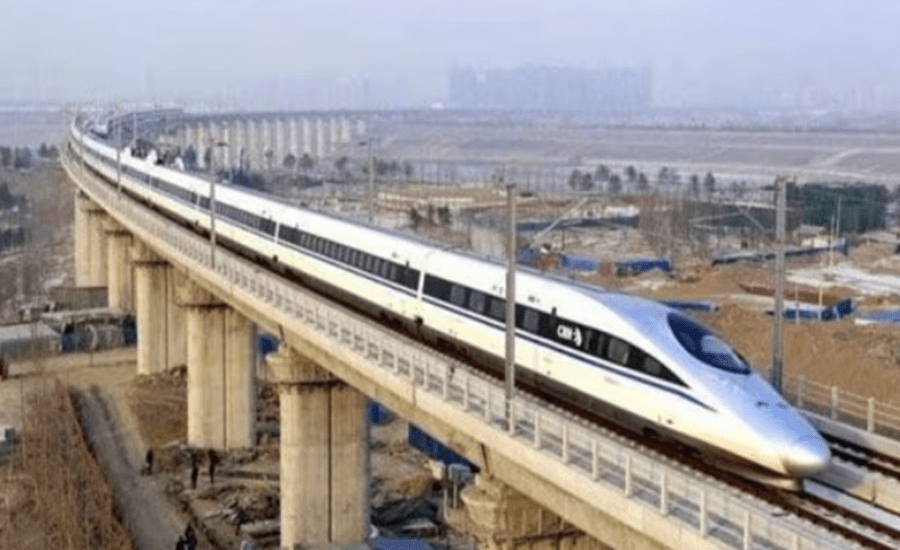
New Delhi: The Mumbai-Ahmedabad High Speed Rail (MAHSR) Project is not only India’s first bullet train corridor but also a transformative initiative building long-term domestic capability in high-speed rail (HSR) technology, manufacturing and operations.
The 508-km corridor, being executed with technical and financial assistance from the Government of Japan, is under active construction across Gujarat, Maharashtra and the Union Territory of Dadra & Nagar Haveli.
The update was shared by Union Minister for Railways, Information & Broadcasting and Electronics & Information Technology, Mr. Ashwini Vaishnaw, in a reply to questions in the Lok Sabha.
MAHSR: India’s First Bullet Train Corridor
The Mumbai-Ahmedabad High Speed Rail corridor will connect:
Mumbai, Thane, Virar, Boisar, Vapi, Billimora, Surat, Bharuch, Vadodara, Anand, Ahmedabad and Sabarmati.
The project:
- Spans 508 km
- Is constructed largely on elevated viaducts
- Is the only HSR project currently under execution in India
- Is supported technically and financially by Japan
So far, an expenditure of ₹86,939 crore has been incurred on the project as of December 31, 2025.
Experience from MAHSR to Power Future High-Speed Corridors
The government stated that the technical expertise being developed through the project in areas such as:
- Track construction
- Advanced signalling
- Rolling stock manufacturing and maintenance
- Project management
will provide a strong foundation for future high-speed rail corridors in India. The accumulated knowledge is expected to strengthen India’s planning and decision-making capabilities in the HSR sector.
Indigenisation and Capacity Building
A major focus of the project is strengthening domestic manufacturing under Make in India and Aatmanirbhar Bharat initiatives.
Key Indigenisation Achievements:
- Long-span steel truss girders are being fabricated in Indian workshops, supported by analytical modelling and field measurements.
- Heavy construction machinery for full-span launching has been indigenised and is now manufactured in India.
- Most slab track materials and specialized track machines are being developed domestically.
- Dynamic analysis and design variations are being handled by Indian agencies in collaboration with IITs, with advanced tools and design charts developed for long-term HSR capability.
Additionally, Integral Coach Factory (ICF), in collaboration with Bharat Earth Movers Limited (BEML), is designing and manufacturing high-speed train sets with a design speed of 280 kmph, building on the success of Vande Bharat trains.
Innovation in Construction and Engineering
The MAHSR project has introduced several engineering innovations in India:
- First-time adoption of full-span launching method for 40-metre prestressed box girders (~1000 MT), reducing launching time to about 16 hours.
- Indigenous noise barriers installed along the corridor.
- Advanced simulation tools for OHE-pantograph interaction and traction power supply modelling developed with IIT Delhi.
- Underground station designed with provision for a future 90-metre high building on the same foundation.
Indigenous Rail Turnover Prevention Device (RTPD) introduced to enhance derailment safety.
Training of Indian Engineers
Around 1,000 Indian engineers and skilled workers have been trained in Japanese high-speed rail methodology. Track works are currently being executed under their supervision.
A dedicated Special Track Training Facility has been set up at Surat for regular training and refresher courses.
Safety and Security Measures
The project incorporates global best practices in safety and structural design.
Key Safety Features:
- Structures designed as per international standards and validated by a Japanese High-Level Committee.
- Earthquake-resistant design with steel and damper stoppers on viaducts and bridges.
- Installation of an Earthquake Early Warning System (EQEWS).
- High-level security systems for operational areas and sensitive buildings.
HSR stations will feature:
- Controlled entry points
- Baggage scanners
- Door Frame Metal Detectors (DFMDs)
- CCTV surveillance
Station Design and Passenger Amenities
The 12 planned stations are being developed as modern city gateways reflecting local identity.
They include:
- Anti-vibration measures
- Wind-pressure management in station roofs
- Anti-vibration hangers and clamps
- Seamless multimodal connectivity
- Ample parking and drop-off areas
Sustainable features aligned with IGBC Platinum standards
Geo-Technical Investigation and Structural Safety
Extensive geo-technical investigations (GTI) have been carried out:
- At 100-metre intervals
- At shorter intervals for special structures
- A new geo-tech lab has been established
This approach ensures structural adequacy and minimizes geological risks.
Project Progress: State-Wise Update
Gujarat Section
- Foundation: 352 km
- Piers: 352 km
- Girder Casting: 342 km
- Girder Launching: 331 km
- Track Bed Construction: 152 km
- OHE Mast Erection: 121 km
Maharashtra Section
- Foundation: 74 km
- Piers: 65 km
- Girder Casting: 9 km
- Girder Launching: 3 km
Land acquisition delays in Maharashtra impacted progress until 2021, but picked up significantly from 2022 onwards.
Station and Tunnel Works
- Entire land (1389.5 hectares) has been acquired.
- All statutory clearances obtained.
- 1,651 utilities shifted.
Out of 12 stations:
- Foundation works completed at 8 stations in Gujarat.
- Foundation ongoing at Thane, Virar and Boisar.
- Excavation near completion at BKC station; base slab casting has begun.
The under-sea tunnel (approximately 21 km) has commenced, with 4.8 km completed between Ghansoli and Shilphata.
17 river bridges have been completed. Work is at an advanced stage on major bridges over the Narmada, Mahi, Tapti and Sabarmati rivers.
High-Frequency Operations and Fare Structure
The MAHSR corridor is designed for:
- High-frequency train operations
- Substantial passenger capacity
- Ticket pricing competitive with existing rail and air travel
Project viability has been assessed on long-term parameters, including passenger demand, time savings, economic benefits and regional development.
Dedicated Freight Corridors: Creating Network Capacity
The Ministry of Railways has also completed major progress on Dedicated Freight Corridors (DFC):
- Eastern DFC (1337 km) fully completed and commissioned.
- Western DFC (1506 km): 1404 km commissioned; 102 km (Vaitarna-JNPT) under execution.
- Total cost: ₹1,24,005 crore.
Currently, 406 trains per day are operating on EDFC and WDFC, freeing up capacity on the conventional railway network by diverting freight traffic.