New Delhi: India’s livestock sector supports millions of rural households, making animal health closely linked to farm incomes, milk production and rural livelihoods. To address disease-related losses, the government’s National Animal Disease Control Programme (NADCP) has focused on nationwide vaccination, surveillance and digital monitoring of livestock.
Launched in September 2019, the programme primarily targets Foot and Mouth Disease (FMD) and Brucellosis, two diseases that can affect livestock productivity and reproduction and, consequently, farmers’ earnings.
Why Animal Disease Control Matters for Farmers
Livestock diseases can affect farmers beyond the immediate cost of veterinary treatment. FMD can reduce milk production, affect the growth and working capacity of animals and restrict livestock trade, while Brucellosis can cause reproductive problems and affect milk and meat production.
The NADCP therefore takes a preventive approach, with vaccination forming the core of its disease-control strategy.
The programme aims to:
- Vaccinate eligible livestock against FMD twice a year.
- Provide one-time Brucellosis vaccination to female bovine calves aged 4–8 months.
- Strengthen disease surveillance and outbreak investigation.
- Improve animal identification and vaccination tracking.
- Expand veterinary services to rural and remote areas.
- Strengthen cold-chain infrastructure for vaccine delivery.
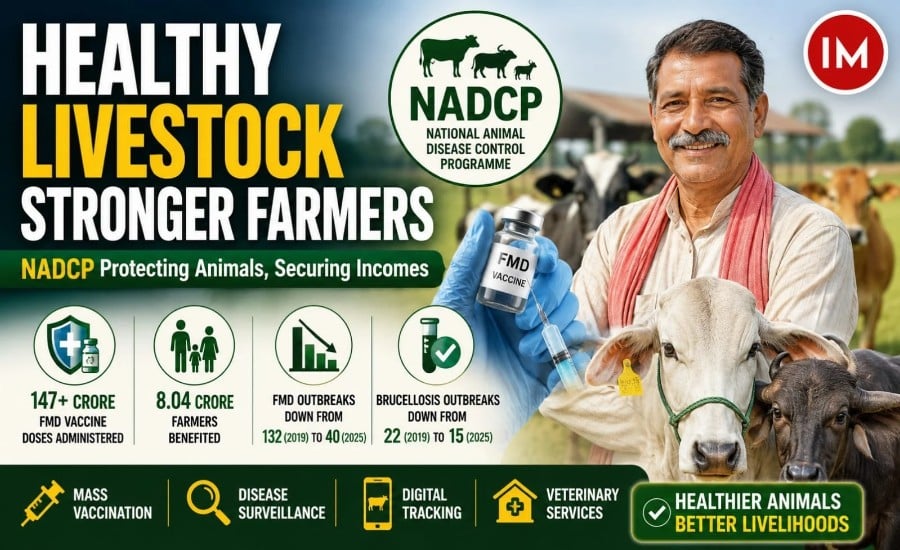
147 Crore FMD Vaccine Doses Administered
The scale of the vaccination campaign is one of NADCP’s major features.
According to the government:
- 147.16 crore FMD vaccine doses have been administered under the programme.
- The vaccination effort has benefited 8.04 crore farmers.
- Average protective immunity against FMD serotypes O, A and Asia1 has reached 78.1%, 71.7% and 77.6%, respectively.
- There has been no FMD outbreak caused by Serotype Asia-1 for the last three years in the country.
The reported number of FMD outbreaks also declined from 132 in 2019 to 40 in 2025, indicating a substantial reduction in reported disease incidence during the period.
Brucellosis Control Focuses on Young Female Bovines
Brucellosis is another major disease targeted by NADCP. Unlike FMD, the programme provides a one-time vaccination during the lifetime of female bovine calves aged 4–8 months.
The government reported that post-vaccination monitoring in 2025 recorded seroconversion rates of:
- 75.63% among cattle calves
- 67.17% among buffalo calves
Reported Brucellosis outbreaks declined from 22 in 2019 to 15 in 2025.
Controlling the disease is particularly important for livestock productivity because Brucellosis can affect reproduction and lactation.
Taking Vaccination to the Last Mile
NADCP’s implementation extends beyond vaccine administration. It combines vaccination with animal identification, surveillance and veterinary services.
The programme has expanded its reach through:
- Bharat Pashudhan Portal: More than 39 crore livestock had been registered by July 2026. Each registered animal receives a unique 12-digit identification number, allowing vaccination and livestock information to be digitally tracked.
- Mobile Veterinary Units: 4,019 MVUs are operational across 29 States and Union Territories. Through the toll-free 1962 service, they provide doorstep veterinary services.
So far, these units have:
- Benefited 136 lakh farmers
- Treated 276 lakh animals
The programme has also supported the training of 39,810 Multi-Purpose Artificial Insemination Technicians in Rural India (MAITRIs) to strengthen doorstep livestock services.
Disease Control and Livestock Productivity
The government has also reported improvements in bovine productivity alongside the broader interventions in animal health.
Average productivity of indigenous and non-descript cattle increased from 927 kg per animal per year in 2014–15 to 1,343.2 kg in 2024–25, while buffalo productivity rose from 1,880 kg to 2,365.2 kg during the same period.
Overall average bovine productivity increased from 1,640 kg to 2,250 kg per animal per year.
India’s milk production also rose from 146.31 million tonnes in 2014–15 to 247.87 million tonnes in 2024–25.
These figures cover broader developments in the livestock sector and should not be attributed solely to NADCP. However, disease prevention and improved animal health form an important part of efforts to maintain livestock productivity.
NADCP Now Part of a Wider Livestock Health Framework
The government’s animal-health strategy has expanded beyond the original NADCP framework.
Under the revised Livestock Health and Disease Control Programme (LHDCP), NADCP, the Livestock Health and Disease Control component and the Pashu Aushadhi initiative have been brought under a common umbrella.
The total budget outlay for LHDCP for 2026–27 is ₹2,010 crore.
The broader framework is intended to combine disease control with veterinary services, medicines, surveillance and other animal-health interventions.
Linking Livestock Health With Pandemic Preparedness
Animal disease control is also being connected with India’s wider One Health approach, which recognises the links between human, animal and environmental health.
The government has supported disease surveillance, laboratory strengthening and preparedness measures through the Pandemic Fund Project on Animal Health Security Strengthening in India for Pandemic Preparedness and Response.
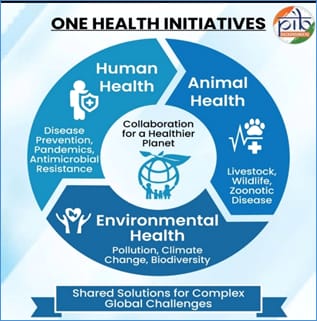
The US$25 million project, launched in 2024 with support from the G20 Pandemic Fund, is being implemented in partnership with the Asian Development Bank, Food and Agriculture Organization and World Bank.
It complements NADCP by strengthening surveillance, laboratory capacity and preparedness for zoonotic and transboundary animal diseases.
What NADCP Means for Livestock Farmers
For farmers, the significance of NADCP goes beyond preventing individual disease outbreaks. A healthier animal population can help reduce disease-related productivity losses and support more reliable livestock-based livelihoods.
The programme’s approach rests on three interconnected pillars:
- Prevention: Regular vaccination against major livestock diseases.
- Detection: Surveillance, testing and outbreak investigation to identify disease risks.
- Response: Veterinary services, digital tracking and disease-control measures to contain outbreaks.
With more than 147 crore FMD vaccine doses administered, millions of farmers reached and reported declines in both FMD and Brucellosis outbreaks, NADCP represents a large-scale shift towards preventive animal healthcare.
The programme’s continued focus on vaccination, surveillance, digital livestock records and last-mile veterinary services is aimed at building a more disease-secure livestock sector while supporting the farmers whose incomes depend on it.
Read Also: UP Dairy Conclaves Take Welfare Schemes and Scientific Dairy Practices to 75 Districts