Kolkata/Baikunthapur: A few days into its life, a newborn elephant calf found itself fighting for survival in the swollen waters of the Teesta River in West Bengal.
Separated from its herd while elephants were crossing the river near the Gajoldoba Teesta Barrage in Jalpaiguri, the 3–4-day-old calf was swept nearly 4–5 km downstream by the strong current.
Its small trunk remained above the water as it struggled to stay afloat.
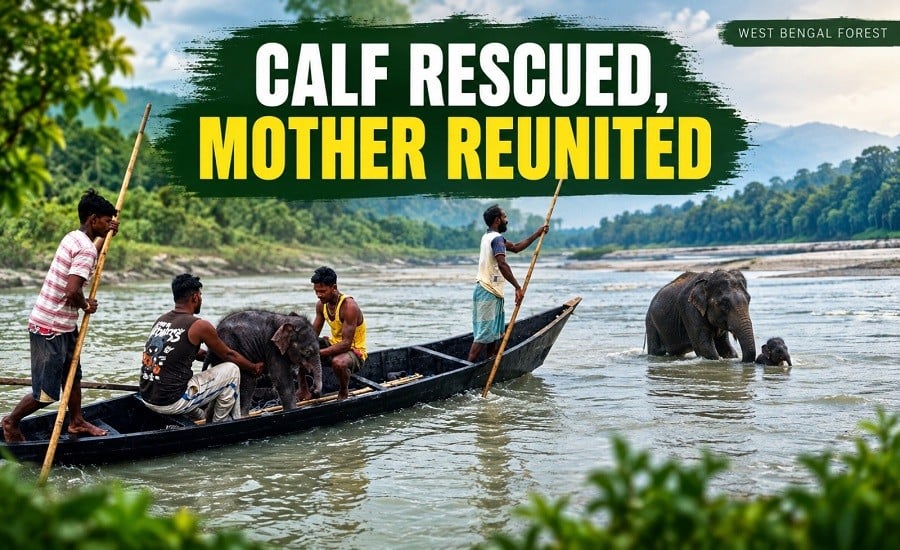
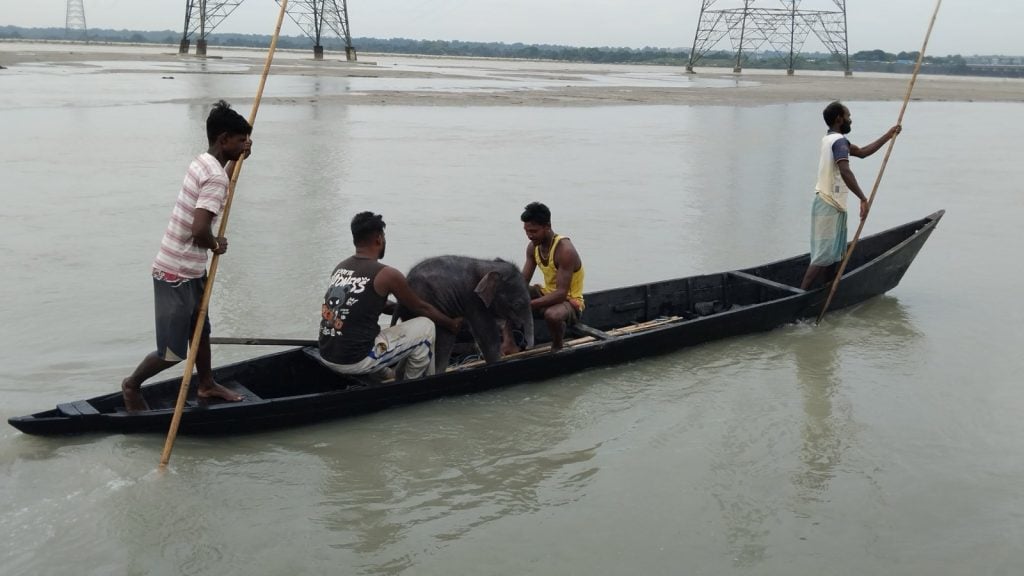
The calf’s life, however, took a dramatic turn when a group of local fishermen spotted it struggling in the river. They immediately rowed towards the animal, risking themselves in the strong current to pull it onto their boat.
The rescue was followed by another equally important challenge — finding the calf’s mother and ensuring that the newborn was returned to its herd.
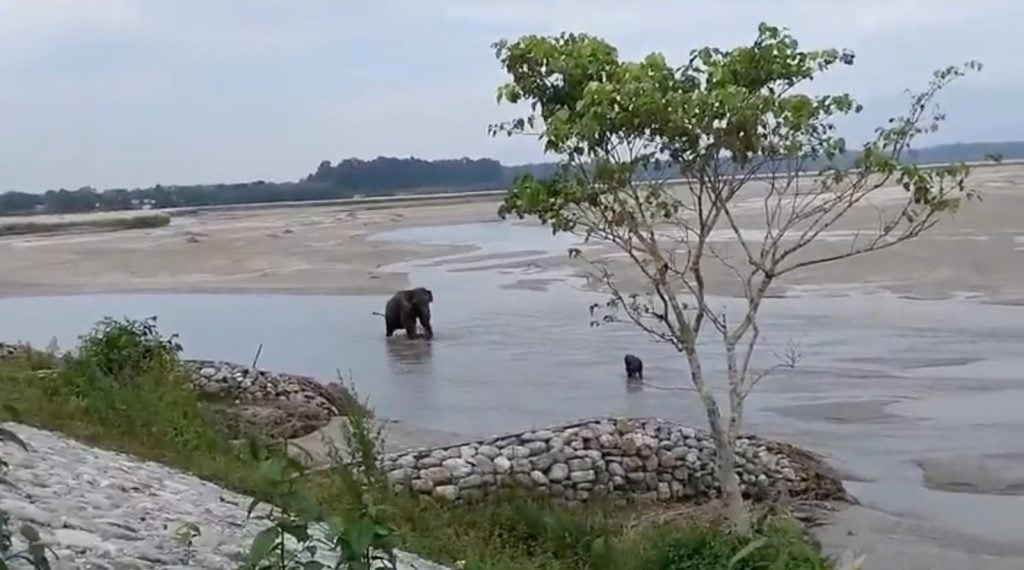
After nearly two hours of coordinated efforts involving the Baikunthapur Forest Division, local fishermen and residents, the calf was successfully reunited with its mother near a Teesta river char at Gajoldoba. The mother approached the calf and was later seen nursing it.
Fishermen Spot Calf Struggling in Swollen Teesta
The incident occurred after a herd of around five elephants was moving upstream of the Gajoldoba Teesta Barrage.
As the elephants crossed the river, the newborn calf became separated from the herd. The strong current carried the tiny animal downstream, leaving it struggling against the waves.
Five fishermen – Bablu Das, Mithun Das, Kader Das, Biswanath and Gopal – were travelling in a small boat when they spotted the calf near the 12th spur of the Teesta, close to the Punjab embankment.
The fishermen saw that the calf was in serious danger. With the river flowing strongly, the animal was being pushed farther downstream.
They immediately moved their boat towards it.
Three of the fishermen then entered the water and helped pull the calf onto the boat. As they headed back towards the riverbank, the three men swam alongside the boat, helping push it against the current.
Their intervention gave the newborn elephant a crucial chance of survival.
Forest Team Provides Immediate Veterinary Care
After bringing the calf safely to the riverbank, the fishermen handed it over to Forest Department personnel.
Teams from the Baikunthapur Forest Division had already reached the area after receiving information about the stranded calf.
The animal was taken to the Kathambari range office, where it received immediate veterinary attention.
For Forest Department personnel, however, the rescue was only the first part of the operation.
The priority was to locate the mother and return the calf to its herd as quickly as possible.
Two-Hour Search for the Mother
Forest personnel began searching for the herd with the assistance of local residents and the fishermen who had helped rescue the calf.
The teams believed that the elephants had taken shelter on a dry stretch of the riverbed after crossing the Teesta.
The rescued calf was subsequently transported across the barrage towards the area where the herd was believed to be present.
The operation continued for nearly two hours as the teams tried to trace the mother and create an opportunity for natural reunification.
Eventually, the mother elephant approached the rescued calf.
The moment marked the successful conclusion of a rescue operation that had begun with the newborn struggling against the current.
The mother was later seen nursing the calf, confirming the reunion.
DFO Mudit Verma Praises Fishermen and Forest Team
Baikunthapur DFO Mudit Verma, an IFS officer of the 2020 batch, highlighted the role played by both the local fishermen and Forest Department personnel.
“A newborn elephant calf was swept nearly 5 km downstream by Teesta’s strong currents. Our Forest team, with help of local fishermen, rescued the drowning calf and reunited it with its mother,” he said.
Describing the episode as “a beautiful story of rescue and reunion”, Verma praised the fishermen and Forest Department team for their courage and commitment.
“The compassionate & courageous fishermen and our dedicated forest team are the true heroes,” he said.
The operation demonstrated how local knowledge and immediate community intervention can complement the work of wildlife officials during emergencies.
Why Quick Reunification Matters
Rescuing a wild animal is not always the end of a conservation operation. In the case of young elephants, returning a separated calf to its mother and herd can be especially important.
Extended human contact can complicate efforts to return a young elephant to its natural social group. For this reason, once the calf received necessary veterinary attention, Forest Department teams focused on locating the herd rather than keeping the newborn in human care.
The Teesta operation also comes against the backdrop of another elephant-calf rescue in North Bengal during last year’s floods. In that case, a calf rescued from the Mechi River was reportedly not accepted by its herd later.
The Teesta team therefore moved quickly to give the rescued calf an opportunity to reconnect with its mother.
Fishermen Become the First Responders
The role of the five fishermen was particularly significant because they were the first to spot the calf and intervene.
Approaching a distressed newborn elephant in a swollen river was itself a risky task. The fishermen brought their boat close to the animal, entered the water to pull it aboard and then helped propel the boat back towards safety against the current.
Their actions bought valuable time for the Forest Department to take over the rescue and begin the search for the herd.
The episode also highlights the importance of communities living around forest and river landscapes in wildlife emergencies. Their familiarity with local waters and willingness to assist can become critical when animals are in distress.
Senior Officers Applaud Rescue and Reunion
The successful reunion drew appreciation from senior forest and administrative officers on social media.
Senior IAS officer Supriya Sahu praised the fishermen and the Baikunthapur Forest Division for the rescue.
“What an incredible rescue of a newborn elephant calf swept away by the Teesta River!” she wrote, appreciating the courage and quick thinking of the local fishermen and the swift response of the Forest Division.
She noted that the coordinated effort ultimately enabled the calf to be reunited with its mother.
Senior IFS officer Ramesh Pandey also described the operation as a heartwarming rescue.
“A young elephant calf swept away in Teesta River” was rescued by Baikunthapur Forest Division staff with the help of local fishermen and reunited with its mother, he wrote on social media.
From a Swollen River to Its Mother’s Side
For a newborn only a few days old, being swept kilometres away from its herd in a powerful river could easily have ended in tragedy.
Instead, the sequence of events brought together three crucial elements — the alertness of local fishermen, the rapid response of Forest Department personnel and the determination to return the calf to its natural family.
The image of the mother approaching the rescued calf and nursing it brought a deeply rewarding end to the operation.
What began with a tiny elephant struggling to keep its trunk above the turbulent waters of the Teesta ended with the calf safely back beside its mother — a reminder of how timely human intervention, when carefully directed towards wildlife welfare, can help restore a natural bond.
Read also: Rare Cheetah Bond in Kuno: 2 Unrelated Males Hunt, Groom & Defend Territory Together