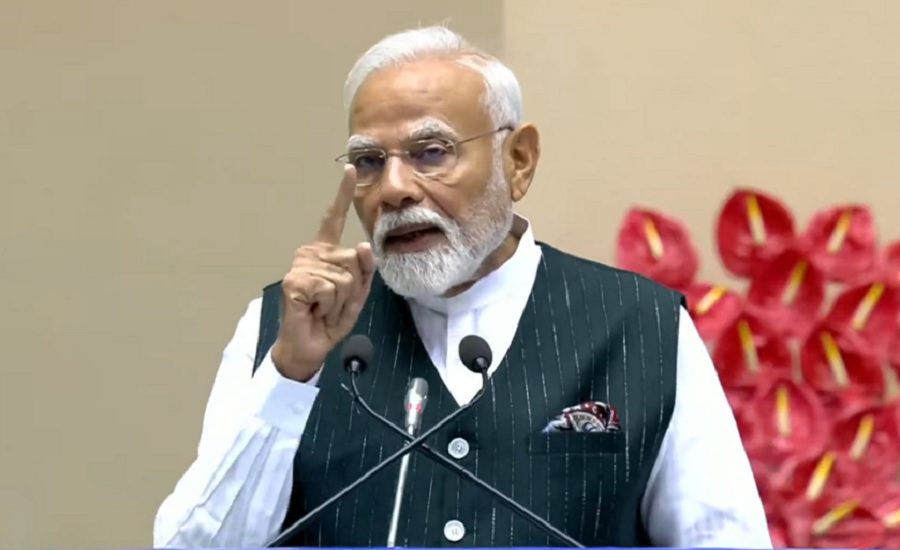
New Delhi: Prime Minister Narendra Modi today addressed the 17th Civil Services Day at Vigyan Bhawan, New Delhi, delivering a powerful call to action for India’s civil servants to embrace transformation, innovation, and inclusivity in governance.
The event, marking the 75th year of the Constitution of India and the 150th birth anniversary of Sardar Vallabhbhai Patel, saw the Prime Minister reaffirm the legacy of the ‘Steel Frame of India’ and envision its evolution into a dynamic force steering India toward becoming a developed nation.
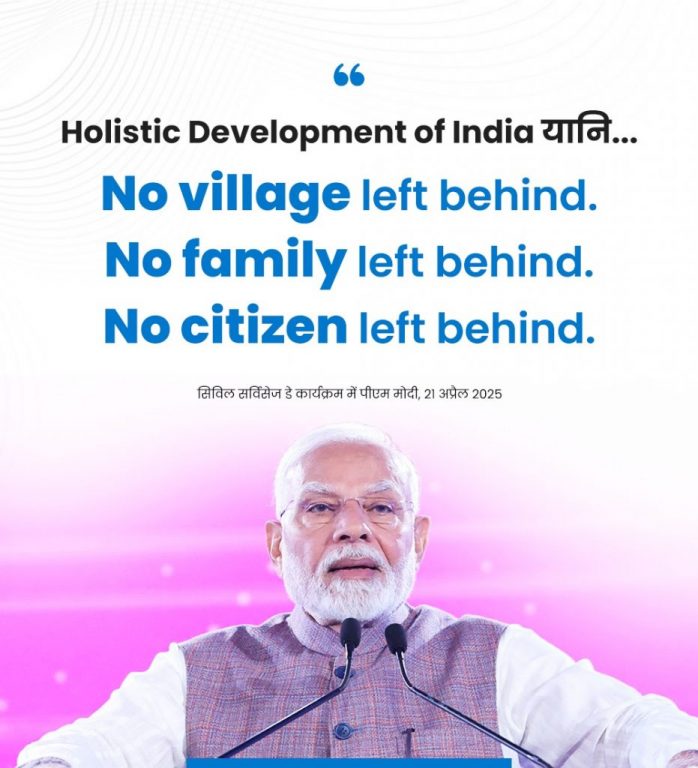
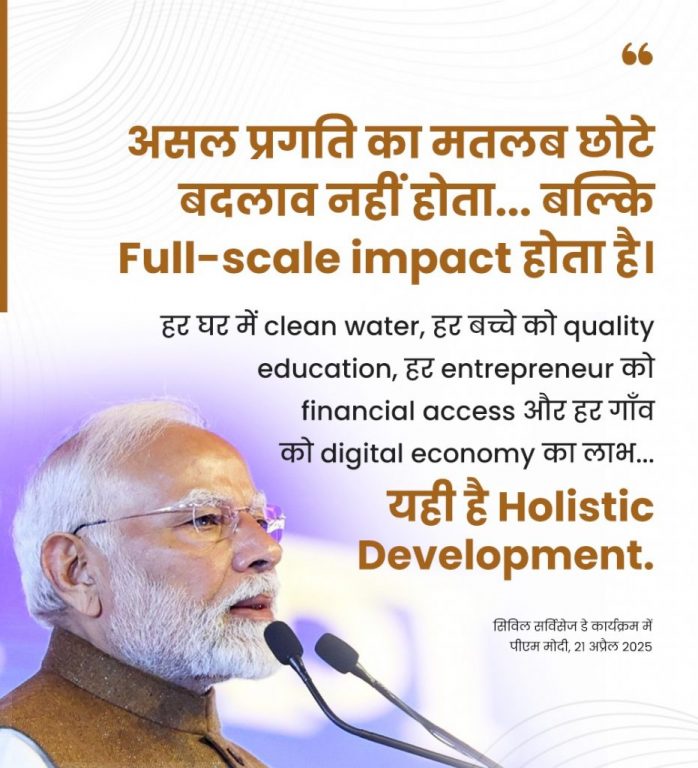
Delivering his keynote address, PM Modi emphasized that the policies and decisions being shaped today will influence India’s destiny for the next thousand years. “Real progress does not mean small changes but full-scale impact,” he said, outlining a comprehensive vision of holistic development that includes clean water in every home, quality education for every child, and access to digital and financial infrastructure for all citizens.
“Our Decisions Today Will Shape the Next Thousand Years”
Reflecting on his earlier call from the Red Fort to lay the foundation of India for the next millennium, PM Modi asserted:
“The policies we are working on today, the decisions we are making, are going to shape the future of the next thousand years.”
He emphasized that success does not come from fate alone but through collective effort, hard work, and determination – urging civil servants to become the driving force behind India’s journey to become a Viksit Bharat (Developed India).
Civil Services: The Foundation of Viksit Bharat
Remembering Sardar Patel’s foundational vision for Indian civil services, PM Modi described bureaucrats as nation-builders who must uphold discipline, integrity, and service. He underscored the importance of transforming the bureaucracy into an “enabler” rather than a regulator, helping citizens overcome obstacles and unleashing the full potential of India’s entrepreneurial spirit.
In line with this vision, he highlighted the significance of Mission Karmayogi and the Civil Services Capacity Building Programme, initiatives aimed at making the civil services future-ready in a technology-driven era.
Transformative Governance & Holistic Development
Reflecting on India’s governance journey over the past decade, PM Modi stated that the nation has moved “beyond incremental change to impactful transformation.” He cited measurable improvements across Aspirational Districts and Blocks, where data-driven interventions have delivered remarkable results in health, nutrition, infrastructure, and education.
“Transformation is possible even in remote areas with the right intent, planning, and execution,” he remarked, referring to success stories from Tonk, Bhagalpur, Kupwara, and Jharkhand’s Gurdih Block, where institutional deliveries and access to clean water saw dramatic increases.
The theme for this year’s Civil Services Day – Holistic Development of India – was described by the Prime Minister not just as a concept, but as a national pledge to leave no village or citizen behind.
Administrative Reform: From Red Tape to Red Carpet
The Prime Minister highlighted the removal of:
- Over 40,000 compliances
- 3,400+ decriminalized legal provisions
These reforms, despite initial resistance, have enhanced the Ease of Doing Business and positioned India as a top investment destination. PM Modi called for similar efforts at state, district, and block levels to eliminate bureaucratic bottlenecks.
Technology & Transparency
Calling for a paradigm shift in how governance is perceived and delivered, PM Modi said, “In the age of technology, governance is not about managing systems, it is about multiplying possibilities.”
He stressed the importance of leveraging AI, data analytics, and smart governance tools to make policies more effective and inclusive.
India: Setting Global Benchmarks in Governance
The Prime Minister also hailed India’s G20 Presidency as a milestone in global diplomacy, made successful through a Janbhagidari (public participation) model that transformed the event into a people’s movement. “The world has acknowledged India’s leadership; India is not just participating, it is leading,” he affirmed.
PM Modi proudly asserted: “India is now recognized not just for its growth, but for setting new benchmarks in governance, transparency, and innovation.”
Citing the success of India’s G20 Presidency, which saw over 200 meetings across 60+ cities, he praised the Janbhagidari (public participation) approach that made G20 a people’s movement.
Driving Economic Growth and Ease of Doing Business
PM Modi underscored that India’s civil services play a critical role in ensuring that the country becomes the third-largest global economy at the earliest. He detailed reforms undertaken to reduce bureaucratic hurdles – with over 40,000 compliances removed and more than 3,400 legal provisions decriminalized – to encourage investment and innovation.
He emphasized that India’s bureaucracy must provide the world’s best ease of compliance environment, especially for MSMEs and startups, which face competition on a global scale.
Addressing a programme on Civil Services Day… https://t.co/aq2mNspFL2
— Narendra Modi (@narendramodi) April 21, 2025
Serving Citizens, Not Systems
Echoing the spirit of “Nagrik Devo Bhava,” the Prime Minister urged civil servants to adopt a citizen-first mindset, listening empathetically and prioritizing solutions for the underprivileged. “You are not just administrators – you are the architects of a developed India,” he said, encouraging officers to choose “integrity over convenience, innovation over inertia, and service over status.”
In closing, PM Modi reiterated the importance of aligning administrative efforts with the “Panch Pran” – the five vows he introduced from the Red Fort – as the guiding principles for building a developed India by 2047.
Awards for Excellence in Public Administration
At the ceremony, the Prime Minister also conferred 16 prestigious awards to civil servants and districts for their exemplary work under categories including Holistic Development of Districts, Aspirational Blocks Programme, and Innovation. These awards recognized efforts aimed at enhancing the welfare of common citizens through grassroots reforms.
Union Minister of State Dr. Jitendra Singh, Principal Secretary to the PM Shri Shaktikanta Das, Cabinet Secretary Shri T.V. Somanathan, and Secretary of the Department of Administrative Reforms and Public Grievances Shri V. Srinivas were among the dignitaries present at the occasion.