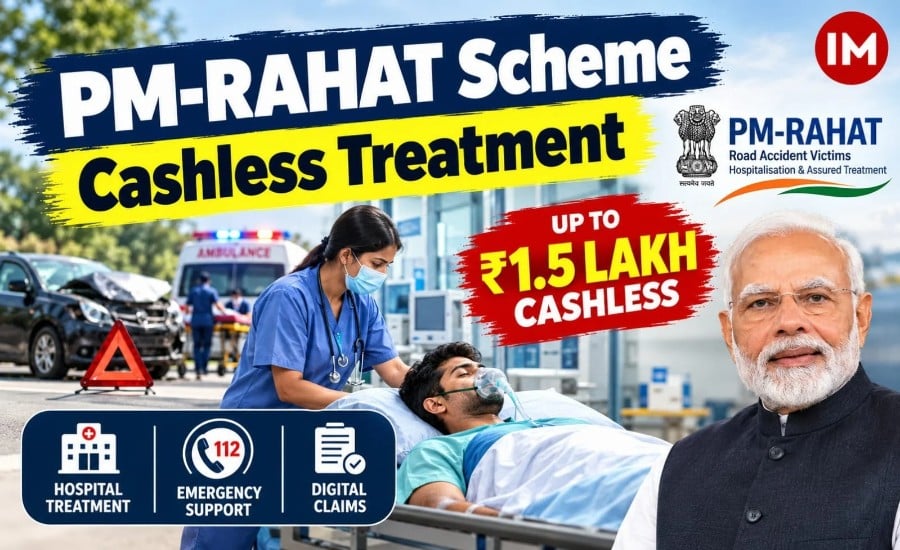
New Delhi: The Government of India’s Prime Minister–Road Accident Victims’ Hospitalisation and Assured Treatment (PM-RAHAT) Scheme provides eligible road accident victims with cashless medical treatment of up to ₹1.5 lakh for a maximum of seven days from the date of an accident.
Launched nationwide by Prime Minister Narendra Modi on February 13, 2026, the scheme aims to ensure that victims of road accidents involving motor vehicles can receive timely medical attention without having to arrange immediate payment for treatment.
The initiative focuses on the critical period following an accident, commonly known as the Golden Hour, when prompt medical intervention can significantly improve a victim’s chances of survival.
The scheme operates under Section 162 of the Motor Vehicles Act, 1988. Its implementation involves the Ministry of Road Transport and Highways (MoRTH), the National Health Authority, state health agencies, police authorities and designated hospitals.
What Is the PM-RAHAT Scheme?
PM-RAHAT is a cashless treatment framework designed to facilitate access to emergency medical care for people injured in road accidents involving motor vehicles.
Read Also: Odisha Directs DGP to Address Police Delays Affecting PM-Rahat Scheme
Under the scheme, eligible victims can receive treatment worth up to ₹1.5 lakh per person, subject to a maximum coverage period of seven days from the date of the accident.
The benefit applies to accidents on any category of road in India. The scheme is intended to reduce delays in accessing medical care caused by financial constraints and to provide hospitals with a defined mechanism for reimbursement.
The scheme was originally notified as the Cashless Treatment of Road Accident Victims Scheme in May 2025. It was subsequently renamed PM-RAHAT through a government notification in February 2026.
Key Features of PM-RAHAT
- Cashless treatment: Coverage of up to ₹1.5 lakh per eligible road accident victim.
- Treatment period: Up to seven days from the date of the accident, subject to the financial limit.
- Road coverage: Applicable to eligible accidents involving motor vehicles on any category of road.
- Emergency stabilisation: Stabilisation treatment for up to 24 hours in non-life-threatening cases and up to 48 hours in life-threatening cases at designated hospitals, subject to the scheme’s provisions.
- Emergency assistance: Integration with the Emergency Response Support System (ERSS) 112 to help victims access ambulance services and locate designated hospitals.
- Digital processing: Electronic coordination of accident reporting, hospital admission, police authentication, treatment records and reimbursement claims.
- Hospital reimbursement: Payments are processed through the Motor Vehicle Accident Fund (MVAF).
How Much Treatment Coverage Does PM-RAHAT Provide?
The scheme provides cashless treatment of up to ₹1.5 lakh per eligible victim for a maximum of seven days from the date of the accident.
The coverage is intended to help victims receive medical attention during the immediate aftermath of an accident, including emergency stabilisation and subsequent treatment covered under the scheme.
The treatment period and financial ceiling are separate limits: the scheme does not provide ₹1.5 lakh for each day of hospitalisation.
How the treatment period works
The scheme distinguishes between stabilisation and the broader treatment coverage.
- Non-life-threatening cases: Stabilisation treatment may be provided for up to 24 hours.
- Life-threatening cases: Stabilisation treatment may be provided for up to 48 hours.
- Overall cashless treatment coverage: Up to seven days from the date of the accident, subject to the ₹1.5 lakh ceiling and applicable scheme conditions.
The stabilisation provisions are intended to facilitate immediate medical intervention while the required verification and other formalities are completed.
How Can Road Accident Victims Access PM-RAHAT?
The scheme connects emergency response services with designated hospitals to facilitate treatment following a road accident.
A victim, a Rah-Veer (Good Samaritan) or any other person present at the accident site can call 112, India’s integrated emergency response helpline, to seek assistance.
The helpline can help callers obtain information about the nearest designated hospital and request ambulance assistance. This enables coordination among emergency responders, police authorities and hospitals.
Step-by-step process
Contact emergency services
Call 112 to request emergency assistance and, where necessary, an ambulance.
Reach a designated hospital
The injured person should be taken to a hospital designated under the scheme that can provide the required treatment.
Record the accident and treatment details
The hospital records the necessary information through the scheme’s digital platform, initiating the process for treatment and verification.
Complete police authentication
Police authorities verify the accident through the integrated system within the prescribed timelines. The framework provides for police confirmation within 24 hours in non-life-threatening cases and 48 hours in life-threatening cases.
Process the treatment claim
The hospital’s claim is processed through the digital system and the relevant state health agency. Approved claims are reimbursed through the designated funding mechanism.
The process is designed to connect accident reporting with hospital admission and claim settlement, reducing reliance on separate manual procedures.
How Does the Government Pay Hospitals Under PM-RAHAT?
The scheme uses the Motor Vehicle Accident Fund (MVAF) to reimburse hospitals for eligible treatment provided to road accident victims.
The funding mechanism differs depending on whether the vehicle involved in the accident is insured.
- Insured vehicles: Payments are drawn from contributions made by general insurance companies.
- Uninsured vehicles: Payments are made through budgetary allocations by the Government of India.
- Hit-and-run cases: Government budgetary allocations provide the funding for eligible claims.
Once a claim is approved by the State Health Agency, payment is to be made within 10 days.
This reimbursement framework is intended to give hospitals greater financial certainty and support the uninterrupted provision of emergency treatment.
How Does Technology Support PM-RAHAT?
PM-RAHAT uses an integrated digital framework connecting accident records, hospital treatment and reimbursement.
Two key platforms support its implementation:
- Electronic Detailed Accident Report (eDAR): Managed by the Ministry of Road Transport and Highways, this platform supports the digital recording and processing of road accident information.
- Transaction Management System (TMS 2.0): Operated by the National Health Authority, this platform supports the management of treatment transactions and related claims.
The integration enables information to move across different stages of the process, including accident reporting, hospital admission, police authentication, treatment administration, claim processing and final payment.
The system also establishes timelines for police verification, balancing the need for authentication with the objective of avoiding unnecessary delays in emergency care.
Who Monitors Complaints Under PM-RAHAT?
The scheme includes a district-level grievance redressal mechanism for road accident victims.
A Grievance Redressal Officer is nominated by the District Road Safety Committee, which is chaired by the District Collector, District Magistrate or Deputy Commissioner, as applicable.
This arrangement provides an administrative channel for addressing complaints relating to the implementation of the scheme and access to treatment.
The involvement of district authorities is intended to strengthen accountability among the agencies responsible for emergency response, verification and hospital treatment.
PM-RAHAT Implementation: How Many Victims Have Benefited?
According to the Ministry of Road Transport and Highways, 22,481 road accident victims had benefited from PM-RAHAT across 34 States and Union Territories as of July 31, 2026.
The figure indicates the scheme’s reach during its initial months of nationwide implementation.
The ministry has also outlined a framework involving state-level implementation agencies, designated hospitals, police authorities and digital systems to facilitate access to cashless treatment.
Why Is PM-RAHAT Important?
Road accidents can create an immediate medical emergency in which delays in reaching a hospital or arranging payment can complicate access to treatment.
PM-RAHAT addresses the financial and administrative aspects of this challenge by combining cashless treatment coverage with emergency response coordination and a defined hospital reimbursement process.
Its key provisions include:
- Financial coverage of up to ₹1.5 lakh for eligible treatment.
- Access to treatment for eligible road accident victims across different categories of roads.
- Emergency assistance through the 112 helpline.
- Digital coordination among hospitals, police authorities and health agencies.
- A funding mechanism for reimbursing hospitals, including eligible uninsured-vehicle and hit-and-run cases.
- District-level grievance redressal arrangements.
The scheme’s effectiveness will depend on continued coordination among emergency responders, police authorities, hospitals and state agencies, along with public awareness of how to access the available assistance.
By linking emergency response with cashless treatment and digital claim processing, PM-RAHAT seeks to make timely medical care more accessible to road accident victims.