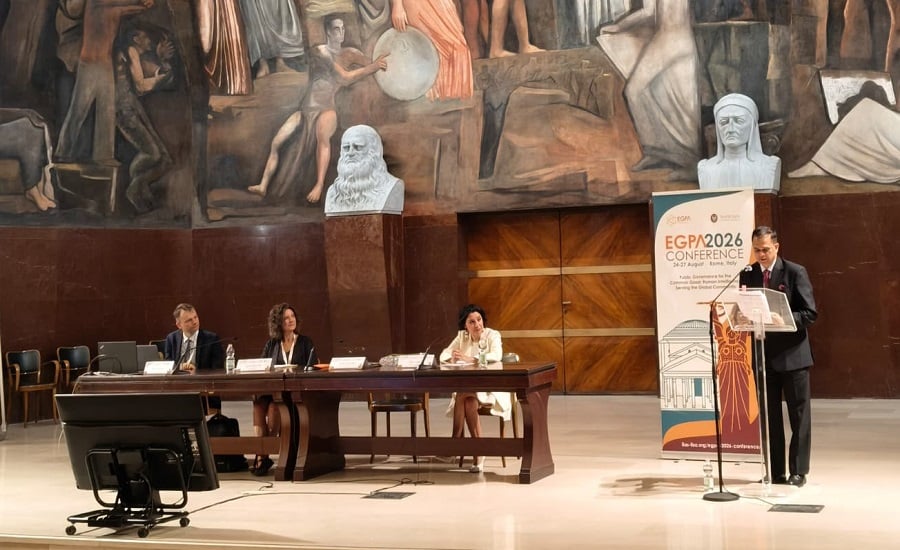
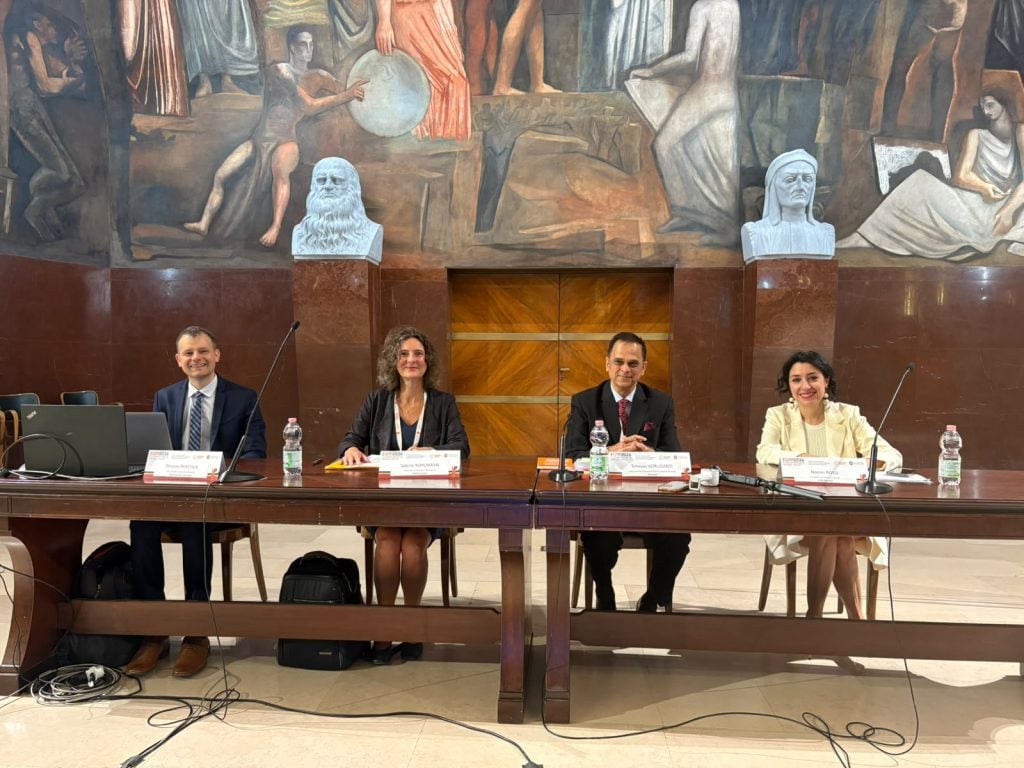
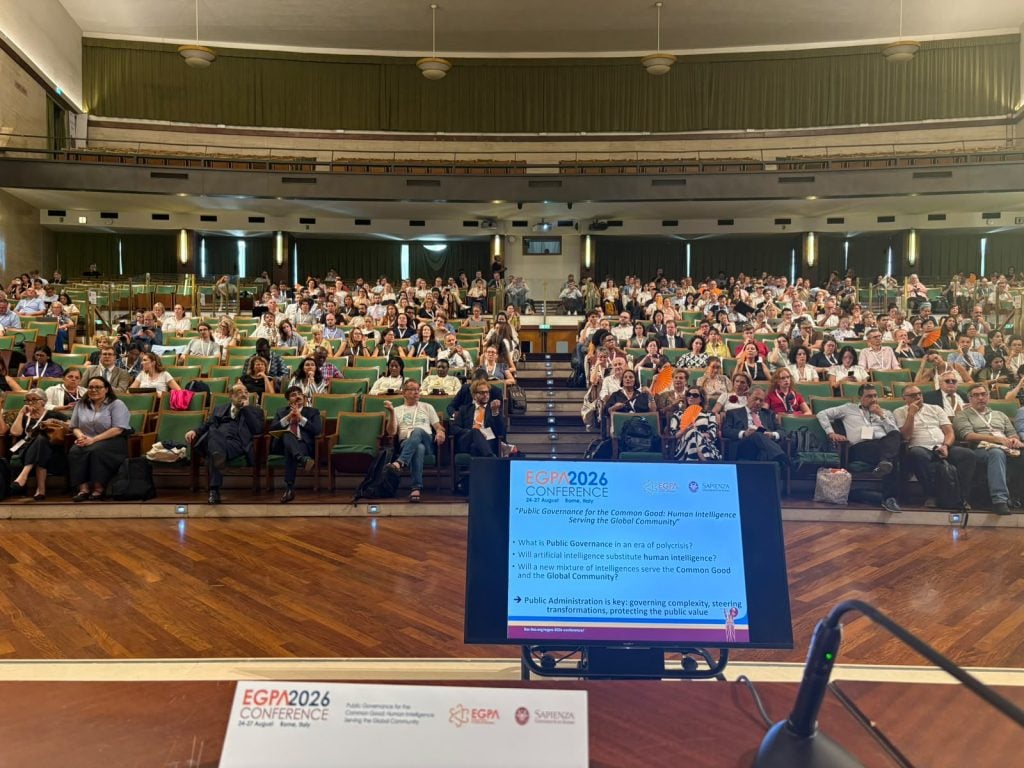
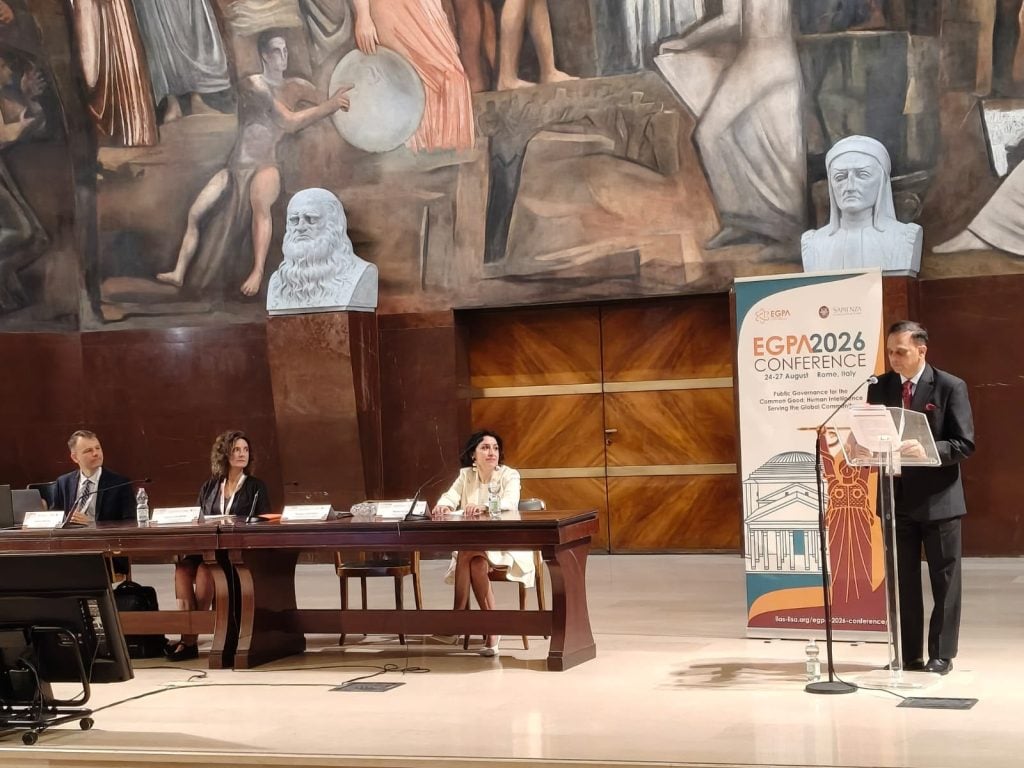
Rome, Italy: Voruganti Srinivas (1989:IAS:Rajasthan), President of the International Institute of Administrative Sciences (IIAS) and Chief Secretary of the Government of Rajasthan, delivered the inaugural address at the 51st European Group for Public Administration (EGPA) Conference at Sapienza University in Rome on August 25, 2026.
The four-day conference, themed “Public Governance for the Common Good: Human Intelligence Serving the Global Community,” has received more than 900 submissions from over 70 countries, making it one of EGPA’s major international gatherings.
The inaugural session was attended by Italian Minister of Public Administration Paolo Zangrillo, Rome Mayor Roberto Gualtieri, EGPA President Prof. Dr. Sabine Kuhlmann, Sapienza University Vice Rector Antonella Polimeni, Conference Chair Prof. Dr. Noemi Rossi, ambassadors, IIAS Council members and delegates from across the world.
Srinivas congratulated the EGPA leadership for organising the conference, which includes a PhD Symposium, Permanent Study Groups, Transatlantic and Mediterranean Dialogues, a Euro-Asia Panel and a thematic roundtable on “Grand Challenges, Shared Agendas – Where is Public Administration Heading?”
Srinivas Highlights Strengthening of IIAS and EGPA
Speaking about the evolution of international public administration institutions, Srinivas highlighted the priorities of the Indian Presidency of IIAS, which began in June 2025.
He said the presidency has focused on strengthening EGPA’s autonomy, reconstituting its Permanent Study Groups and advancing accreditation in European public administration.
Srinivas also highlighted the nearly century-long contribution of IIAS as a global platform for comparative public administration, scientific principles and knowledge exchange through its regional bodies, including IASIA, EGPA, LAGPA and AGPA.
Looking towards the centenary of IIAS in 2030, he envisioned the organisation as a “digitally agile, publications-rich and resource-strong” knowledge institution serving governments, civil servants, academics, researchers and practitioners.
He emphasised the importance of international collaboration, saying, “The future of the IIAS must be built on collaboration without borders, knowledge without boundaries and governance without exclusion.”
Srinivas also traced EGPA’s 51-year journey, beginning with the 1974 Speyer Conference, and highlighted its subsequent expansion through study groups, engagement with Eastern Europe after the Cold War, doctoral education initiatives and research on ethics, trust, resilience, digital transformation and sustainability.
India’s Next-Generation Governance Reforms
Connecting the conference theme with India’s governance experience, Srinivas spoke about the country’s focus on next-generation reforms during Amrit Kaal.
He referred to Prime Minister Narendra Modi’s emphasis on strengthening last-mile delivery while reducing unnecessary government intervention in citizens’ lives.
Srinivas outlined the “Panch Pran” resolutions associated with the vision of Viksit Bharat@2047 and the principle of “Maximum Governance – Minimum Government.”
He highlighted several areas of India’s governance reform agenda, including digitally empowered citizens, ease of living and doing business, improved grievance redressal mechanisms and capacity building of government personnel.
He also referred to the i-GOT Karmayogi portal and the saturation approach based on “Sabka Saath, Sabka Vikas, Sabka Vishwas, Sabka Prayas.”
Rajasthan’s Governance Innovations Showcased
Srinivas also presented Rajasthan’s experience with next-generation administrative reforms under the state’s “Viksit Rajasthan 2047” Vision Document.
Among the initiatives highlighted was the Rajasthan Jan Sampark platform for public grievance redressal. He also spoke about Raj Kaj analytics, which enables performance ranking of government departments.
Another initiative highlighted was Mission Rajeevika, focused on women’s economic empowerment through programmes such as Lakhpati Didis, Bank Sakhis and Solar Didis.
Srinivas also discussed Raj Unnati, an initiative modelled on the Centre’s PRAGATI mechanism for reviewing major infrastructure projects. The system covers projects worth more than ₹2.5 billion in sectors including power, railways and petroleum.
Technology and AI in Governance
The Rajasthan Chief Secretary underlined the expanding role of technology in public administration.
He referred to initiatives and platforms including Smart Cities, digital public infrastructure, UMANG, WhatsApp-based service delivery and Aadhaar-enabled platforms, while also highlighting the growing application of artificial intelligence in governance.
Quoting Prime Minister Modi, Srinivas said, “In the age of technology, governance is not about managing systems, it is about managing possibilities.”
He emphasised that technology should not merely digitise existing administrative processes but should help governments improve service delivery, responsiveness and citizens’ experience.
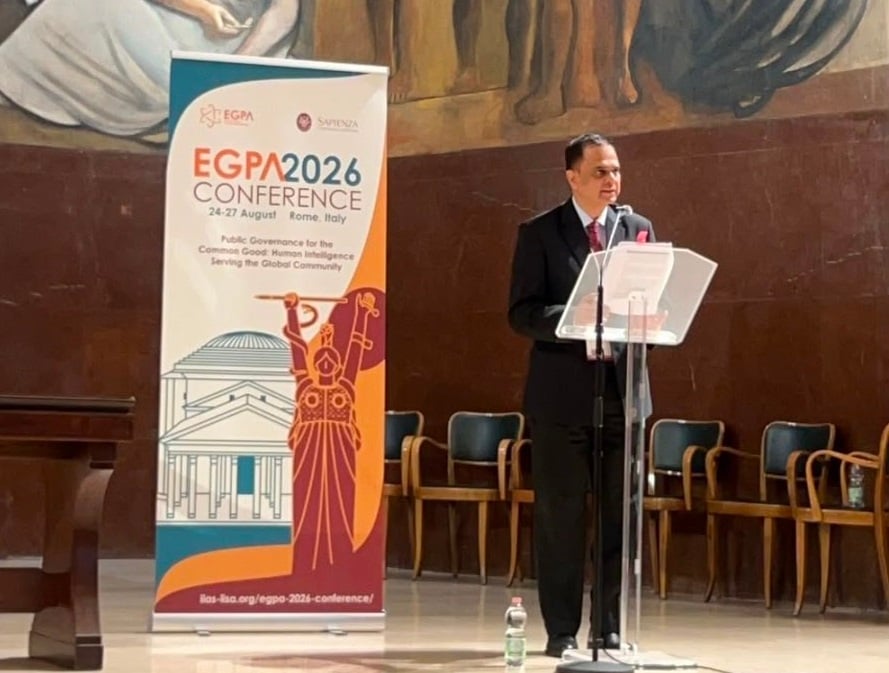
Srinivas Calls for Roadmap for EGPA@60
Looking ahead to the next phase of EGPA’s development, Srinivas praised the organisation’s revival under the leadership of Prof. Dr. Sabine Kuhlmann and outlined areas that could strengthen the institution as it moves towards its 60th year.
He called for greater institutional fundraising, stronger partnerships with the European Union and national schools of administration, deeper Euro-Mediterranean engagement and greater attention to digital transformation, sustainability and citizen-centric governance.
He also advocated transparent internal decision-making, clearer complementarity between EGPA and IIAS while preserving EGPA’s distinct European identity, and greater emphasis on cross-national and interdisciplinary research projects.
Srinivas further called for closer engagement with European policymakers and continued inclusivity across disciplines, generations and geographies.
Four-Day Conference to Focus on Future of Public Administration
Concluding his inaugural address, Srinivas wished the 51st EGPA Conference success in its deliberations.
The conference will continue over the next four days with academic exchanges, policy dialogues and institutional meetings, bringing together researchers, administrators, policymakers and practitioners to examine emerging challenges in public administration.
The discussions are expected to focus on how public institutions can adapt to technological change, sustainability challenges and evolving citizen expectations while strengthening governance systems for the common good.