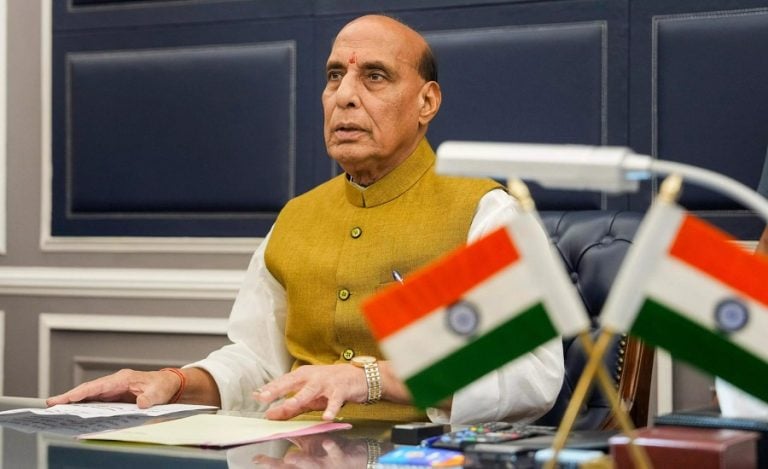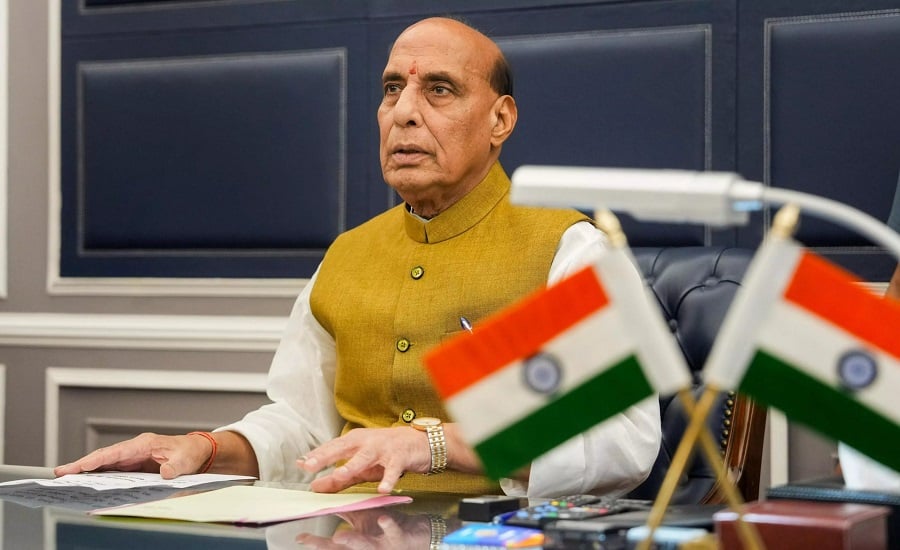
New Delhi: Defence Minister Rajnath Singh has said India’s armed forces have been given the freedom and resources to respond decisively to security threats, including the ability to strike adversaries inside their own territory.
Speaking at an event in New Delhi on September 7, Singh said India’s approach to national security has shifted from a reactive posture to a more proactive strategy, while maintaining that the country remains committed to peace.
‘Peace Should Not Be Mistaken for Weakness’
Singh stressed that India does not seek war or the territory of another country but warned that terrorism against India would invite a strong response.
Read Also: India-Sri Lanka Defence Ties Set for Fresh Push During Rajnath Singh’s Three-Day Visit
He said there was a clear distinction between peace and weakness and maintained that India’s defence forces would respond appropriately to countries promoting terrorism against the country.
The Defence Minister highlighted Surgical Strikes, the Balakot Airstrike and Operation Sindoor as examples of India’s strategy of taking decisive military action against terrorism and its networks.
Key Points on India’s Security Approach:
- Defence forces have been given greater operational freedom and resources.
- India has adopted a more proactive approach towards national security.
- Terror activities against India will face a “befitting response”.
- The government has combined military action with rehabilitation and de-radicalisation efforts in Jammu and Kashmir.
Focus on Future Warfare and Indigenous Technology
Singh said the nature of warfare is changing rapidly, with space and cyberspace emerging alongside land, air and sea as major domains of conflict.
He identified technologies such as:
- Artificial Intelligence
- Drones and autonomous systems
- Precision weapons
- Cyber and space technologies
- Advanced defence platforms
as critical components of future military capabilities.
The government, he said, is working towards making India a country capable of developing advanced defence technologies indigenously.
Defence Production Rises to ₹1.80 Lakh Crore
Singh highlighted the growth of India’s domestic defence manufacturing ecosystem as a key component of the country’s push for self-reliance.
According to the Defence Minister, defence production has risen from around ₹40,000 crore before 2014 to approximately ₹1.80 lakh crore, while defence exports have increased 56-fold to more than ₹38,000 crore.
He also said the government aims to take defence equipment exports to ₹50,000 crore by 2029.
Indigenous Platforms Highlighted
Singh pointed to a range of indigenously developed systems and platforms, including:
- Akashteer Air Defence Control System
- Akash air defence missile
- Pinaka rocket launcher
- Astra air-to-air missile
- Prachand and Dhruv helicopters
- Tejas fighter aircraft
- Arjun main battle tank
- Indigenous drone and counter-drone systems
- INS Vikrant aircraft carrier
He added that India is also pursuing the development of sixth-generation fighter aircraft.
All 16 DPSUs Operating Without Losses
The Defence Minister said all 16 Defence Public Sector Undertakings (DPSUs) are now operating without losses and are increasing investments in research and development while exploring export opportunities.
He also highlighted the expansion of the defence budget, which he said has increased from around ₹2.5 lakh crore to approximately ₹8 lakh crore over the past 12 years.
Private Sector and MSMEs Expand Defence Footprint
Singh said the private sector and MSMEs are playing a growing role in India’s defence manufacturing ecosystem.
According to him, more than 16,000 MSMEs are now engaged in defence production, while investment proposals worth around ₹70,000 crore have been received for the Defence Industrial Corridors in Uttar Pradesh and Tamil Nadu. Nearly ₹10,000 crore of these investments has already been made.
The Defence Minister also highlighted the growth of defence start-ups, saying their number has increased from a few dozen in 2018 to more than 2,000.
Strategic Autonomy Amid Global Uncertainty
Singh linked India’s defence self-reliance with its broader pursuit of strategic autonomy amid geopolitical uncertainty.
He said India was strengthening critical supply chains, promoting indigenous manufacturing and developing sectors such as semiconductors to reinforce economic resilience.
He also cited India’s 7.8% growth rate while arguing that a strong economy is essential for sustaining modern military capabilities and strategic independence.
Defence Innovation and Hypersonic Technology
The Defence Minister called on young Indians to become innovators and job creators and highlighted government initiatives such as iDEX and iDEX-Prime for supporting defence innovation.
He also referred to DRDO’s successful testing of a scramjet combustor in May, describing it as an important step towards hypersonic missile development.
The government is also transferring selected DRDO-developed missile technologies to Indian industry, enabling private companies to manufacture these systems for the armed forces.
Defence Self-Reliance as a National Security Priority
Singh said India’s objective is to build an indigenous defence ecosystem capable of strengthening national security, supporting economic growth and enhancing India’s role in the global security architecture.
He expressed confidence that by 2047, India would achieve the goal of Viksit Bharat while emerging as a global leader in technology, economy and defence.