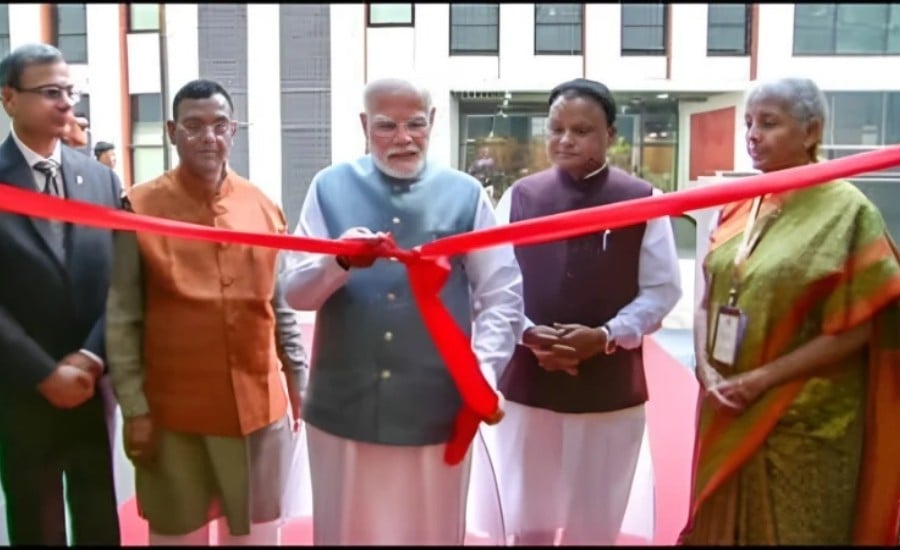
Bhubaneswar: Prime Minister Narendra Modi inaugurated the Reserve Bank of India’s (RBI) newly established Data Centre and Cybersecurity Training Institute in Bhubaneswar, Odisha, on October 25, describing the facilities as an important step towards strengthening India’s financial infrastructure and cybersecurity capabilities.
Invoking the blessings of Lord Jagannath, the Prime Minister said the new institutions would benefit Odisha and the country. He emphasised that as India’s economy and digital banking ecosystem continue to expand, protecting financial systems from cybercriminals and cyberterrorists has become increasingly important.
Modi also highlighted the role of digital banking in expanding financial inclusion, bringing formal banking services to previously underserved communities and improving access to credit and social security schemes.
New RBI Facilities to Strengthen Financial Security
The two facilities are intended to support the RBI’s digital infrastructure and strengthen the expertise required to address emerging cybersecurity challenges in the financial sector.
Read Also: Banks Seek Relief and Clarity on RBI’s New Forex Rules as Regulator Moves to Support the Rupee
The Prime Minister stressed that modern threats extend beyond conventional warfare, with attacks on a country’s economy and financial institutions also capable of undermining its security.
Key takeaways from his address included:
- Stronger digital infrastructure: The new Data Centre will contribute to the RBI’s technological infrastructure.
- Cybersecurity preparedness: The training institute will help strengthen cybersecurity capabilities and expertise.
- Protection against cyber threats: The Prime Minister called for safeguards against cybercriminals and cyberterrorists targeting the financial system.
- Reliable banking services: The facilities support the broader objective of making banking more efficient, secure and dependable.
Modi said the coming decade should focus on improving the efficiency and reliability of banking, following the expansion of financial access over the previous decade.
From Banking the Unbanked to More Reliable Digital Services
The Prime Minister described India’s financial inclusion efforts as a major change in the delivery of public services.
He observed that despite bank nationalisation in the 1960s and 1970s, large sections of the population remained outside the formal banking system until recent years.
According to Modi, digital banking has now made round-the-clock banking services accessible to people across the country.
He highlighted the following developments:
- Jan Dhan accounts: Nearly 60 crore accounts have been opened under the financial inclusion initiative.
- Direct Benefit Transfer: Government assistance is transferred directly to beneficiaries’ bank accounts, helping reduce leakages.
- Digital banking: Citizens can access banking services beyond traditional branch-based transactions.
- RuPay cards: Wider access to debit and credit cards has expanded participation in formal financial services.
The Prime Minister credited the RBI, commercial banks and banking employees for their contribution to expanding access to financial services.
Mudra, PM SVANidhi and PM Vishwakarma Expand Access to Credit
Modi highlighted the role of government-backed credit programmes in enabling people without conventional collateral to access formal loans and establish livelihood activities.
He said small entrepreneurs, traditional artisans, street vendors and workers in the unorganised sector had benefited from improved access to credit.
The schemes highlighted during his address included:
- Pradhan Mantri Mudra Yojana: Provides loans to eligible individuals and small businesses to support income-generating activities.
- PM SVANidhi: Facilitates working-capital loans for eligible street vendors.
- PM Vishwakarma: Supports traditional artisans and craftspeople through assistance that includes skill development and access to credit.
- Self-Help Groups: Women’s groups have received bank assistance to support livelihoods and economic activity.
The Prime Minister said these initiatives had enabled people who previously struggled to access formal banking to obtain credit and pursue entrepreneurial opportunities.
Social Security Schemes Extend Insurance and Pension Coverage
The Prime Minister also discussed government-backed social security programmes aimed at making pension and insurance benefits more accessible.
According to the figures cited in his address, the Atal Pension Yojana covers approximately nine crore citizens, including around 38 lakh beneficiaries in Odisha.
He also highlighted two insurance schemes:
- Pradhan Mantri Suraksha Bima Yojana: Offers accident insurance coverage of ₹2 lakh under the scheme’s prescribed terms, with an annual premium of ₹20.
- Pradhan Mantri Jeevan Jyoti Bima Yojana: Provides life insurance coverage through an affordable annual premium, subject to the scheme’s applicable conditions.
Modi noted that insurance and pension programmes were helping extend financial protection to families that might otherwise struggle to afford such coverage.
He also referred to more than ₹25,000 crore in insurance claims paid to families during difficult circumstances.
Odisha’s Development Vision: From Mines to Microchips
The Prime Minister described eastern India as an important contributor to the vision of a developed India, or Viksit Bharat.
He said Odisha could build on its traditional strengths in mining and mineral-based industries while expanding into emerging sectors such as semiconductors, electronics, data centres and advanced computing.
The state’s growing technology ecosystem, he said, could create new opportunities for young people and diversify its industrial base.
Key areas highlighted in the address included:
- Semiconductors and electronics: Opportunities to expand technology-based manufacturing.
- Data centres: Infrastructure to support digital services and computing requirements.
- Advanced computing: Capacity to support emerging technology applications.
- Youth employment: Potential for new career and entrepreneurship opportunities in technology-intensive sectors.
Modi expressed confidence that Odisha could combine its established industrial strengths with emerging technologies to support its future development.
Pro-People Governance and Balanced Regional Development
The Prime Minister said the government’s approach was guided by a model of pro-people, proactive and good governance, with an emphasis on equitable development and last-mile delivery.
He cited infrastructure and public-service initiatives intended to extend opportunities beyond major cities, including expressways, medical colleges, AIIMS facilities, Ayushman Arogya Mandirs and digital connectivity in remote areas.
He said development should improve citizens’ quality of life and ensure that opportunities reach villages and smaller towns.
The inauguration of the RBI’s new facilities in Bhubaneswar, he added, reflected the importance of establishing institutions that support national development while strengthening regional capabilities.
Cybersecurity Becomes Critical as Digital Banking Expands
The Prime Minister’s address placed cybersecurity at the centre of India’s next phase of banking development.
As digital transactions and online financial services become more widespread, protecting banking infrastructure, customer information and financial systems from malicious activity remains a critical challenge.
The new Data Centre and Cybersecurity Training Institute are intended to contribute to the RBI’s technological and cybersecurity capabilities.
Modi said India’s growing economic strength must be accompanied by stronger protection against attacks on its financial system, adding that modern infrastructure and skilled personnel would be essential to addressing evolving cyber threats.
The inauguration marks a step in strengthening the institutional capacity required to support a more secure and reliable financial system as India continues to expand digital banking and financial inclusion.
Read Also: Who Is Sudhakar Malli? RBI Appointed Him Executive Director from Oct 1