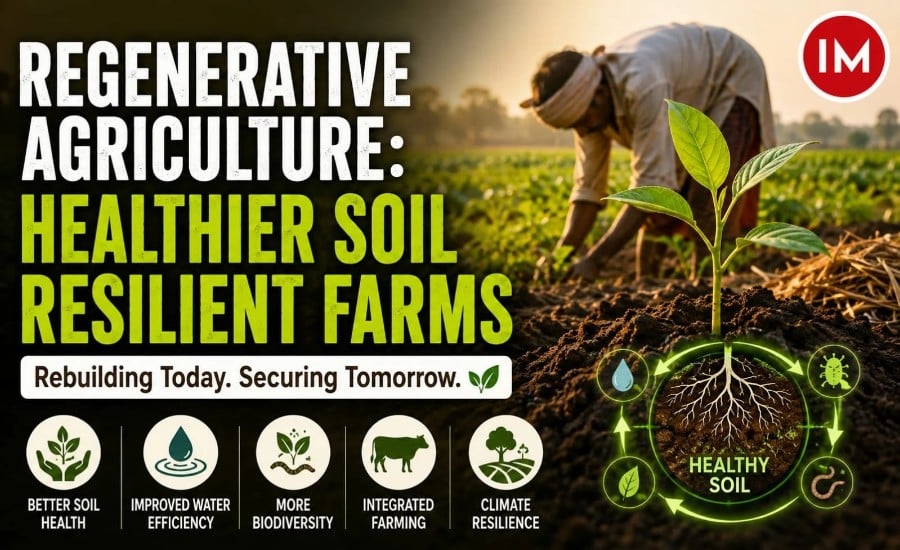
New Delhi: India is increasingly turning attention towards regenerative agriculture, a farming approach that goes beyond maintaining existing soil conditions and focuses on actively restoring soil health, biodiversity and the resilience of agricultural ecosystems.
The approach is gaining relevance as Indian agriculture seeks to sustain productivity while dealing with challenges such as soil degradation, erratic rainfall, water stress and rising dependence on external farm inputs.
According to the Ministry, India’s agriculture and allied sectors recorded 4.45% decadal growth during FY2016-17 to FY2024-25. Sustaining this growth, however, requires protecting the ecological resources on which agricultural production depends.
What Is Regenerative Agriculture?
Regenerative agriculture is a holistic approach to farming that aims to improve the health of the soil and wider ecosystem while maintaining agricultural productivity.
Read Also: “The Goal Is More Than Food Production”: Atish Chandra on the Future of Indian Agriculture
Unlike conventional sustainability approaches that primarily seek to prevent further degradation, regenerative agriculture focuses on restoring and improving the natural foundations of farming.
Its key principles include:
- Minimising soil disturbance
- Keeping soil covered
- Maintaining living roots, particularly of perennial crops
- Increasing biodiversity
- Integrating livestock into farming systems
- Reducing dependence on chemical inputs
Healthy soil can support better water retention, nutrient cycling and biological activity, making agricultural systems better equipped to cope with environmental stresses.
Why Does India Need Regenerative Agriculture?
India has a large and diverse agricultural sector that depends heavily on soil, water and climatic conditions. Continued intensive cultivation, inappropriate input use and increasing climate variability can put pressure on these resources.
For farmers, declining soil health can translate into higher input requirements and greater uncertainty in crop production. At the same time, droughts, excessive rainfall and heat stress can affect yields and farm incomes.
Regenerative agriculture seeks to address these challenges by improving the underlying health of farming systems.
The approach can help farmers through:
- Better soil health: Practices such as mulching, cover cropping and green manuring add organic matter and support soil structure.
- Improved water management: Micro-irrigation can deliver water more efficiently and reduce wastage.
- Greater biodiversity: Diverse cropping systems and agroforestry can provide habitats for beneficial organisms.
- Resource efficiency: Better nutrient and water management can reduce unnecessary input use.
- Greater climate resilience: Healthier soils and diversified farming systems can help farms cope with climatic variability.
From Natural Farming to Agroforestry: What Does It Look Like?
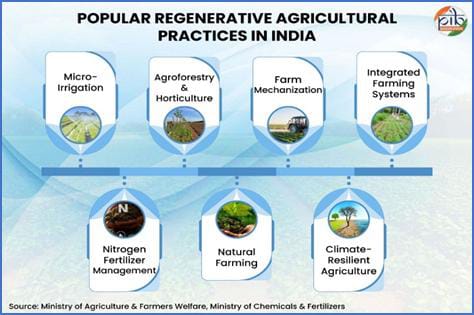
Regenerative agriculture is not a single farming technique. It brings together several practices that can restore soil and improve the efficiency of farm resources.
Natural Farming
Natural farming reduces reliance on synthetic agricultural inputs and uses biological and on-farm inputs such as Jeevamrit, Beejamrit and botanical formulations.
It also promotes practices such as:
- Mulching
- Multi-cropping
- Continuous soil cover
- Minimal soil disturbance
- Integration of livestock
- Use of traditional seed varieties
Integrated Farming Systems
Integrated Farming Systems combine crops with activities such as livestock, fisheries, horticulture, agroforestry and apiculture.
The integration allows different farm enterprises to complement one another while diversifying sources of income and reducing dependence on a single crop.
Agroforestry
Agroforestry combines trees with crops and other agricultural activities. It can provide additional sources of farm income while contributing to soil moisture conservation, biodiversity and carbon storage.
Micro-Irrigation
Drip and sprinkler systems under the Per Drop More Crop programme improve water-use efficiency by delivering water more precisely to crops.
Government Programmes Supporting the Transition
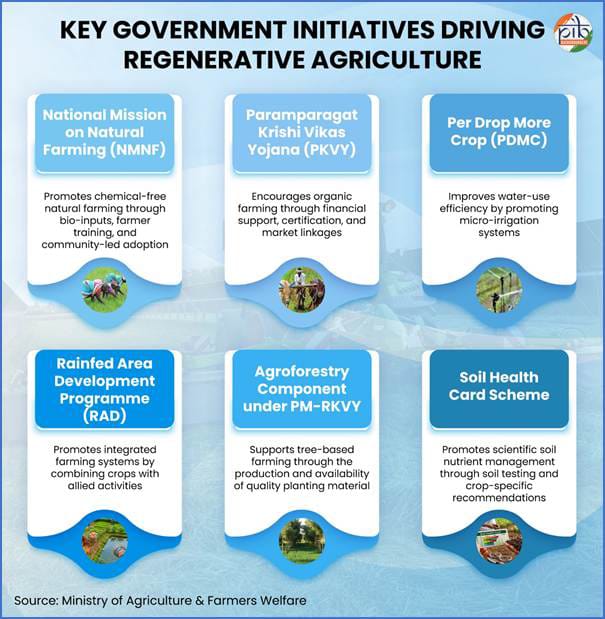
The government is supporting several components associated with regenerative agriculture rather than implementing it through a single standalone programme.
National Mission on Natural Farming
The National Mission on Natural Farming (NMNF) was launched in 2024 to support farmers transitioning towards natural farming.
As of March 5, 2026:
- 18,786 natural farming clusters had been formed.
- The clusters covered 8.80 lakh hectares.
- 18.19 lakh farmers had been enrolled.
- 33,676 Community Resource Persons had been trained.
Per Drop More Crop
The Per Drop More Crop scheme promotes drip and sprinkler irrigation to improve farm-level water-use efficiency.
As of May 2026, approximately 109 lakh hectares had been covered under the scheme, with ₹26,325 crore released as central assistance.
Soil Health Card Scheme
The Soil Health Card Scheme provides farmers with scientific information about the nutrient status of their soil and recommendations for appropriate fertiliser and soil management.
As of March 13, 2026, 25.89 crore Soil Health Cards had been generated since the scheme’s inception.
The cards assess soil conditions across 12 parameters, covering nutrients and other important soil properties.
What Could Regenerative Farming Mean for Farmers?
The focus of regenerative agriculture is not simply on reducing the environmental footprint of farming. Its objective is also to build productive and resilient farm systems.
The government identifies several potential benefits:
- Improved soil fertility and structure
- Better water retention and reduced runoff
- Greater resource-use efficiency
- Reduced dependence on certain external inputs
- Diversified farm activities and income sources
- Greater resilience to climate variability
- Improved conditions for long-term agricultural productivity
The approach therefore connects soil health with farm resilience and livelihood security.
The Larger Shift: From Maintaining Soil to Rebuilding It
The central idea behind regenerative agriculture is that soil should not be treated merely as a medium for growing crops. It is a living system that supports nutrient cycling, water management, biodiversity and plant growth.
For India, where agricultural livelihoods remain closely linked to natural resources, rebuilding this foundation is increasingly important.
With natural farming, integrated farming, agroforestry, soil-health management and efficient irrigation being promoted through different government interventions, regenerative approaches are becoming part of the broader effort to make Indian agriculture more resource-efficient, climate-resilient and productive over the long term.
Read Also: Bihar Targets 5,700 Hectares for Natural Farming in 2026–27, Farmers to Get ₹4,000 Per Acre