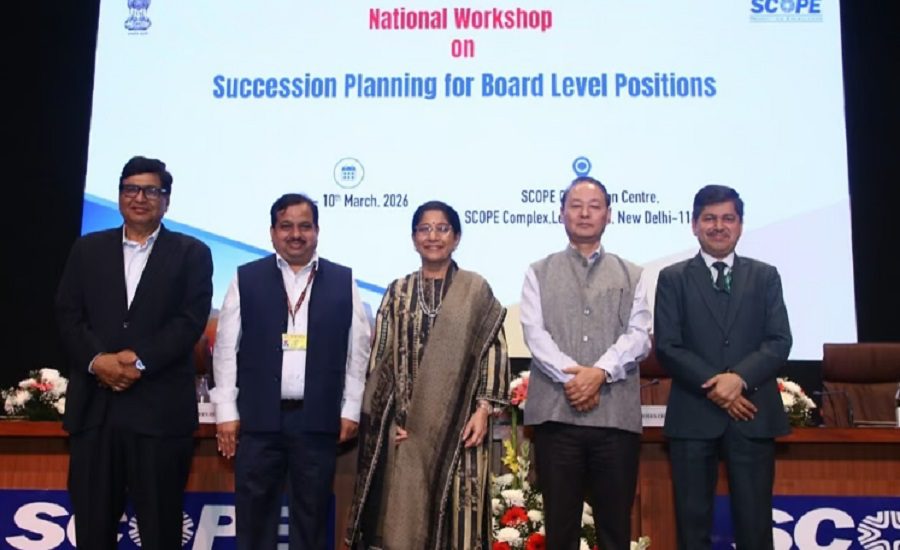
New Delhi: The Standing Conference of Public Enterprises (SCOPE) organized a national workshop on succession planning for board-level positions in public sector enterprises (PSEs), emphasizing the need to build a robust leadership pipeline to navigate increasing global competition and technological transformation. The event witnessed participation from over 100 senior officials representing PSEs across various sectors.
Inauguration by PESB and DPE Leadership
The workshop was inaugurated by Mallika Srinivasan, Chairperson of the Public Enterprises Selection Board (PESB), and K. Moses Chalai, Secretary of the Department of Public Enterprises (DPE). Senior leaders including K.P. Mahadevaswamy, Chairman of SCOPE and CMD of NBCC (India) Limited, Brajesh Kumar Upadhyay, Vice-Chairman of SCOPE and CMD of Goa Shipyard Limited, and Atul Sobti, Director General of SCOPE, were also present.
The program brought together CMDs, directors, and senior officials from PSEs, PESB, DPE, and the Central Bureau of Communication (CBC), creating a platform for knowledge-sharing and best practices in leadership succession.
Emphasis on Strategic Succession Planning
Addressing participants, Mallika Srinivasan emphasized that succession planning should be treated as a strategic imperative rather than a routine administrative exercise. She urged PSEs to identify high-potential talent early, provide them with diverse leadership experiences, and assign increasing responsibilities at appropriate stages in their careers to prepare future-ready leaders.
K. Moses Chalai highlighted the importance of building strong leadership pipelines as PSEs face rapid technological changes and global competition. He also emphasized the need for consistent recruitment strategies and greater participation of women in leadership positions to strengthen organizational competitiveness.
Role of Boards and Leadership Development
K.P. Mahadevaswamy spoke about the multidimensional role of boards in PSEs and stressed the importance of developing leaders equipped with effective decision-making skills and enhanced competencies. He noted SCOPE’s collaborations with national and international institutions to nurture leadership capabilities.
Atul Sobti highlighted the “five Cs” — Character, Competence, Commitment, Courage, and Compassion — as essential qualities for modern PSE leadership. He also described SCOPE initiatives like the DAKSH capacity-building program and the Advanced Global Leadership Programme as critical to grooming future leaders.
Brajesh Kumar Upadhyay added that leadership continuity and robust governance frameworks are vital as PSEs evolve into globally competitive organizations. He described the workshop as an important step in institutionalizing a seamless succession planning framework.
Focus on Visionary Leadership and Self-Reliant India
The workshop underscored the government’s vision of building a self-reliant India by fostering capable, visionary leaders in public sector enterprises. SCOPE announced its continued commitment to organizing such initiatives to ensure PSEs have a sustainable and effective leadership pipeline for the future.
About SCOPE
The Standing Conference of Public Enterprises (SCOPE) is a premier organization representing central public sector enterprises in India. It works to strengthen corporate governance, enhance operational efficiency, and promote professional management practices in PSEs. SCOPE also undertakes leadership development initiatives, capacity-building programs, and policy advocacy to support the growth and competitiveness of India’s public sector.
Read also: SCOPE Launches Harvard ManageMentor Program to Build Future-Ready Leaders in India’s Public Sector