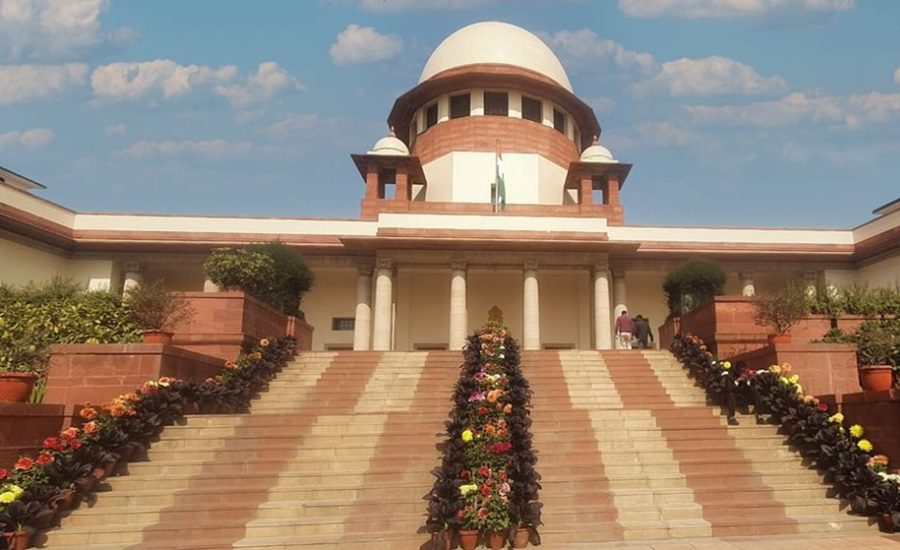
New Delhi: The Supreme Court on Friday, September 25, declined to entertain a Public Interest Litigation seeking directions to the Centre to constitute a commission to examine and recommend the use of Hindi as the official language of the apex court.
A bench comprising Chief Justice Surya Kant and Justices Joymalya Bagchi and V. Mohana said language-related reforms were already being considered through administrative processes and could not be introduced through judicial orders. The bench composition is also reflected in the Supreme Court’s official listing for September 25.
The PIL was filed by Brahmeshwar Nath Mishra, who sought a direction to the Centre to constitute a commission that could examine the issue and make recommendations regarding the use of Hindi as the official language of the Supreme Court.
PIL Sought Commission on Hindi in Supreme Court
The petition sought an institutional mechanism to examine whether Hindi could be adopted as the official language of proceedings and functioning in the Supreme Court.
The petitioner had asked the Centre to constitute a commission to study the matter and make recommendations. However, the bench declined to entertain the PIL, observing that reforms concerning language were already being considered administratively.
The Court’s response means that the issue, as raised through this particular PIL, will not be taken forward through a judicial direction to the Centre.
Read also: Supreme Court Gives States Four Weeks To Appoint Disability Commissioners Under RPWD Act
Court Says Language Reforms Are Administrative
The bench indicated that changes relating to the language used by the apex court are matters that can be addressed through administrative processes rather than being imposed through judicial orders.
This distinction is important because the petition was asking the judiciary to direct the executive to establish a commission for examining the issue.
The Court therefore did not enter into a broader determination on whether Hindi should or should not become the official language of the Supreme Court. Instead, it declined to use judicial directions as the mechanism for initiating the proposed language reform.
Supreme Court Has Already Expanded Hindi Public Information
The development comes at a time when the Supreme Court has itself taken steps to make information about its work available in Hindi.
On September 15, the Supreme Court announced a Hindi public information service, under which simplified Hindi summaries of important judgments as well as daily audio and video bulletins would be made available.
The Court’s website also provides judicial information and several resources in Hindi and other Indian languages. Its digital platform lists multiple Indian-language resources, including Hindi, Gujarati, Gurmukhi, Malayalam, Odia, Sanskrit, Tamil, Telugu and Urdu.
These initiatives are focused on improving public access to information rather than changing the official language of the Court’s proceedings.
Difference Between Public Access and Court Language
The latest development highlights a distinction between making judicial information accessible in Indian languages and formally changing the language used by the Supreme Court.
The PIL sought a commission specifically to examine the use of Hindi as the official language of the apex court. The Supreme Court, however, said such language-related reforms are already being considered administratively.
The decision therefore does not amount to a judicial ruling that Hindi cannot be used in the Supreme Court. It concerns the manner in which such a language reform can be pursued.
Language and Access to Justice
Language has wider implications for access to legal information, particularly for people who are more comfortable reading or understanding Indian languages.
Making judgments, public information and other court-related material available in Hindi can help a wider audience understand judicial developments. At the same time, any change in the formal language framework of a constitutional court would involve administrative, legal and institutional considerations.
The Supreme Court’s recent Hindi public information initiative shows that language accessibility is already being addressed through administrative and technological measures.
PIL Does Not Change Existing Language Framework
The rejection of the PIL does not itself introduce any change to the Supreme Court’s existing language framework.
Instead, the Court has indicated that language-related reforms should be considered through the appropriate administrative route. The petitioner’s proposal for a commission, therefore, was not accepted through the judicial process.
The development keeps the broader question of language accessibility in the judicial system within the administrative and institutional domain, while the Supreme Court continues to expand public-facing information in Hindi and other Indian languages.
Read also: Kerala High Court Clarifies Akshaya Centre Reservation Rules: No Mandatory Quota For Women Or PwDs