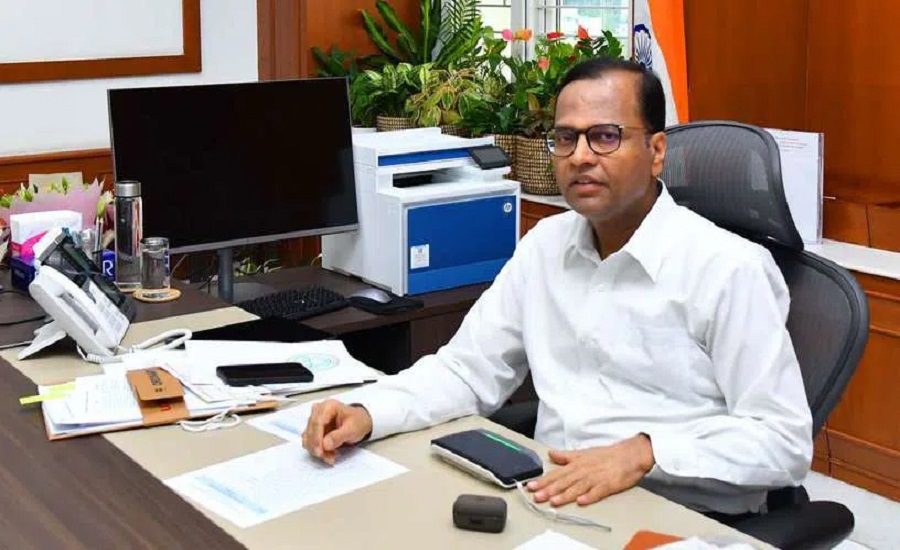
Hyderabad: In a move that ends weeks of intense bureaucratic speculation in Telangana, the Centre on Thursday approved a fresh three-month service extension for K. Ramakrishna Rao, allowing him to continue as Chief Secretary of the state until June 30, 2026. The extension, effective from April 1, 2026, comes after the state government formally requested the Union government to retain his services in view of ongoing administrative priorities and the need for continuity in governance.
The latest decision marks the second extension granted to the 1991-batch IAS officer of the Telangana cadre by the Union Ministry of Personnel, Public Grievances and Pensions, reinforcing his importance in the state’s top administrative structure at a time when multiple development initiatives and fiscal decisions are underway.
Second Extension Ends Weeks of Bureaucratic Uncertainty
For several weeks, senior bureaucratic circles in Telangana had been abuzz with speculation over who would succeed Rao at the state’s top administrative post. Several senior IAS officers were reportedly under consideration, and succession discussions had intensified as March-end approached.
However, the state government’s preference for continuity prevailed, with Chief Minister A. Revanth Reddy backing Rao’s continuation for another three months.
Officials indicated that the government wanted to avoid disruption during the fiscal transition period and while multiple key developmental and financial projects remain in critical stages of execution.
Earlier Seven-Month Extension Had Expired on March 31
K. Ramakrishna Rao was originally scheduled to retire in August 2025. However, given his central role in state financial management, the Telangana government had earlier sought and secured a seven-month extension, which was due to end on March 31, 2026.
With the newly approved extension, Rao will now remain in office until June 30, 2026, giving the government additional time to finalize succession planning for the Chief Secretary’s post.
The extension also ensures administrative continuity during the first quarter of the new financial year, traditionally a crucial period for state-level financial approvals, departmental allocations and project execution monitoring.
Why the Telangana Government Wanted Rao to Continue
Sources in administrative circles suggest that Rao’s retention was considered strategically important because of his unmatched grip over state finances and institutional governance systems.
His tenure has coincided with major fiscal restructuring exercises, budget formulation processes and digital governance reforms, making him one of the most influential bureaucrats in Telangana’s post-bifurcation governance history.
Officials believe that replacing him immediately could have affected continuity in key policy implementation areas, especially in finance-linked governance.
From Gooty to Telangana’s Top Bureaucratic Post
Born on August 30, 1965, in Gooty, K. Ramakrishna Rao’s journey reflects a combination of academic excellence and administrative precision.
He began his education in government residential institutions, including the AP Residential Junior College at Nagarjuna Sagar, where he built the academic foundation that later led him to India’s top engineering institutions.
IIT and Global Financial Education Shaped His Administrative Style
Rao completed his B.Tech. from Indian Institute of Technology Kanpur and later earned an M.Tech. from Indian Institute of Technology Delhi.
He further expanded his expertise internationally by pursuing an MBA in Investments from Duke University.
This rare combination of engineering, technology and finance gave him a distinct edge in public administration, especially in handling macro-fiscal systems and governance reforms.
Early Administrative Career: Field Governance and Grassroots Exposure
Before rising to the top bureaucratic rank, Rao held important district-level assignments that shaped his administrative profile.
He served as District Collector of Adilabad and Guntur, where he handled complex district governance responsibilities, including rural administration, tribal welfare and development coordination.
These field postings gave him direct experience in grassroots administration, which later influenced his governance style in higher policy roles.
Role in Education and Governance Reforms
Rao also served as Director of School Education, where he worked on strengthening foundational education systems and improving administrative delivery in the education sector.
His reputation for systematic governance grew further during his tenure at the Centre for Good Governance, where he contributed to institutional reforms and technology-led administrative systems.
Centre for Good Governance became one of the early platforms where Rao’s policy orientation toward digital governance gained prominence.
Architect of Telangana’s Fiscal Framework
His most defining contribution came as Special Chief Secretary (Finance), a position he held for nearly a decade.
During this period, Rao emerged as the principal architect of Telangana’s fiscal framework after the state’s formation in 2014.
He is widely credited with steering 14 consecutive state budgets, an achievement rarely matched by senior bureaucrats in India.
His financial stewardship helped Telangana navigate post-bifurcation institutional rebuilding, revenue balancing and expenditure prioritisation.
IFMIS: A Landmark Digital Financial Reform
Among his most significant administrative contributions is the implementation of the Integrated Financial Management & Information System (IFMIS).
The digital reform transformed financial governance in Telangana by bringing transparency, centralized monitoring and faster financial approvals across departments.
IFMIS is considered one of the most impactful digital fiscal systems introduced in the state’s governance architecture.
Appointment as Chief Secretary in 2025
On April 30, 2025, Rao was appointed Chief Secretary of Telangana, succeeding A. Santhi Kumari.
His appointment came at a time when the state required strong fiscal leadership and stable administrative coordination.
Even after reaching retirement age, the government continued to rely on his expertise, leading to repeated extension requests.
Why Rao Remains Central to Telangana Governance
Within administrative circles, K. Ramakrishna Rao is often referred to as “KRK” and is regarded as one of India’s most fiscally astute bureaucrats.
His strength lies in combining technical knowledge, financial discipline and policy execution capacity.
The latest extension underlines the confidence the Telangana government continues to place in his leadership during a critical administrative phase.
Succession Question Deferred, Not Closed
While the extension delays immediate succession, it also means the state government now has three additional months to identify and prepare the next Chief Secretary.
Senior officers within the Telangana cadre remain under watch as possible successors, but for now, Rao’s continuation ensures continuity at the top of the bureaucracy.
Read also: 12 Himachal Pradesh IAS Officers Appointed as Election Observers in Five Poll-Bound States