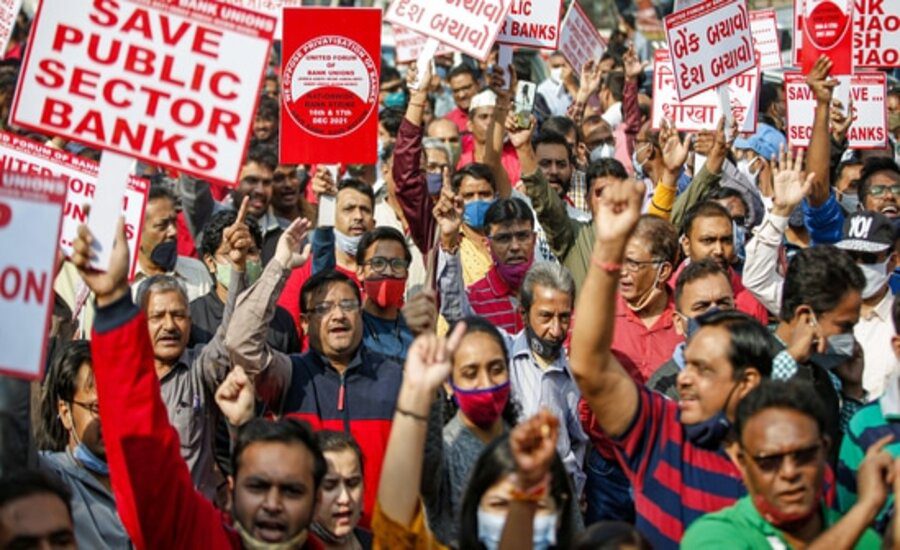
New Delhi: Nine unions representing lakhs of bank employees across India have launched a fierce protest against the Centre’s controversial decision to open leadership positions in public sector banks and insurance companies to private candidates
In a development that has sent shockwaves through India’s banking sector, the United Forum of Bank Unions (UFBU) has strongly condemned the government’s decision to allow private sector executives into top leadership roles at the State Bank of India, Public Sector Banks, and Life Insurance Corporation.
The umbrella body, representing nine major trade unions of officers and workmen across all banks, termed the move as “an attack on the public character of national institutions” and demanded immediate rollback.
Background of this protest against Backdoor Privatisation
The controversy erupted after the Appointments Committee of the Cabinet (ACC) issued revised consolidated guidelines on October 4, 2025, opening positions of Managing Directors, Executive Directors, Whole-Time Directors, and Chairpersons in PSBs and insurance companies to private sector candidates.
This marks the first time in history that the post of Managing Director at State Bank of India has been opened to private sector individuals, according to an October 8, 2025 order on revised selection guidelines.
UFBU has challenged the legal validity of these guidelines, stating they were issued without amending the enabling statutes—the State Bank of India Act, 1955, the Banking Companies Acts of 1970 and 1980, and the LIC Act, 1956.
De Facto Privatisation Through Executive Backdoors’
In a hard-hitting statement released on Friday, UFBU described the policy as “executive privatisation of leadership in statutory public institutions” that violates constitutional provisions.
The union forum emphasized that under Articles 73 and 77 of the Constitution, the Union Government’s executive powers must conform to laws made by Parliament.
Any alteration in qualification or appointment processes requires legislative amendment, not merely an executive order.
“By authorizing lateral entry of private-sector executives into statutory leadership positions, these guidelines alter the public character, accountability framework, and legislative intent underlying bank nationalization,” the statement noted.
Senior Bankers Express Concern Over Institutional Integrity
Beyond union opposition, senior public sector bankers have also raised red flags about the policy shift.
A senior banker, speaking on condition of anonymity, told Business Standard:
“This poses a serious risk to the institutional framework and culture of PSBs. The strength of institutions like SBI lies in the fact that a probationary officer can rise to become chairman through years of service and experience.”
The banker warned that allowing external entrants at the top may disrupt succession systems and affect operational decision-making, as the MD’s position is central to bank functioning.
APAR System Replaced by Private HR Assessments
UFBU has also criticized the removal of Annual Performance Appraisal Report (APAR)-based evaluation for top posts, which has been replaced with “behavioral and competency assessments” by private HR agencies.
The Financial Services Institutions Bureau (FSIB), the nodal agency for recommending appointments, has been empowered to hire HR agencies for candidate assessment.
UFBU warned that such subjective evaluations could invite bias, opacity, and cronyism, replacing objective performance records with discretionary assessments lacking transparency and auditability.
Impact of Backdoor Privatisation
The union forum cautioned that opening the highest posts to private executives while excluding career public-sector officers would demoralize the internal cadre and disrupt succession planning.
“Opening the topmost echelons to outsiders from private and corporate sectors while lifelong PSB officials remain ineligible will weaken the stewardship culture built since nationalization,” UFBU stated.
The move risks replacing lifelong public servants and nation-building bankers with transient corporate technocrats who lack the public service ethos that defines these institutions.
UFBU Stressed Public Institutions or Corporate Enterprises
UFBU stressed that PSBs and LIC are national institutions that symbolize public trust and play critical roles in financial inclusion, rural credit, and national development.
“PSBs like SBI represent national trust and are instruments of financial inclusion, not corporate enterprises driven by profit motives,” the statement emphasized.
The forum warned that importing private-sector executives risks undermining public ethos, fiduciary accountability, and sovereign responsibility to the people of India.
Five-Point Demand Charter of UFBU
The United Forum of Bank Unions has urged the government to:
1. Keep the revised ACC Guidelines (dated October 4, 2025) in abeyance pending detailed review
2. Constitute a Joint Stakeholder Committee comprising representatives from Department of Financial Services, RBI, FSIB, UFBU, and independent jurists
3. Refer the entire policy to the Parliamentary Standing Committee on Finance for comprehensive review
4. Ensure all future reforms in PSBs and insurance companies are placed before Parliament with stakeholder consultations
5. Preserve parity and internal succession within PSBs and SBI, ensuring leadership emerges from within the public-sector banking cadre
“We Will Not Allow backdoor privatisation’ – UFBU
Concluding its statement, UFBU declared: “This is not a policy adjustment but a structural assault on India’s public-sector edifice.”
“Public-sector banking and insurance are not commodities for experimentation; they are constitutional instruments of economic justice and national sovereignty.
The public-sector banking system is the backbone of India’s economic sovereignty. We will not allow its statutory character to be diluted or privatised through executive backdoors.”
What This Means for India’s Banking Sector
The controversy highlights the ongoing tension between reform and preservation of public sector character in India’s financial institutions.
While the government may argue that private sector expertise can strengthen PSB leadership, unions and career bankers see it as erosion of the public service mandate that has guided these institutions since nationalization.
The coming weeks will be crucial as stakeholders await the government’s response to UFBU’s demands and whether Parliament will be involved in reviewing this significant policy shift.
About UFBU
The United Forum of Bank Unions or UFBU is an umbrella body of nine national-level trade unions—AIBEA, AIBOC, NCBE, AIBOA, BEFI, INBEF, INBOC, NOBW, and NOBO—representing officers and employees across all public sector banks in India.