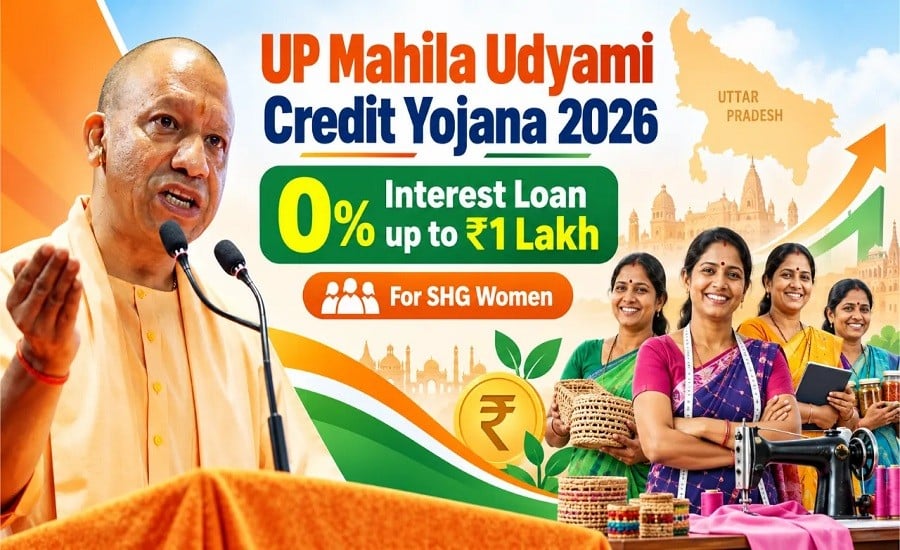
Lucknow: The Uttar Pradesh government is preparing to roll out the proposed Uttar Pradesh Mahila Udyami Credit Yojana, an interest-free credit scheme aimed at women associated with self-help groups. The scheme, announced in the Uttar Pradesh Budget 2026–27, is expected to benefit around one crore women and provide credit of up to Rs 1 lakh in three stages.
Credit to Be Provided in Three Stages
Under the proposed scheme, eligible women would receive credit in three tranches, with timely repayment determining eligibility for subsequent assistance.
The proposed structure is:
- First tranche: Rs 20,000
- Second tranche: Rs 30,000 after timely repayment of the first tranche
- Third tranche: Rs 50,000 after repayment of the second tranche
- Total potential credit: Up to Rs 1 lakh
The interest-free credit is intended to help women start new small businesses or expand their existing enterprises.
Read also: UP Targets 1 Million MT Green Hydrogen Capacity by 2028 With New Policy Push
Special Credit Cards Proposed for Women Entrepreneurs
Eligible women are expected to receive a special credit card under the proposed scheme. The card could be used to access funds for setting up or expanding small businesses.
Banks have reportedly prepared a preliminary framework for the proposed facility, while the Rural Development Department is working on the formal proposal.
Keshav Prasad Maurya Reviews Scheme Preparations
Deputy Chief Minister Keshav Prasad Maurya has directed officials to prepare the proposal for the credit scheme.
A high-level meeting of the Rural Development Department was held at Yojana Bhawan to review preparations and discuss measures to strengthen economic opportunities for women associated with self-help groups.
The scheme is being prepared ahead of the Uttar Pradesh Assembly elections and is part of the government’s broader focus on women’s economic empowerment.
Focus on Digital Empowerment of Self-Help Group Women
Along with providing financial support, the government is also looking to strengthen the digital capabilities of women linked to self-help groups.
Officials have been directed to explore the development of digital identification cards with QR-code features and greater integration with:
- Digital payment platforms
- Online marketing
- E-commerce
- Financial services
The proposed digital initiatives are intended to make it easier for women entrepreneurs to access markets, financial services and digital business platforms.
Government Examines Support for E-Rickshaws
The meeting also reviewed other measures aimed at expanding economic opportunities for women.
Officials were asked to examine the possibility of providing financial assistance of up to Rs 2 lakh for the purchase of e-rickshaws under an e-rickshaw scheme.
The proposal is expected to provide another avenue for women to establish independent income-generating activities.
100 Mahila Shakti Kendras Under Consideration
The meeting also discussed expanding financial assistance for women through other schemes.
Officials were asked to examine the possibility of providing assistance of up to Rs 2 lakh for purchasing e-rickshaws under a proposed e-rickshaw scheme.
The initiative could provide another avenue for women to develop independent livelihood opportunities and generate income through small businesses.
Scheme Comes Ahead of Assembly Elections
The proposed credit scheme comes amid increased political attention on financial assistance and economic empowerment for women ahead of the Uttar Pradesh Assembly elections. There had earlier been speculation about the government providing Rs 50,000 in financial assistance to women. However, no such announcement had been officially made at that time.
The proposed Mahila Udyami Credit Yojana now envisages a different structure, with interest-free credit being provided in three stages and the total potential benefit reaching Rs 1 lakh, subject to timely repayment.
The broader objective is to help women associated with self-help groups transition from conventional group-based activities to sustainable micro-enterprises, while improving their access to credit, digital tools, markets and financial services.