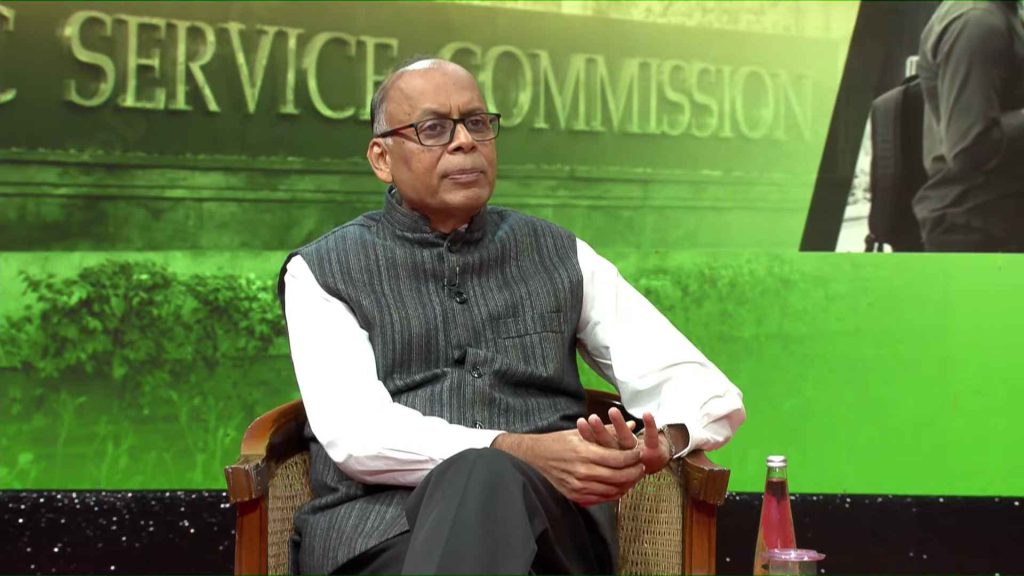
New Delhi: Union Public Service Commission (UPSC) Chairman Dr Ajay Kumar, a 1985-batch IAS officer of the Kerala cadre, has highlighted the need for examination processes to assess candidates on their reasoning, adaptability and ability to make decisions in uncertain situations, rather than relying primarily on prepared or model answers.
Kumar made the remarks during the ‘Shatabdi Samaroh – Manthan’, the two-day programme marking 100 years of the UPSC at Bharat Mandapam in New Delhi. The Commission’s centenary discussions focused on the evolving role of civil services, innovation in public administration and institutional values.
UPSC Chairman Highlights Reasoning and Decision-Making
Kumar said assessment should give importance to a candidate’s ability to reason, think intuitively and take decisions when faced with ambiguous situations.
Read Also: UPSC Turns 100: PM Modi to Release Commemorative Coin, Stamp and Landmark Judgments Book
The emphasis forms part of the broader discussion on how public-service recruitment can assess capabilities relevant to administrative responsibilities rather than simply testing the ability to reproduce prepared responses.
Trust, Transparency and Technology Guide UPSC’s Next Phase
Kumar outlined Trust, Transparency and Technology as three guiding principles for the Commission’s next phase.
He said institutions need to adapt to changing circumstances while preserving the principles underlying their constitutional role. The discussion also emphasised merit, fairness and equal opportunity in public-service recruitment.
UPSC has already introduced technology-based measures in its examination processes. These include a new online application portal, universal registration and other digital mechanisms. The Commission has also introduced measures such as face authentication and AI-based verification of Civil Services Examination attempts.
Digital Measures Being Expanded in Recruitment
The UPSC Chairman also referred to measures such as digital e-admit cards and face authentication as part of the Commission’s efforts to strengthen examination processes.
A July 2026 government statement said UPSC reforms had reduced the recruitment cycle from more than 15 months to about 13 months and listed the Modular Online Application Portal, AI-based verification, face authentication, provisional answer keys, a candidate helpdesk and expansion of examination centres among the measures introduced.
UPSC Handles Hundreds of Recruitment Processes
The Commission conducts the Civil Services Examination each year for recruitment to services including the Indian Administrative Service, Indian Foreign Service and Indian Police Service, besides conducting other examinations and recruitment processes.
UPSC also handles recruitment to various Group A and Group B gazetted posts across government departments. In 2025, the Commission said it had received more than 240 recruitment cases covering medical, scientific, engineering, technical, legal, teaching and specialised positions.
The Commission’s recruitment planning also involves advance scheduling. According to the remarks cited during the centenary discussions, its examination calendar is prepared well ahead of the examination cycle.
‘Manthan’ Discusses Future of Civil Services
The first session of the centenary programme focused on ‘Role of Civil Services in Viksit Bharat’. UPSC member Suman Sharma chaired the session, which included Chief of Defence Staff General N.S. Raja Subramani, former Foreign Secretary and Rajya Sabha member Harsh Vardhan Shringla, and Uttar Pradesh Public Service Commission Chairman Sanjay Sreenath.
The discussion covered the role of civil servants in translating government policies into outcomes, the participation of young people and candidates from smaller cities, and accountability in public administration.
A second session on ‘Innovation in Public Service’, chaired by UPSC member Lieutenant General Raj Shukla (Retd), discussed the potential use of artificial intelligence, data analytics and digital architecture in public administration.
UPSC’s Technology Journey Spans Decades
The Commission’s technology adoption predates its current digital reforms. The centenary discussions noted that computerisation in UPSC began in 1978, followed by successive changes to examination and recruitment processes.
Recent reforms include the introduction of a Universal Registration system and a new online application portal in 2025. The portal replaced the earlier One-Time Registration system and provides common modules that candidates can complete before applying for specific examinations.
UPSC Completes 100 Years
The UPSC’s institutional journey began on October 1, 1926, when the first Public Service Commission was established in India. It later became the Federal Public Service Commission in 1937 and was renamed the Union Public Service Commission after the Constitution came into force in 1950.
The year-long centenary celebrations began on October 1, 2025, and conclude on October 1, 2026. The celebrations have provided a platform for discussions on the Commission’s institutional history, recruitment reforms, technology and the future of public service.
Read Also: Supreme Court Advocate Anurag Kumar Appointed UPSC Panel Counsel Until September 2027