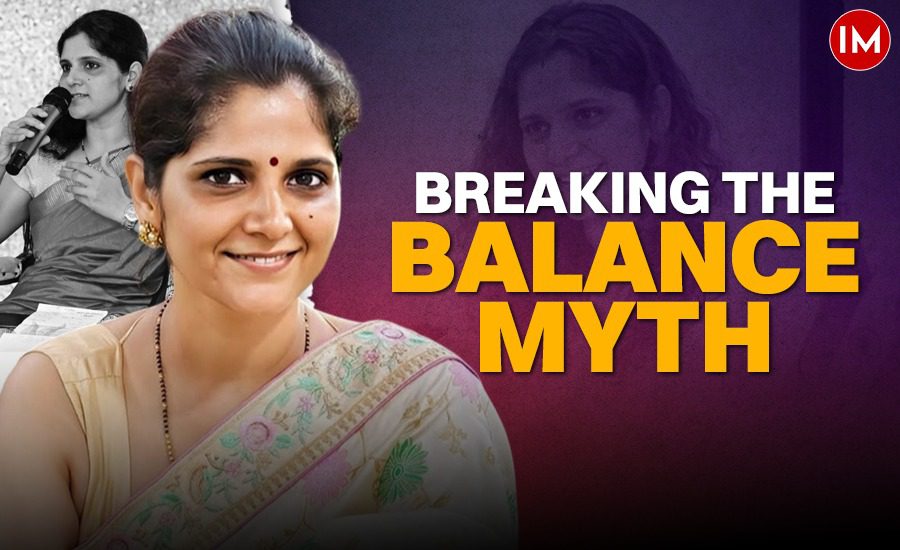
For many women, success often comes with an unspoken question—can you truly have it all?
A fulfilling career. A happy family. Personal peace.
The world often presents it as a choice. But for Anu Kumari (2018 batch, Kerala cadre), currently serving as the District Collector of Thiruvananthapuram since July 2024, the answer lies not in choosing one over the other, but in building a support system that makes both possible.
Her journey is not just about administrative success—it is about redefining how we look at ambition, balance, and the role of women in leadership.
THE MYTH OF DOING IT ALL ALONE
There is a common narrative that strong women do everything on their own. But Anu Kumari challenges this idea.
“Balancing career and family is not easy, and it is often difficult to achieve the best of both worlds,”she admits while talking to Indian Masterminds.
What made it possible for her was a supportive environment at home—something she considers crucial.
She believes that no individual, man or woman, can manage both career and family responsibilities without support.
This perspective is important, especially in a society where women are often expected to excel professionally while also carrying the primary responsibility of caregiving.
REDEFINING SUCCESS BEYOND WORK
For her, success is not just about professional achievements.
Family, relationships, and personal well-being hold equal importance.
“What are we working and earning for if not for peace and happiness in life?” she reflects.
She also emphasises the need to change how society defines success. Homemakers, she says, deserve the same respect as working professionals.
In a world that often glorifies hustle and burnout, her message is simple—balance matters, and well-being should not be compromised.
BREAKING SILENT BARRIERS
While overt discrimination may not always be visible, subtle biases still exist.
There have been moments when male staff found it difficult to take instructions from a woman officer. In such situations, she had to assert her authority more strongly.
Leadership styles, too, are often judged differently.
Her approach—based on empathy, collaboration, and teamwork—is sometimes perceived as weak compared to traditional authoritative styles.
But she sees strength in empathy.
And slowly, this perception is changing as more women take up leadership roles.
FROM CORPORATE TO CIVIL SERVICES
Before joining the civil services, she worked in the corporate sector—a world very different from government systems.
The transition was not easy.
Corporate environments are fast-paced and efficiency-driven, while governance involves complexity, scale, and multiple layers of decision-making.
Initially, the slower pace felt frustrating. But over time, she adapted.
She understood that governance is not just about speed—it is about responsibility and impact on millions of lives.
INSPIRING THE NEXT GENERATION
Her message to young girls, especially from small towns, comes from personal experience.
She recalls moments of self-doubt when she compared herself to more confident, English-speaking peers.
But instead of giving in to those doubts, she worked on improving herself.
“Never doubt your potential. Dream big and work towards it,” she advises.
Her emphasis is on discipline, self-belief, and making the best use of available resources.
LEADING WITH PURPOSE
As District Collector, she continues to lead impactful initiatives like Project X, focusing on comprehensive sexuality education, and has been recognised for her work in district election management.
Her leadership reflects both strength and sensitivity—a combination that is increasingly defining modern governance.
A NEW DEFINITION OF EMPOWERMENT
Anu Kumari’s journey reminds us that empowerment is not about doing everything alone.
It is about building support, making conscious choices, and redefining success on one’s own terms.
In doing so, she is not just shaping policies—she is shaping perspectives.
And perhaps that is her most powerful contribution.