In the farmlands of Andhra Pradesh, what once symbolised prosperity had turned toxic. Years of unchecked chemical farming had seeped deep into the soil and water. In a few villages of Guntur, traces of pesticide residues were even found in mothers’ milk. The food that was meant to nourish had begun to harm. The land was still green, but it was quietly dying.
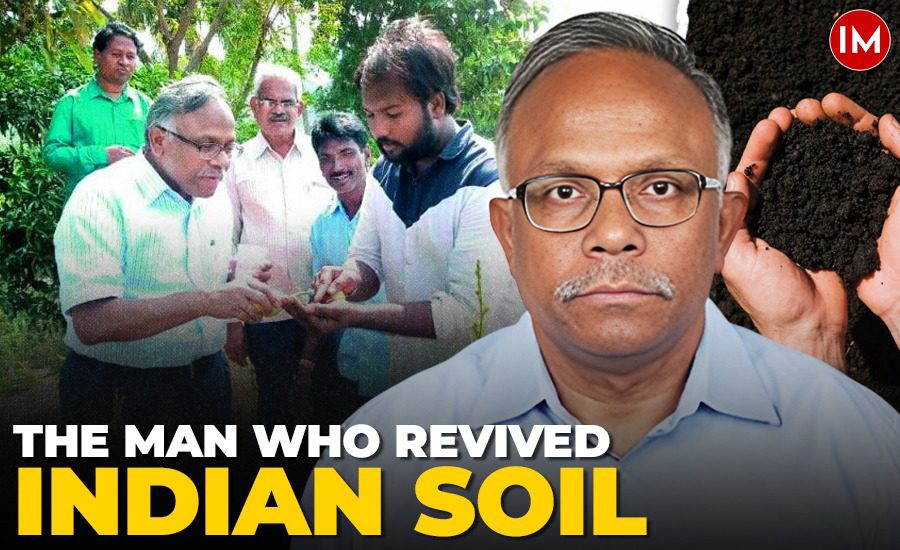
Amid this slow decay, a quiet shift began. Farmers started talking about an alternative. A method that didn’t rely on fertilisers, didn’t pollute the soil, and didn’t burden them with endless loans. It was called Zero Budget Natural Farming, and at the centre of this shift was a man who had spent most of his life working for rural India, Mr. T Vijay Kumar.
FROM SECRETARIAT TO SOIL
T Vijay Kumar had retired from the Indian Administrative Service in 2016. He had served in key positions in the Tribal Welfare, Rural Development, and Agriculture departments of Andhra Pradesh. Most would have walked away at that point. He chose to stay.
Post-retirement, he became Adviser to the state government on agriculture and was made Vice-Chairman of Rythu Sadhikara Samstha, a non-profit institution tasked with transforming the state’s farming practices. He did not arrive with speeches or big declarations. He arrived with intent.
Natural farming, as he envisioned it, involved no synthetic fertilisers or pesticides. It required nothing external. Farmers used cow dung, cow urine, neem leaves, jaggery, gram flour, and microbial solutions prepared at home. It was local, it was inexpensive, and most importantly, it was sustainable. The idea was inspired by Subhash Palekar, a farmer from Vidarbha, who had developed the concept decades ago. Kumar brought him to Andhra Pradesh for a massive training session that drew thousands. What followed wasn’t a seminar. It was ignition.
SPEAKING THE LANGUAGE OF THE FARMER
Kumar understood something that most bureaucrats didn’t. Change doesn’t happen in offices or policy papers. It happens in villages, in conversations between farmers, in early morning field visits, and in shared meals. He pushed for the creation of a local network of trained farmers who could become the face of the movement in their own villages.
These community resource persons, trained intensively in natural farming, began to reach out to other farmers. Not as experts, but as peers. When one farmer saw his neighbour achieving decent yields without chemical inputs, curiosity replaced resistance. Word spread faster than any pamphlet could.
Over time, the numbers started to grow. From a few hundred to thousands, and then to lakhs. The villages started shifting. Slowly but surely, fields that had long depended on urea and DAP were now smelling of neem and cow dung. It was not just a new practice. It was a new rhythm of farming.
A HISTORY OF WORKING WITH THE MARGINS
T Vijay Kumar had spent years working with communities on the edge. As head of the Girijan Cooperative Corporation in the early 90s, he worked with tribal families on forest-based livelihoods. Later, as CEO of the Society for Elimination of Rural Poverty, he oversaw one of the largest women empowerment programmes in the country. Millions of rural women were brought together in self-help groups, saving money, accessing bank loans, and transforming household incomes.
Those same women would now become a quiet but powerful force in the natural farming movement. They prepared the bio-inputs. They insisted on growing food that didn’t harm their children. They encouraged their husbands to shift methods. They understood health in a way few others did. Natural farming entered homes not through policy but through maternal instinct.
A FILM, A MOVEMENT, A VOICE
In 2023, documentary filmmaker Renuka George captured this entire shift in a film titled Indian Soil in Revolution. The film followed farmers in Andhra Pradesh and traced how this new way of farming had taken hold. At its centre was Kumar, not shown as a bureaucrat, but as someone who had become part of the land’s story.
The film was screened in Europe before making its way to India. At the Delhi screening, Kumar joined the conversation virtually. The questions from the audience were varied; they were about yield, cost, acceptance, and training. His answers were clear. There was no sugarcoating. The transition was hard. The early months could bring lower yields. But once the soil began to heal, the land gave back. What was needed was patience.
Farmers in some districts, especially those who had once benefitted from the Green Revolution, were sceptical. They feared losing income. Kumar didn’t push them. He promised to walk with them through the transition. His appeal wasn’t dramatic. It was quiet and logical. Let the soil return to its natural state, and it will reward you.
NO SHORTCUTS, NO FREEBIES
One of the defining features of the programme was its refusal to rely on subsidies. Farmers were not lured with money. They were shown an alternative. If they believed in it, they could adopt it. If they didn’t, they were free to wait.
That honesty gave the movement strength. There was no pressure, only proof. When farmers saw that their neighbours were spending less, staying out of debt, and still producing food, they followed. The fields changed not because they were told to change, but because they were shown something better.
A RETURN, NOT A REVOLUTION
T Vijay Kumar doesn’t like calling it a revolution. He says it is the most natural thing in the world. The soil is being allowed to breathe again. The food is becoming safer. The farmer is finding a way out of a system that had trapped him for decades.
As of now, more than eight lakh farmers in Andhra Pradesh have adopted natural farming. The plan is to reach sixty lakh by 2024 and to cover ninety per cent of the cultivable land by 2026. These are numbers that few believed possible. But they are slowly turning into reality.
A LEGACY BEYOND THE DESK
For someone who spent a lifetime in service, Kumar’s most impactful work may be what he is doing now, outside government buildings, away from headlines, standing under trees in a farmer’s backyard, talking about microbes in cow dung.
He isn’t pushing a miracle. He is just helping the land return to what it once was. And in doing so, he is helping thousands of farmers return to a way of life that brings health, stability, and pride.
This is not a story of innovation. It is a story of remembering. The answers were always there. Someone just had to listen.