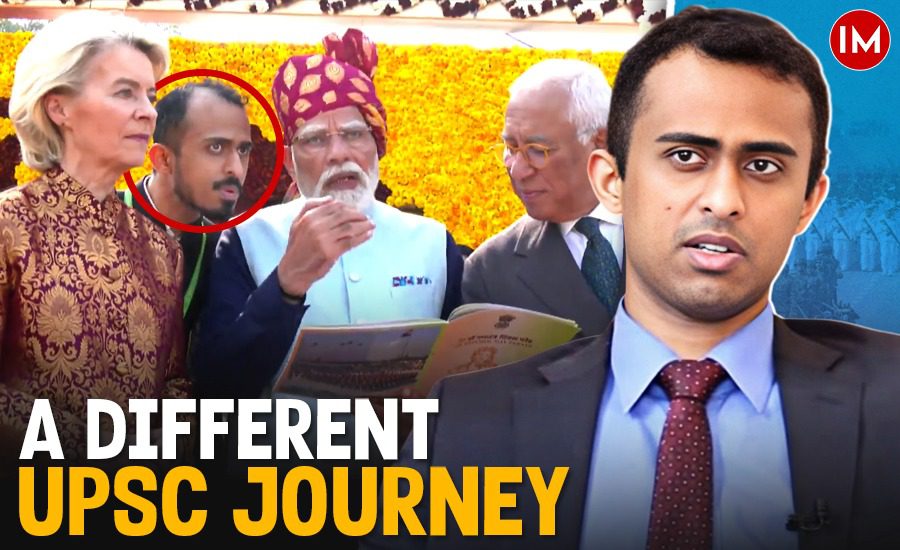
At India’s 77th Republic Day parade, as tanks rolled past Kartavya Path and cultural tableaux narrated the story of a nation, a quiet moment unfolded on the VIP podium. Standing beside Prime Minister Narendra Modi, a young man was seen leaning in, listening carefully, and translating with ease for the chief guest, European Commission President Ursula von der Leyen. He wasn’t part of the parade, yet he caught the attention of millions watching closely.
The interpreter was Siddharth Babu, a 2017-batch Indian Foreign Service (IFS) officer. In a ceremony dominated by spectacle, his composed presence and effortless command over language made him an unexpected talking point. But the Republic Day moment was only a snapshot of a much larger journey – one shaped by curiosity, calm decision-making, and a refreshingly grounded approach to the UPSC Civil Services Examination.
A KERALA CHILDHOOD AND AN ENGINEERING START
IFS Siddharth Babu hails from Kochi, Kerala, growing up in Kaloor in a middle-class household that valued education but did not necessarily chart a predefined path to the civil services. Academically inclined, he pursued mechanical engineering, a choice that aligned with conventional expectations of stability and professional growth.
After graduation, he joined the e-commerce sector and began working in the private industry. By most standards, he was on a solid career track. Yet, even while navigating corporate routines, his interests stretched beyond balance sheets and deadlines. International affairs, geopolitics, and diplomacy increasingly caught his attention.
This interest did not emerge from textbooks alone. Hollywood films centered on the Cold War, espionage, and global power equations sparked early curiosity. More importantly, a television programme – *India’s World* – played a decisive role. The show, which featured discussions by retired diplomats and leading academics, offered Siddharth a practical window into how foreign policy is shaped and executed.
For the first time, diplomacy felt tangible and accessible, not abstract. It planted a question that would not fade: could this be a way to serve the country on a global stage?
CHOOSING UPSC WITHOUT THE DRAMA
Until 2014, Siddharth had not seriously considered the UPSC Civil Services Examination. Once the idea settled, however, he made a decisive move—resigning from his job to prepare full-time. Unlike many aspirants driven by rigid routines and extreme isolation, Siddharth’s preparation philosophy evolved through experience.
His first attempt at the UPSC exam did not yield success, but it delivered clarity. He realised that the exam rewards much more than accumulated information. Strategy, pattern recognition, and answer presentation mattered as much as content. Simply knowing facts was not enough; understanding how to apply them under exam conditions was essential.
Crucially, he also learnt something personal: stress did not improve his performance. His earlier experience preparing for the CAT exam had already shown him that anxiety drained focus rather than sharpening it. For the civil services, he consciously chose a different route.
A BALANCED SECOND ATTEMPT
During his second attempt, Siddharth refined both his academic and mental approach. He remained structured where necessary but allowed space for balance. He continued meeting friends, even during intense preparation phases. If someone visited him in Kochi or Delhi, he made time to meet them. Preparation, for him, did not mean disconnecting from life.
Networking also became part of his learning process. Siddharth reached out to Bharath Bhushan, the journalist who anchored *India’s World*. The interaction proved transformative. Through Bhushan, he met retired diplomats who shared candid accounts of their careers—the challenges, the compromises, and the satisfaction of representing India abroad.
These conversations grounded him. They expanded his understanding of diplomacy beyond exam syllabi and reinforced his motivation during moments of doubt. They also helped him accept that setbacks are part of long professional journeys, not endpoints.
Academically, he focused on identifying patterns in questions, refining answer structures, and aligning preparation with the demands of the exam rather than chasing completeness. He openly admits that he left significant portions of the syllabus untouched. Luck played its part, as it does for every candidate, but preparation met opportunity.
The result was All India Rank 15 in the Civil Services Examination—an outcome that placed him among the top candidates in the country.
AN INTERVIEW THAT REFLECTED HIS PERSONALITY
Siddharth’s personality – relaxed yet attentive – also shaped his performance in the UPSC interview. The panel interaction, by his own account, was straightforward. He did not attempt to project an image or force responses. Instead, he stayed composed and honest, drawing on clarity rather than theatrics.
He believes the key difference between his first and second attempts was balance. Being overly casual had not worked earlier, but neither did excessive pressure. Finding the middle ground made all the difference.
LIFE IN THE INDIAN FOREIGN SERVICE
After joining the Indian Foreign Service, Siddharth’s academic and professional interests aligned seamlessly. His training included a stint at the Middlebury Institute of International Studies in Monterey, known globally for diplomacy, international policy, and language studies.
Today, he serves as an Divisional Secretary in the Ministry of External Affairs (MEA). His work involves policy inputs, coordination, and engagement on international matters – tasks that demand both precision and perspective. Language skills form a critical part of this role, as was evident during the Republic Day ceremony when he interpreted at the highest diplomatic level.
That moment on Kartavya Path symbolised years of quiet preparation. It was not about visibility, but responsibility – ensuring clear communication between world leaders during a globally watched event.
LESSONS FOR UPSC ASPIRANTS
IFS Babu’s journey offers practical insights for UPSC aspirants and young professionals alike:
- Preparation is not about covering everything; it is about covering what matters well.
- Staying calm can be a strategic advantage, not a weakness.
- Learning from people who have walked the path before can reshape understanding.
- A fulfilling preparation journey does not require cutting off from friends or life outside books.
His story challenges the stereotype of the perpetually stressed aspirant and shows that self-awareness can be as important as discipline.
A QUIET ROLE MODEL FOR A NEW GENERATION
From a mechanical engineering graduate working in e-commerce to an IFS officer interpreting between global leaders, Siddharth Babu’s path reflects how modern civil servants are shaped—by curiosity, adaptability, and thoughtful choices rather than rigid templates.
The Republic Day spotlight may fade, but his journey continues, desk by desk and dialogue by dialogue, contributing to India’s engagement with the world. For aspirants watching from afar, his story reassures that success does not demand constant strain. Sometimes, clarity and calm are the most effective tools of all.