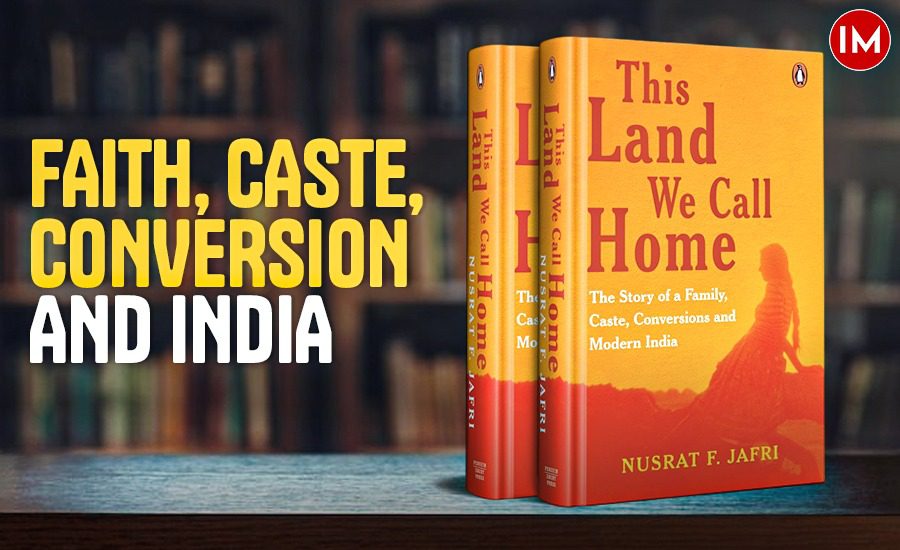
Identity in India is rarely linear today — even if one’s parents are from the same area, one’s own life may be shaped by other geographies inhabited for study or work. Language is contentious for this reason, and regionalisms are becoming narrower in an effort to preserve some semblance of easy explanation. But, as Nusrat Jafri’s This Land We Call Home: The Story of a Family, Caste, Conversions, and Modern India points out, we are each composed of pluralisms and each a part of this vibrant country regardless.
Jafri is a cinematographer, and this autobiographical book is rich with visual imagery. It begins with her maternal great grandparents Hardayal and Kalyani Singh rebuilding their lives in Uttar Pradesh in the haunting shadow of their camp being set on fire. Originally from Rajasthan, they belonged to the nomadic Bhantu tribe which claims Rajput descent from the army of Rana Pratap and through the Raja Sansamal. Persecuted by the British under the Thuggee and Dacoity Suppression Acts between 1836 and 1848 for their Robin Hood looting of the rich, they were seen with even greater suspicion after the Revolt of 1857. By 1871, Bhantus were listed in the Criminal Tribes Act under which Hardayal Singh’s grandfather was exiled to the Kala Pani jail in the Andaman and Nicobar Islands. Prevailing European 19th century paranoia about hereditary criminality led to their designation as ‘Born Criminals’. Despite being indigenous inhabitants – whose code of faith includes pathar puja to stone deities in front of whom no lie is permitted – Bhantus were stigmatized, and nobody helped when their home was ablaze. The Salvation Army stepped in with food and shelter: ‘The sick received medical aid, however, what stood out the most for the distressed Bhantus was not the material help, but the respect and empathy they received without discrimination or prejudice.’
Although the East India Company had initially forbidden missionary work, the Crown was influenced by Anglican Evangelism. As Jafri notes, government census data between 1881 and 1911 shows an increase of nearly 40% in Indian Christians (within an overall population increase of 2.5% in India ) This was due to the Methodist Church’s focus on education and healthcare. Between 1922 and 1953, prison-like reformatories were established for ‘criminal tribes’, but there were also genuinely helpful educational institutions by individuals like Clara Swain and Isabella Thoburn which had easier access for those already conversant with English. An element of gender equality was promised within Christianity, as well as the boon of castelessness — the act of singing hymns together was itself a keen joy of community.
Reverend Hardayal Singh, as he became known after studying at the Bareilly Theological School, ensured that his children had the finest education possible. Six of his daughters went on to become nurses, with one joining the Auxiliary Nursing Service India. The youngest, Prudence, named after one of the four classical Christian virtues (alongside courage, temperance, and justice) grew up visiting the riverside with her mother Kalyani and a favourite water buffalo named Moti. Her education was sponsored in part by an elder sister; she rode horses, played baseball, and once posed for headshots which ended up being shortlisted for the film Jwaar Bhata opposite Dilip Kumar. Eventually she married assistant jailer and closet revolutionary John Wilson Bunch in Lucknow.
Their firstborn Meera, named after Mirabai, was a breech baby delivered on the full moon Holika night of March 1947. Considered to have the special powers endowed to those born in this leg-first position, Meera was frequently requested to kick the backsides of various persons suffering from aches. It was the year of Independence in a time that re-shaped the subcontinent. Jafri weaves the familial and national into a singular picture. Through both lenses, she is unsparingly honest: John’s alcoholism and the friction between the sisters is written about in the same candour with which she approaches the thorny histories of those political parties which emerged in the aftermath of India choosing its own leaders.
A committee with Morarji Desai, BG Kher, and Gulzari Lal Nanda had already been formed to redress the colonial Criminal Tribes Act, which led to a repeal, but subsequently the Habitual Offenders (Control and Reform) Act of 1952 recast ‘denotified tribes’. Very little actually changed. Jafri writes: ‘In the face of this disheartening reality, I find myself pondering how the narrative of my family’s past might have unfolded without conversion and access to education.’ Western education was a factor in Prudence’s conversion to Catholicism. Although Meera briefly sacrificed schooling to care for her younger siblings, she was later encouraged to sit for the national medical entrance exams. At the Krishna Coaching Institute, she met Physics tutor Syed Abid Ali Jafri. Meera’s father and aunts disapproved, but the two wed, and thus ‘…merely ten years after her family’s conversion to Catholicism and half a century since Hardayal’s conversion to Christianity, Meera embarked on her own spiritual path of self-discovery.’
Meera was devoted to her Islamic studies as Abid was to scientific education, and the couple’s progeny – including the author – inherited a dynamic faith. They watched the Asian Games and the Ramayana on television during the 1980s in a fascination which mutated uneasily during the demolition of the Babri Masjid in the next decade. Deeply grateful for her multicultural identity whilst also critical of caste narrowness in all the religions inhabited by her family, Jafri went on to study at Delhi University and married a Hindu Bengali man in 2011.
The book was written with the support of a South Asia Speaks Fellowship and features interviews with scholars including Dakxin Bajrange Chhara and Sarovar Zaidi. Its cast of characters includes neighbours, friends, relatives – and Hardayal Singh’s beloved goat Gadri, named after the village in Ajmer where his wife was born. Ambitiously conceived and steadily sincere, it ends on an another evocative scene: in Mumbai’s August Kranti Maidan where Mahatma Gandhi delivered a ‘Quit India’ speech in 1942, Nusrat Jafri finds herself in 2019 helping two hijabi schoolgirls hold up the tricolour flag of India. The crowd is singing the national anthem. To the reader, another favourite song of this fascinating family comes to mind as prayer — We Shall Overcome.