When Asha Sinha entered the Indian Police Service in 1982, women in uniformed leadership were still a rarity. The corridors of policing were dominated by men, and the idea of a woman commanding a paramilitary unit was almost unimaginable.
Over the next three decades, she quietly dismantled those assumptions — not through slogans or spectacle, but through competence, calm authority and an unwavering commitment to duty.
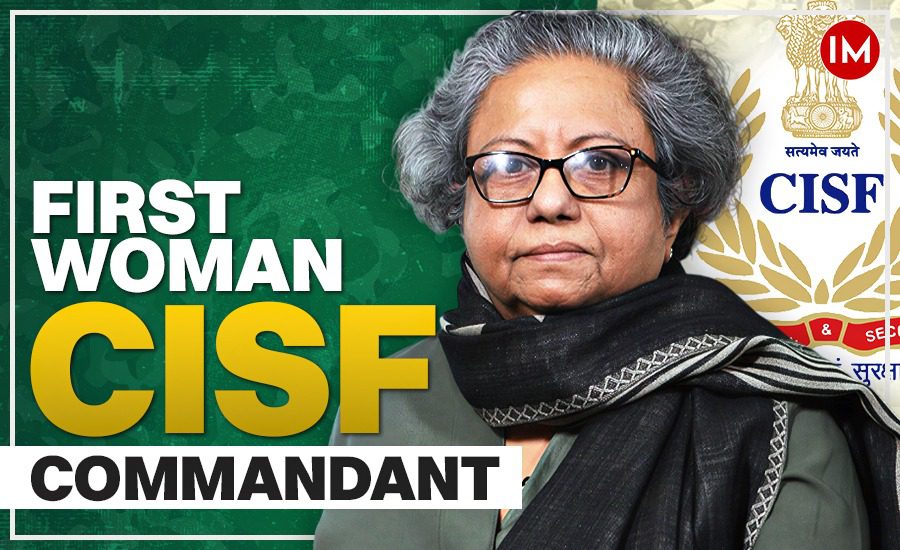
A 1982-batch IPS officer of the Jharkhand cadre, Asha Sinha went on to become the first woman in India to command a paramilitary force unit, leading the Central Industrial Security Force unit at Mazagon Dock Shipbuilders Limited in Mumbai. Later, she would also head two of the most sensitive policing arms in Jharkhand — Special Branch Intelligence and CID (Crime Branch) — during periods marked by insurgency threats and complex law-and-order challenges.
Yet, throughout her career, she maintained a simple philosophy: do the work sincerely and let integrity speak for itself.
From Kerala Classrooms to the IPS
Born in Kottayam, Asha Sinha (born Asha Thampan) grew up in an academically inclined household. Her father, P.K. Thampan, worked as a chartered accountant with the Kerala State Electricity Board, while her mother Valsamma Thampan managed the household.
She completed her schooling at Holy Angels’ Convent and pursued both her graduation and post-graduation at Government College for Women.
Her early career began in academia, teaching at All Saints’ College and S. N. College. She later joined the General Insurance Corporation of India as an Assistant Administrative Officer.
But the pull of public service proved stronger. In 1982, she cleared the Union Public Service Commission civil services examination and joined the IPS — beginning a career that would redefine possibilities for women in policing.
Breaking Barriers in Uniform
In the early 1980s, there were barely 15 women IPS officers in the entire country. Acceptance within the system did not come easily.
Field postings as Sub-Divisional Police Officers were particularly challenging. Women officers had to constantly prove that they were capable of handling the same pressures as their male counterparts.
Yet Asha Sinha approached the challenge with quiet confidence.
“IPS training prepares every officer, regardless of gender, to lead from the front. Leadership is earned through competence and integrity.”
Over time, that competence earned her both respect and critical assignments across multiple states — including Bihar, Maharashtra and later Jharkhand.
Commanding a Paramilitary Unit — A Historic First
One of the defining chapters of her career came in 1992, when she was deputed to the Central Industrial Security Force.
She was appointed Commandant of the CISF unit at Mazagon Dock Shipbuilders Limited in Mumbai, making her the first woman in India to command any paramilitary force unit.
The assignment was far from symbolic. Mazagon Dock is one of India’s most sensitive defence installations, employing a large and diverse workforce.
During her tenure, she strengthened high-level security protocols, tackled theft networks, and helped resolve long-standing labour issues within the establishment.
Her leadership was tested even more during the tense aftermath of the 1993 Mumbai serial blasts, when security across Mumbai’s critical infrastructure was under extreme pressure.
Despite the volatile environment, the installation under her command remained secure.
Steering Intelligence During Insurgency
After returning to her cadre, Asha Sinha took on some of the most sensitive intelligence assignments in Jharkhand.
She was appointed head of the Special Branch Intelligence shortly after the killing of Special Branch Inspector Francis Indwar by Naxalites — a moment that had shaken the morale of the intelligence apparatus.
Soon afterward, the state faced simultaneous Lok Sabha and Assembly elections, accompanied by serious Naxalite threats and heavy VVIP movement.
Managing intelligence inputs, security planning and coordination during that period demanded both strategic thinking and rapid decision-making.
Later, she also headed CID (Crime Branch), making her the first woman IPS officer to lead both intelligence and criminal investigation wings in the state.
A Career Guided by Simple Principles
Across 34 years of service — from ASP in Patna to Director General rank in Jharkhand — Asha Sinha adhered to a set of principles that defined her leadership style.
She believed that postings should not be pursued through influence but earned through work.
“There is no good or bad posting — every assignment is an opportunity. I never lobbied for posts; I simply focused on doing my job.”
Her career eventually culminated in senior leadership positions such as Director General and Commandant General of Home Guards and Fire Services and Director General (Training) in Jharkhand Police.
In recognition of her distinguished service, she was awarded the President’s Police Medal for Meritorious Service in 2010.
Balancing Duty and Family
Like many women officers of her generation, Asha Sinha navigated the demanding balance between a 24×7 policing career and family responsibilities.
Her husband, Sanjoy Sinha, joined the civil services in 1983 and served in the Indian Customs. Together they raised two children — Abhishek Sinha, now an advocate, and Vaishnavi Sinha, a journalist.
She often acknowledges that such careers require strong support systems — family, relatives and trusted help — to sustain the intense pace of public service.
A Legacy of Inclusion and Professionalism
Even years after retirement, Asha Sinha continues to be remembered within police circles as a pioneer who demonstrated that authority in policing flows from professionalism, not gender.
Throughout her career she consistently advocated diversity, fairness and equal opportunities within the police force.
Her journey also mirrors the transformation of Indian policing itself — from an era without computers or mobile phones to one grappling with cybercrime, digital surveillance and complex security threats.
Today, as increasing numbers of women join the Indian Police Service, her story stands as a reminder of the generation that first opened those doors.
Asha Sinha never sought power or visibility. Yet through integrity, discipline and quiet determination, she carved a legacy that continues to inspire young officers across the country.