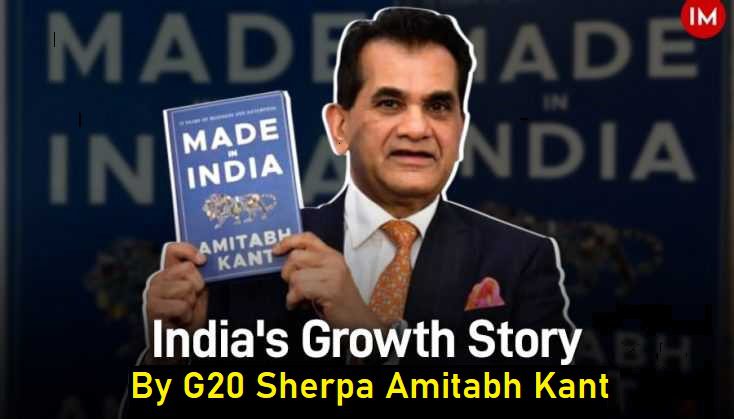
When India’s G20 Sherpa Amitabh Kant comes out with a new book that goes by the title ‘Made in India’, it is bound to arouse curiosity and expectation. Expectation because the author is a key driver of the ‘Make in India’ campaign. Curiosity because one would like to know whether the transition from ‘Make’ to ‘Made’ has been made. The fact is, the book goes far beyond that. It transcends the boundaries of success’ benchmarks to trace a journey of 75 years of economic evolution which is intrinsically linked to the rise of private enterprise.
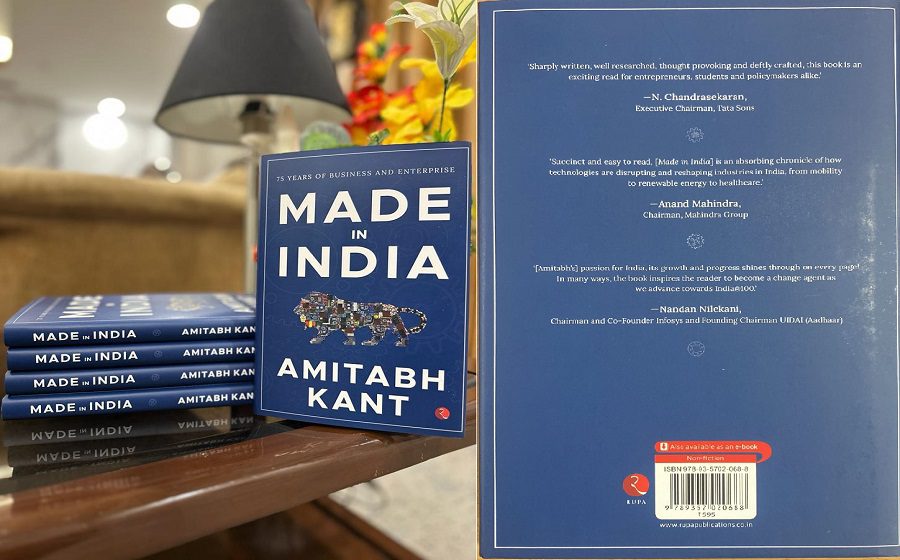
The book, Made in India: 75 Years of Business and Enterprise, is a comprehensive exploration of India’s economic journey post-Independence, focusing on the pivotal role played by private enterprise in shaping its growth trajectory. It showcases how private businesses have been the driving force behind India’s remarkable evolution from a nation that emerged from colonial constraints to becoming a global economic powerhouse.
Speaking to Indian Masterminds, author Amitabh Kant said that his book is a call to action for policymakers, entrepreneurs, and the entire ecosystem to work together towards creating an environment that propels India to even greater heights.
INDIA’S BUSINESS EVOLUTION
Made in India captures the pre-colonial era’s vibrant business landscape, the challenges faced during colonial rule, the resurgence of private enterprise, the impact of post-independence policies, the game-changing reforms of 1991, and the modern era of digitalization and innovation.
Encapsulating its essence, Mr. Amitabh Kant said, “This book reflects my profound passion for India’s economic journey over seven and a half decades. It narrates our nation’s business evolution, highlighting the determination and innovation of Indian entrepreneurs who have shaped our economic path,”
PRE-COLONIAL & COLONIAL ERA: THE DECLINE
The initial pages capture the pre-colonial era’s vibrant business landscape and the challenges faced during colonial rule. Merchants and entrepreneurs were central to the agrarian economy, engaging in diverse trade not only within the subcontinent but also across international borders, and the historical trade route called the Silk Road bears testimony to it. According to estimations by Angus Maddison, India’s share of global GDP was approximately 24% in the year 1700.
However, over the centuries, India’s economic standing underwent significant changes. By 1947, India’s contribution to global GDP had plummeted to a mere 5%. This decline over a span of around 250 years marked a transformation from being a major global economy to a peripheral player on the international trade and commerce stage.
LATE-COLONIAL ERA: THE REVIVAL
The decline in India’s economic prominence was partly a consequence of external factors, but the arrival of European powers, particularly the British, had a profound impact on India’s economic landscape.
However, despite British colonial rule, Indian entrepreneurship experienced a revival during the late colonial era. Visionaries like Jamsetji Tata and Ghanshyam Das Birla diversified into newer areas and laid the foundation for India’s industrial landscape.
POST-INDEPENDENCE TO 1991: RISE OF PRIVATE ENTERPRISE
Post-Independence, India adopted a mixed economy model with a significant role for the public sector. State intervention and complex regulations created a challenging business environment, culminating in the infamous ‘license raj’. However, amidst these challenges, there were instances of entrepreneurial success. Dhirubhai Ambani’s Reliance Industries and the burgeoning IT industry showcased the spirit of private enterprise, even in a constrained environment.
Throughout its pages, the book emphasizes the critical role of private businesses in reshaping India’s economic narrative and underscores the potential for continued growth and prosperity in the years ahead.
“This is one of the reasons behind writing this book. I wanted to showcase the remarkable transformation that India has undergone since gaining Independence. We have transitioned from a nation burdened by colonialism to becoming one of the fastest-growing economies globally. Through the lens of business and enterprise, I aim to spotlight the role of Indian entrepreneurs in this journey, from pre-colonial times to the present day.”
1991 REFORMS: THE IT BOOM
1991. The watershed moment in India’s economic history, the author writes, recalling the series of comprehensive reforms that brought about rapid changes. GDP growth rates surged, trade and investment policies were liberalized, FDI inflows surged, resulting in India’s GDP skyrocketing from $275 billion in 1991 to over $2.7 trillion in 2020.
The reforms also triggered the transformation of India’s services sector, particularly IT and digital services with the country emerging as a global hub for IT services. Software exports surged from $150 million in 1991 to over $300 billion in FY-2023.
Mr. Kant credits this to the path laid down by the visionary entrepreneurs of the past. “I firmly believe that understanding our economic history is crucial for charting a successful path forward. Today, as we navigate a rapidly changing global landscape, it’s essential to recognize the lessons of our past and the challenges we’ve overcome. The stories of our entrepreneurs, from the days of the Silk Road to the digital age, offer insights into resilience, adaptability, and the power of innovation. By revisiting our economic history, we can draw inspiration to address the challenges of today and embrace the opportunities of tomorrow.”

2014 TO NOW: GAME-CHANGERS
As the pages turn over to 2014, the period under the leadership of Prime Minister Narendra Modi arrives, a period that has witnessed accelerated digitalization and inclusive reforms through initiatives like Aadhaar, digital payments, Jan-Dhan Yojana, GST, Make in India and Startup India – initiatives that revolutionized governance and were game-changers in the entrepreneurial ecosystem.
Mr. Kant said, “The book underscores the importance of fostering a conducive environment for entrepreneurship, innovation, and sustainable growth. By highlighting both successes and setbacks, it encourages a balanced perspective on our economic journey. It’s a call to action for policymakers, entrepreneurs, and the entire ecosystem to work together towards creating an environment that propels India to even greater heights.”
LOOKING AHEAD
In its concluding sections, the book serves as a reminder of the potential that lies within the nation for economic development, growth and prosperity, like renewable energy, biotechnology, AI, fintech, and a youthful workforce.
Referring to this ‘youthful workforce’ in the context of the contemporary challenges, Mr. Kant said: “I hope this book sparks a renewed appreciation for the transformative power of business and enterprise. It’s a reminder that our economic journey is a collective endeavour, where every individual contributes to the larger narrative. Through these stories, I aspire to inspire young minds to think boldly, take risks, and contribute uniquely to India’s growth story.”
(The book, Made in India, by Amitabh Kant has reached its sixth edition and is available on amazon.in. Here is the link: https://amzn.eu/d/9zYMXVf)