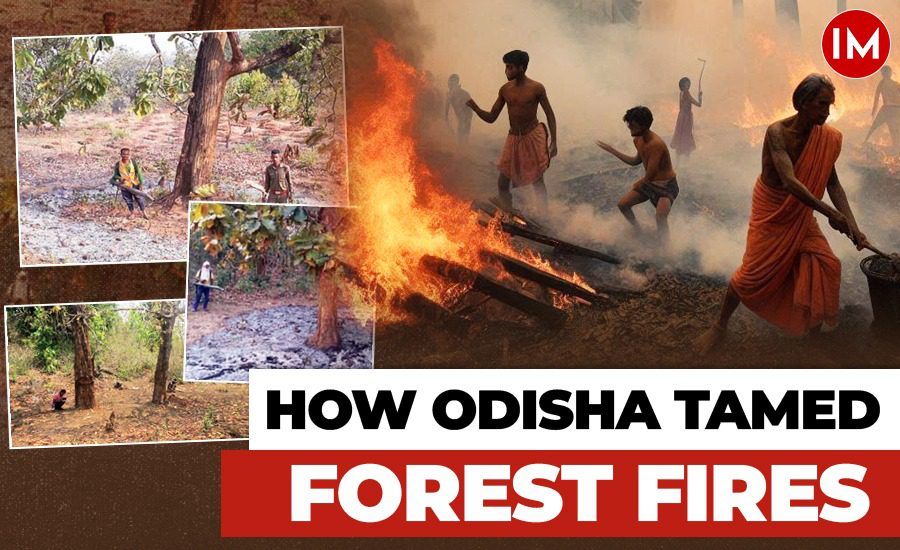
Uttarakhand’s forests are on fire. The state machinery is combating the fire menace in almost every district. Uttarakhand however, could reduce the damage to its forest cover and the habitat, had it taken a cue from Odisha. In Orissa’s tropical deciduous forests, fires were a common occurrence during summer because of higher water stress. According to the Forest Survey of India (FSI), Odisha had the highest number of forest fires in 2017. Within Odisha, the Balliguda forest division recorded the most fires, with 3,165 incidents. This is largely due to traditional land use practices and the local population’s reliance on the forest for products like Kendu (Tendu) leaves and Mahua flowers, which has greatly increased the number of fires.
In 2018, when IFS officer Mr. Vishwanath was posted as DCF in Baliguda, Odisha, he and his team not only identified the causes of forest fires but also significantly reduced their number using techniques like the Ring and Strip methods. These techniques were so effective that they are now used throughout the entire state. In an exclusive interview with Indian Masterminds, Mr. Vishwanath who is currently DCF (Forest Headquarters, Odisha) shared the details.
IDENTIFYING THE REASONS
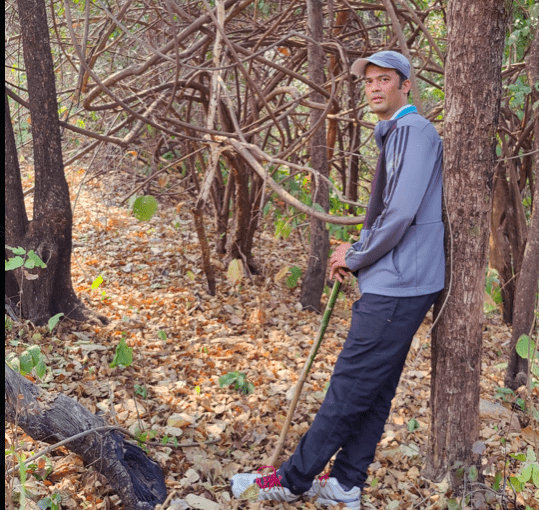
To tackle the issues, a series of meetings and brainstorming sessions were held at both the division and range levels, involving villagers, watchers, and para staff. During these sessions, the causes of forest fires were identified, and potential solutions were analyzed. The best solutions were chosen for implementation.
Using satellite data from sensors like SNPP and MODIS, which detect active fire points based on brightness, temperature levels in shortwave and thermal IR wavelength bands, has increased the accuracy of fire point detection in India. This technology has helped identify not only the fire points but also the underlying reasons for the fires.
“We discovered that there are mainly four or five reasons for forest fires in Odisha, including the collection of Mahua flowers and Kendu (Tendu) leaves by the locals. Additionally, turmeric cultivation, Podu cultivation, and grazing in forest areas were significant factors. After identifying these causes, we created an action plan to address each issue,” said the officer.
Collection of Mahua flowers and Kendu leaves was identified as a major issue, prompting the forest team to start advance planning in 2018. This activity directly affects the livelihoods of local villagers, making it a sensitive issue. February is the peak season for Mahua flower collection. During this time, the ground is covered with dried leaves, so villagers burn the surface at night to make flower collection easier in the morning. They believe the smoke helps the flowers fall and adds a special flavor. However, this method is destructive and harmful to the forest and wildlife, as the fire can spread to nearby areas.
Similarly, tribals collect Kendu leaves from designated areas by cutting the bushes. New leaves grow 45 days after cutting. To get more leaves, villagers set fires in the evening, including on revenue and tin forest land, believing that leaves sprouting from burned bushes are of better quality than those from cutting.
“It is believed that the leaves which sprout from burned Kendu bushes have better quality than those from bush cutting,” the officer added.
THE ACTION PLAN
In preparation for the 2017 fire season, the forest department identified 12,000 Mahua trees, marking each with GPS locations in the villages. This allowed them to use controlled burning methods, such as the Ring and Strip methods, near forest areas. These methods were applied in all sensitive areas to prevent fires.
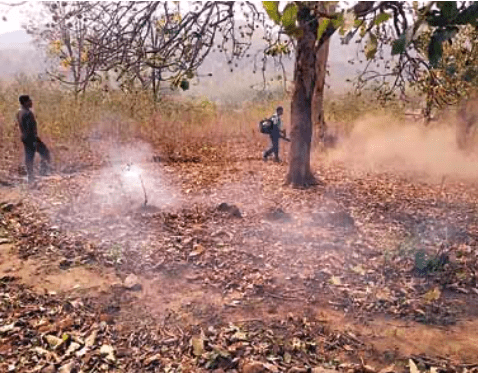
Using blowers, dried leaves were cleared in a ring shape around each tree for the Ring method. For the Strip method, where multiple trees are clustered, leaves were cleared in long strips. This controlled burning method removed the dry leaves, breaking the fire tangle.
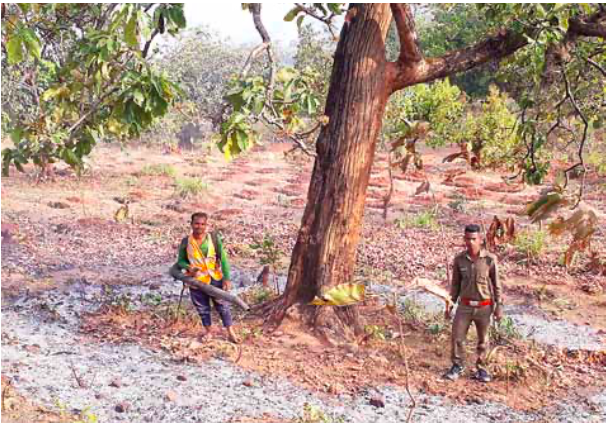
The same method was applied to Kendu leaf areas in coordination with range staff, bush cutters, and local villagers. Mr. Vishwanath emphasized that this approach helped control unscientific forest fires caused by Kendu leaf collectors, benefiting the local people by increasing their profits.
USE OF TECHNOLOGY
During the fire season, Baliguda division implemented a Rapid Fire Alert System. Data entry operators in the control room downloaded CSV files from NASA and FSI websites daily. These files were then input into Q-GIS software to identify the location of the fire, including the range, section, beat, land status, nearest village, and the quickest route. This helped frontline field staff respond to and extinguish forest fires more quickly, reducing the time needed for fire management in the field.
24×7 CONTROL ROOM
Balliguda Forest Division covers an area of 5627.45 square kilometers. To control forest fires, a 24/7 Control Room was established in the Division office and in all Range offices. Contact numbers for these offices were displayed in key locations, including government buildings in villages, based on fire intensity. Staff were prepared in advance for the fire season with necessary resources and equipment. Frontline staff received training to enhance their skills for better fire management.
THE RESULTS
The intervention led to a significant reduction in fire points from 3165 in the 2017 fire season to 2398, 2074, and 1207 in the 2018, 2019, and 2020 fire seasons respectively. The implementation of the Ring and Strip methods has effectively reduced the number of fire points, consequently mitigating the adverse effects on the forest and wildlife.
In April 2017, 572 fire incidents were reported, which decreased to 303 in 2019 and 90 in 2020. Mr. Vishwanath noted that the fire dynamics in the division were closely linked to the livelihood activities of the local people. Analysis revealed a correlation between peak fire points and these activities. Therefore, the division’s intervention has significantly reduced fire points, and further adjustments to Mahua tree locations and Kendu leaf command areas will likely improve the fire situation in the division.