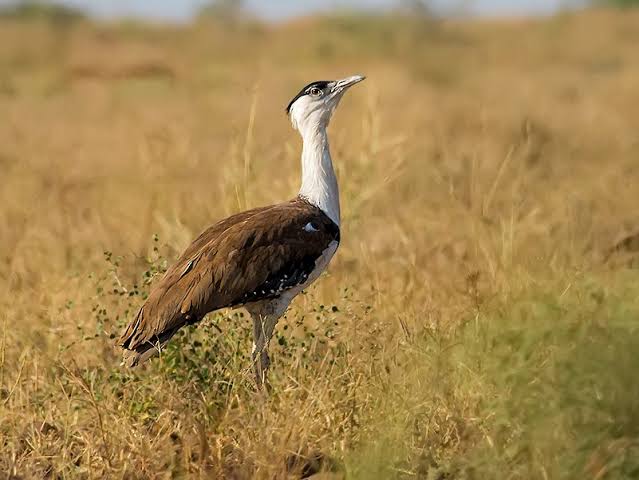
The state bird of Rajasthan, Great Indian Bustard (GIB), popularly known as Godawan and Sonchiriya, has been struggling not to go the dodo way. Loss of habitat and rampant hunting of this bird has critically endangered it despite it being protected under the Wildlife Protection Act. The GIB is a large bird of the bustard family (Otididae) and is one of the heaviest-flying birds in the world. The GIB inhabits dry grasslands and scrublands on the Indian subcontinent.
With only a handful of these birds left in India (Rajasthan, Karnataka, Gujarat among others), the Rajasthan Forest Department’s efforts appear to have yielded positive results as a GIB has successfully hatched from a bird reared in captivity.
Speaking to Indian Masterminds, DCF Jaisalmer Dr. Ashish Vyas explained what all steps were being taken to rear the Sonchiriya in captivity and also protect them in the wild.
BUSTARD RECOVERY PROGRAM
According to a census by the forest department and Wildlife Institute of India (WII), only about 128 GIBs are left. In a conservation effort, an MoU was signed between the Government of India, the Rajasthan Government, and WII (Dehradun) for the Bustard recovery program.
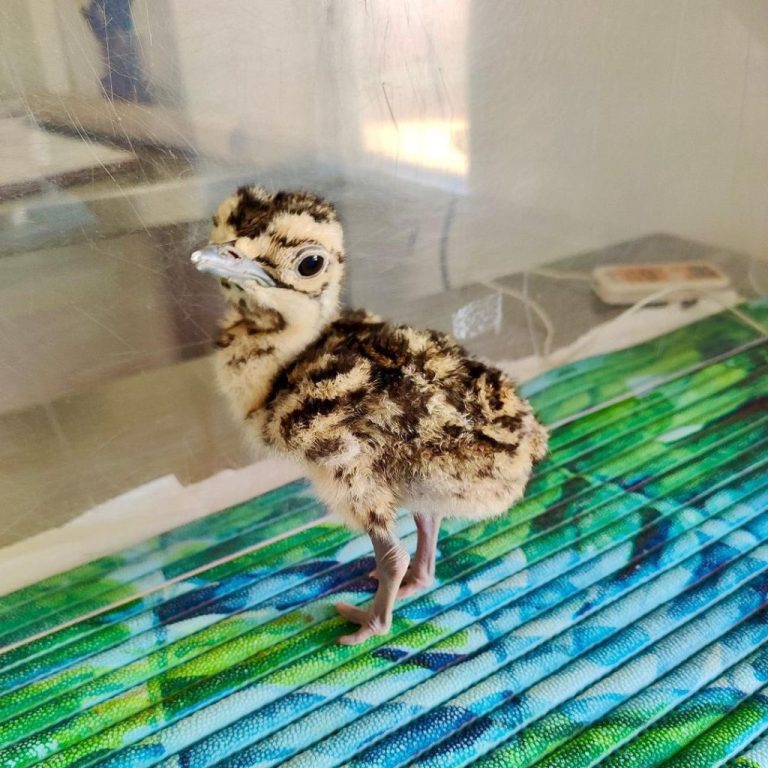
As part of this program breeding centers have been started in Sam and Ramdevra. The eggs of GIB are collected and brought to the center where they are artificially hatched and the Godawan is reared. The baby GIBs grow in the presence of WII scientists and veterinarians.
Explaining its importance Dr. Vyas said, “This has been done to establish a founder population. In case of
mishaps, this population could be used to breed the next generation of these birds.”
WHAT ARE GIBs?
GIBs are tall birds with long legs and long necks. The tallest individuals may stand up to 4 feet and the males and females are roughly the same size, with the largest individuals weighing up to 15 kg.
Sexes are distinguished by the colour of their feathers. Feathers on the top of the head are black in males, which also possess a whitish neck, breast, and underparts, along with brown wings highlighted by black and gray markings.
Males also have a small, narrow band of black feathers across the breast. In contrast, females possess a smaller black crown on the top of the head, and the black breast band is either discontinuous or absent.
In 1994, GIBs were listed as an endangered species on the International Union for Conservation of Nature’s (IUCN) Red List of Threatened Species. By 2011, however, their population decline was so severe that the IUCN reclassified the species as critically endangered.
Smaller regional surveys conducted since have noted that local populations of GIBs have continued to decline. The largest concentration being in the state of Rajasthan.
HAPPY BREEDING
Great news from one of the breeding centres in the desert state came earlier in April when two artificially hatched and sexually matured GIBs mated and produced an egg. The chick has been successfully hatched taking the total number of GIBs in the breeding centre to 23.
“This shows that we are on the right path as captive birds can also do normal breeding,” says Dr. Vyas.
He explained that although these are very shy birds they are used to human habitats. One of the reasons could be that these birds are omnivores and feed opportunistically; that is, they feed on any palatable food in their immediate surroundings. And, often reach the human settlements only to face a huge risk of being hunted by dogs and other animals.
“So, right now these birds are being raised in captivity. Their second or third generation might be taken to the wild,” Dr. Vyas said, adding before that the Sonchiriyas will be trained to develop wild instincts and other skills in separate enclosures.
SAFE ENCLOSURE
While the breeding centers are already giving positive results, the forest department is also taking steps to provide a safe breeding ground for these birds in the wild.
In the Desert National Park (Jaisalmer), some safe enclosure with desert ecology has been created. These enclosures are safe from any sort of encroachment. All predators like wild boars, foxes, and dogs have been tranquilized and taken outside these enclosures. Predator-proof fencing has also been put up.
GIB eggs in the wild are often stolen from nests by foxes, mongooses, monitor lizards, Egyptian vultures, and other birds. The greatest threat to the eggs, however, comes from grazing cows that often trample them. “GIBs lay their eggs on the ground. So, it is important to save them from dogs and other wild animals. These enclosures are helping in providing safe breeding grounds for them,” Dr. Vyas said.
And a true picture of these efforts was seen when six GIBs recently lay double eggs each — a highly unusual but positive sign.